
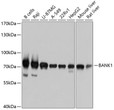


Anti-BANK1 antibody (516-785) (STJ112350)
SPECIFICATIONS
ClonalityPolyclonal
HostRabbit
ConjugationUnconjugated
IsotypeIgG
General Information
| Short Description | Rabbit polyclonal BANK1 (516-785) antibody for use in WB and ELISA in human, mouse and rat samples. Datasheet included with dilution recommendations, and related reagents. |
| Applications | WB/ELISA |
| Host | Rabbit |
| Reactivity | Human/Mouse/Rat |
| Note | STRICTLY FOR FURTHER SCIENTIFIC RESEARCH USE ONLY (RUO). MUST NOT TO BE USED IN DIAGNOSTIC OR THERAPEUTIC APPLICATIONS. |
Product Properties
| Clonality | Polyclonal |
| Isotype | IgG |
| Conjugation | Unconjugated |
| Concentration | Lot specific |
| Purification | Affinity purification |
| Dilution Range | WB:1:1000-1:2000ELISA:Recommended starting concentration is 1 Mu g/mL. Please optimize the concentration based on your specific assay requirements. |
| Formulation | PBS with 0.02% Sodium Azide, 50% Glycerol, pH 7.3. |
| Storage Instruction | Store at-20°C for up to 1 year from the date of receipt, and avoid repeat freeze-thaw cycles. |
Target Information
| Gene Symbol | BANK1 |
| Gene ID | 55024 |
| Uniprot ID | BANK1_HUMAN |
| Immunogen Region | 516-785 |
| Immunogen Sequence | PVANAFQLERPHFTLPGTMV EGQMERSQNWGHPGVRQETG DEPKGEKEKKEEEKEQEEEE DPYTFAEIDDSEYDMILANL SIKKKTGSRSFIINRPPAPT PRPTSIPPKEETTPYIAQVF QQKTARRQSDDDKFRGLPKK QDRARIESPAFSTLRGCLTD GQEELILLQEKVKNGKMSMD EALEKFKHWQMGKSGLEMIQ QEKLRQLRDCIIGKRPEEEN VYNKLTIVHHPGGKETAHN |
| Specificity | Recombinant fusion protein containing a sequence corresponding to amino acids 516-785 of human BANK1 (NP_060405.4). |
Additional Info
| Tissue Specificity | Expressed in B-cell but not T-cell or myeloid cell lines. Highest expression in CD19(+) B-cells, with very low expression in other cell populations. |
| Post Translational Modifications | Phosphorylated on tyrosines upon BCR activation. |
| Function | Involved in B-cell receptor (BCR)-induced Ca(2+) mobilization from intracellular stores. Promotes Lyn-mediated phosphorylation of IP3 receptors 1 and 2. |
| Protein Name | B-Cell Scaffold Protein With Ankyrin Repeats |
| Database Links | |
| Cellular Localisation | |
| Alternative Antibody Names | Anti-B-Cell Scaffold Protein With Ankyrin Repeats antibodyAnti-BANK1 antibody |
Information sourced from Uniprot.org