

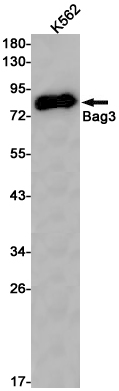

Anti-BAG3 antibody [R09-2G3] (STJA0034065)
SPECIFICATIONS
ClonalityMonoclonal
HostRabbit
ConjugationUnconjugated
IsotypeIgG
ImmunogenRecombinant protein of human Bag3
General Information
| Short Description | Rabbit monoclonal anti-BAG3 for use in WB in Human samples. Datasheet included with dilution recommendations, and related reagents. |
| Applications | WB |
| Host | Rabbit |
| Reactivity | Human |
| Note | STRICTLY FOR FURTHER SCIENTIFIC RESEARCH USE ONLY (RUO). MUST NOT TO BE USED IN DIAGNOSTIC OR THERAPEUTIC APPLICATIONS. |
Product Properties
| Clonality | Monoclonal |
| Clone ID | R09-2G3 |
| Isotype | IgG |
| Conjugation | Unconjugated |
| Concentration | 0.3 mg/mL |
| Purification | Affinity Purified |
| Dilution Range | WB 1:500-1:1000 |
| Formulation | 50mM Tris-Glycine (pH 7.4) , 0.15M NaCl, 40% Glycerol, 0.01% Sodium azide and 0.05% BSA |
| Storage Instruction | Store at 4°C short term. Aliquot and store at-20°C long term. Avoid freeze/thaw cycles. |
Target Information
| Gene Symbol | BAG3 |
| Gene ID | 9531 |
| Uniprot ID | BAG3_HUMAN |
| Immunogen | Recombinant protein of human Bag3 |
Additional Info
| Function | Co-chaperone and adapter protein that connects different classes of molecular chaperones including heat shock proteins 70 (HSP70s), e.g. HSPA1A/HSP70 or HSPA8/HSC70, and small heat shock proteins (sHSPs), e.g. HSPB8. Acts as a nucleotide-exchange factor (NEF) promoting the release of ADP from HSP70s, thereby triggering client protein release. Nucleotide release is mediated via BAG3 binding to the nucleotide-binding domain (NBD) of HSP70s, whereas client release is mediated via binding to the substrate-binding domain (SBD). Has anti-apoptotic activity. Plays a role in the HSF1 nucleocytoplasmic transport. |
| Protein Name | Bag Family Molecular Chaperone Regulator 3Bag-3Bcl-2-Associated Athanogene 3Bcl-2-Binding Protein BisDocking Protein Cair-1 |
| Database Links | Reactome: R-HSA-3371453 |
| Cellular Localisation | NucleusCytoplasmColocalizes With Hsf1 To The Nucleus Upon Heat Stress |
| Alternative Antibody Names | Anti-Bag Family Molecular Chaperone Regulator 3 antibodyAnti-Bag-3 antibodyAnti-Bcl-2-Associated Athanogene 3 antibodyAnti-Bcl-2-Binding Protein Bis antibodyAnti-Docking Protein Cair-1 antibodyAnti-BAG3 antibodyAnti-BIS antibody |
Information sourced from Uniprot.org