

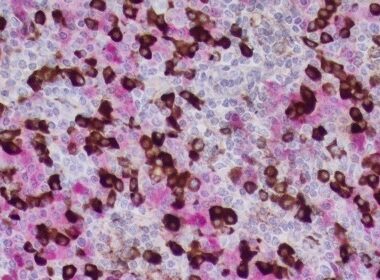

Anti-B clonality cocktail antibody [Kappa (ZR472) + Lambda (LcN2)] (STJ180691)
SPECIFICATIONS
ClonalityMonoclonal
HostRabbit/Mouse
ConjugationUnconjugated
IsotypeIgG + IgG2a/Kappa
ImmunogenHuman Kappa and Lambda polypeptides
General Information
| Short Description | Rabbit/Mouse monoclonal B clonality cocktail antibody for use in IHC-P in human samples. Datasheet included with dilution recommendations, and related reagents. |
| Applications | IHC-P |
| Host | Rabbit/Mouse |
| Reactivity | Human |
| Note | STRICTLY FOR FURTHER SCIENTIFIC RESEARCH USE ONLY (RUO). MUST NOT TO BE USED IN DIAGNOSTIC OR THERAPEUTIC APPLICATIONS. |
Product Properties
| Clonality | Monoclonal |
| Clone ID | Kappa (ZR472) + Lambda (LcN2) |
| Isotype | IgG + IgG2a/Kappa |
| Conjugation | Unconjugated |
| Purification | Affinity purified |
| Dilution Range | 1:100-200 |
| Formulation | Tris-HCI buffer containing stabilizing protein (BSA) and <0.1% ProClin |
| Storage Instruction | Store at 2‐8°C for up to 24 months. Predilute: Ready to use, no reconstitution necessary. Concentrate: Use dilution range and appropriate lab‐standardized diluent. Stability after dilution: 7 days at 24°C, 3 months at 2‐8°C, 6months at ‐20°C. |
Target Information
| Immunogen | Human Kappa and Lambda polypeptides |
| Specificity | Lymph node |
Additional Info
| Background | Zeta s B Cell Clonality Cocktail – DUAL STAIN. Zeta s B Cell Clonality Cocktail provides dual staining for kappa and lambda light chains in immunohistochemistry (IHC) , which is an essential tool used in assessing B-cell clonality to help differentiate reactive (polyclonal) lymphoid proliferations from neoplastic (monoclonal) B-cell processes, such as B-cell lymphomas. Zeta Corporation offers a cocktail of monoclonal antibodies for IHC including Kappa and Lambda. B cells are a type of white blood cell that plays a key role in the immune system by producing antibodies. Clonality refers to the process where a single B cell undergoes division to produce a population of identical cells-plasma cells, which produce monoclonal immunoglobulin with either kappa or lambda light chain. In normal lymphoid tissue, the kappa and lambda cell ratio are approximately 0.3-1.7. In the hematological diseases, such as B-cell lymphomas or B-cell leukemias, there is presence of abnormal monoclonal B cell population with either kappa light chain (>1.7) or lambda light chain (<0.3) predominance. With AP-labeled kappa (ZR471) (red) and HRP labeled lambda (LcN2) (brown) paraffin immunohistochemistry, the B cell/plasma cell clonality can be established. Kappa ( Kappa ) and Lambda ( Lambda ) are the two types of light chains used in immunoglobulins produced by B cells. Each B cell expresses only one type of light chain (either Kappa or Lambda ) —a phenomenon known as allelic exclusion. In normal (reactive) tissue, the ratio of Kappa : Lambda-expressing cells is roughly 2:1. In B-cell malignancies, there is often an overrepresentation of one type, indicating monoclonality. Zeta s DUAL STAIN products provide more information from limited tissues, by seeing two related markers on the same slide while also allowing pathologists to see cellular localization and interaction within the tumor environment. Zeta uses one mouse and one rabbit recombinant monoclonal in each cocktail to allow for differential color results. Zeta Corporation is a leader in recombinant monoclonal IVD antibodies for immunohistochemistry (IHC) offering 400+ tumor and tissue specific relevant products developed by a pathologist for pathologists. Visit Precision Recombinant Antibodies – IVD Antibodies – About Zeta Corporation (zeta-corp.com) to learn more about Zeta Corporation. |
Information sourced from Uniprot.org