
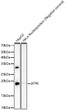


Anti-ATP6 antibody (126-226 aa) [S5030RM] (STJ11105030)
SPECIFICATIONS
ClonalityMonoclonal
HostRabbit
ConjugationUnconjugated
IsotypeIgG
General Information
| Short Description | Rabbit monoclonal ATP6 (126-226 aa) antibody for use in WB and ELISA in human samples. Datasheet included with dilution recommendations, and related reagents. |
| Applications | WB/ELISA |
| Host | Rabbit |
| Reactivity | Human |
| Note | STRICTLY FOR FURTHER SCIENTIFIC RESEARCH USE ONLY (RUO). MUST NOT TO BE USED IN DIAGNOSTIC OR THERAPEUTIC APPLICATIONS. |
Product Properties
| Clonality | Monoclonal |
| Clone ID | S5030RM |
| Isotype | IgG |
| Conjugation | Unconjugated |
| Concentration | Lot specific |
| Purification | Affinity purification |
| Dilution Range | WB:1:1000-1:5000ELISA:Recommended starting concentration is 1 Mu g/mL. Please optimize the concentration based on your specific assay requirements. |
| Formulation | PBS with 0.05% Proclin300, 0.05% BSA, 50% Glycerol, pH 7.3. |
| Storage Instruction | Store at-20°C for up to 1 year from the date of receipt, and avoid repeat freeze-thaw cycles. |
Target Information
| Gene Symbol | Mtatp6 |
| Gene ID | 17705 |
| Uniprot ID | ATP6_MOUSE |
| Immunogen Region | 126-226 aa |
| Immunogen Sequence | AHFLPQGTPISLIPMLIIIE TISLFIQPMALAVRLTANIT AGHLLMHLIGGATLVLMNIS PPTATITFIILLLLTILEFA VALIQAYVFTLLVSLYLHDN T |
| Specificity | A synthetic peptide corresponding to a sequence within amino acids 126-226 of human ATP6. (NP_904333.1). |
Additional Info
| Function | Subunit a, of the mitochondrial membrane ATP synthase complex (F(1)F(0) ATP synthase or Complex V) that produces ATP from ADP in the presence of a proton gradient across the membrane which is generated by electron transport complexes of the respiratory chain. ATP synthase complex consist of a soluble F(1) head domain - the catalytic core - and a membrane F(1) domain - the membrane proton channel. These two domains are linked by a central stalk rotating inside the F(1) region and a stationary peripheral stalk. During catalysis, ATP synthesis in the catalytic domain of F(1) is coupled via a rotary mechanism of the central stalk subunits to proton translocation. With the subunit c (ATP5MC1), forms the proton-conducting channel in the F(0) domain, that contains two crucial half-channels (inlet and outlet) that facilitate proton movement from the mitochondrial intermembrane space (IMS) into the matrix. Protons are taken up via the inlet half-channel and released through the outlet half-channel, following a Grotthuss mechanism. |
| Protein Name | Atp Synthase F(0 Complex Subunit AF-Atpase Protein 6Proton-Conducting Channel - Atp Synthase F(0 Complex Subunit A |
| Database Links | Reactome: R-MMU-163210Reactome: -MMU-8949613Reactome: -MMU-9837999 |
| Cellular Localisation | Mitochondrion Inner MembraneMulti-Pass Membrane Protein |
| Alternative Antibody Names | Anti-Atp Synthase F(0 Complex Subunit A antibodyAnti-F-Atpase Protein 6 antibodyAnti-Proton-Conducting Channel - Atp Synthase F(0 Complex Subunit A antibodyAnti-Mtatp6 antibodyAnti-Atp6 antibodyAnti-Atpase6 antibodyAnti-mt-Atp6 antibody |
Information sourced from Uniprot.org