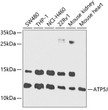
| Function | Subunit F6, of the mitochondrial membrane ATP synthase complex (F(1)F(0) ATP synthase or Complex V) that produces ATP from ADP in the presence of a proton gradient across the membrane which is generated by electron transport complexes of the respiratory chain. ATP synthase complex consist of a soluble F(1) head domain - the catalytic core - and a membrane F(1) domain - the membrane proton channel. These two domains are linked by a central stalk rotating inside the F(1) region and a stationary peripheral stalk. During catalysis, ATP synthesis in the catalytic domain of F(1) is coupled via a rotary mechanism of the central stalk subunits to proton translocation (Probable). In vivo, can only synthesize ATP although its ATP hydrolase activity can be activated artificially in vitro. Part of the complex F(0) domain. Part of the complex F(0) domain and the peripheric stalk, which acts as a stator to hold the catalytic alpha(3)beta(3) subcomplex and subunit a/ATP6 static relative to the rotary elements. |
| Protein Name | Atp Synthase Peripheral Stalk Subunit F6 - MitochondrialAtpase Subunit F6Atp Synthase Peripheral Stalk Subunit F6 |
| Database Links | Reactome: R-HSA-163210Reactome: R-HSA-8949613Reactome: R-HSA-9837999 |
| Cellular Localisation | MitochondrionMitochondrion Inner Membrane |
| Alternative Antibody Names | Anti-Atp Synthase Peripheral Stalk Subunit F6 - Mitochondrial antibodyAnti-Atpase Subunit F6 antibodyAnti-Atp Synthase Peripheral Stalk Subunit F6 antibodyAnti-ATP5PF antibodyAnti-ATP5A antibodyAnti-ATP5J antibodyAnti-ATPM antibody |
Information sourced from Uniprot.org