


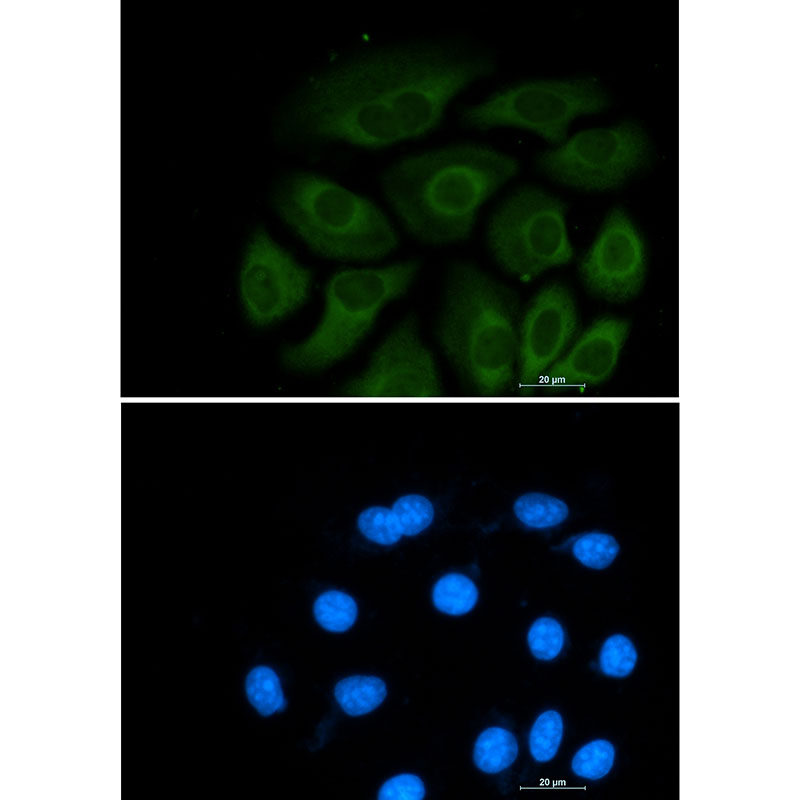
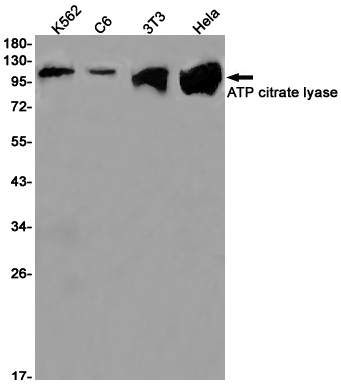

Anti-ATP Citrate lyase antibody [R02-9B5] (STJA0034053)
SPECIFICATIONS
ClonalityMonoclonal
HostRabbit
ConjugationUnconjugated
IsotypeIgG
ImmunogenA synthetic peptide of human ATP citrate lyase
General Information
| Short Description | Rabbit monoclonal anti-ATP Citrate lyase for use in WB, ICC, IF and IP in Human, Mouse and Rat samples. Datasheet included with dilution recommendations, and related reagents. |
| Applications | WB/ICC/IF/IP |
| Host | Rabbit |
| Reactivity | Human/Mouse/Rat |
| Note | STRICTLY FOR FURTHER SCIENTIFIC RESEARCH USE ONLY (RUO). MUST NOT TO BE USED IN DIAGNOSTIC OR THERAPEUTIC APPLICATIONS. |
Product Properties
| Clonality | Monoclonal |
| Clone ID | R02-9B5 |
| Isotype | IgG |
| Conjugation | Unconjugated |
| Concentration | 0.3 mg/mL |
| Purification | Affinity Purified |
| Dilution Range | WB 1:500-1:1000IF 1:50-1:200IP 1:20 |
| Formulation | 50mM Tris-Glycine (pH 7.4) , 0.15M NaCl, 40% Glycerol, 0.01% Sodium azide and 0.05% BSA |
| Storage Instruction | Store at 4°C short term. Aliquot and store at-20°C long term. Avoid freeze/thaw cycles. |
Target Information
| Gene Symbol | ACLY |
| Gene ID | 47 |
| Uniprot ID | ACLY_HUMAN |
| Immunogen | A synthetic peptide of human ATP citrate lyase |
Additional Info
| Post Translational Modifications | Phosphorylated by PKA and GSK3 in a sequential manner.phosphorylation results in activation of its activity. Phosphorylation on Thr-447 and Ser-451 depends on the phosphorylation state of Ser-455. Phosphorylation on Ser-455 is decreased by prior phosphorylation on the other 2 residues. Phosphorylated at Ser-455 by BCKDK and dephosphorylated by protein phosphatase PPM1K. ISGylated. Acetylated at Lys-540, Lys-546 and Lys-554 by KAT2B/PCAF. Acetylation is promoted by glucose and stabilizes the protein, probably by preventing ubiquitination at the same sites. Acetylation promotes de novo lipid synthesis. Deacetylated by SIRT2. Ubiquitinated at Lys-540, Lys-546 and Lys-554 by the BCR(KLHL25) E3 ubiquitin ligase complex and UBR4, leading to its degradation. Ubiquitination is probably inhibited by acetylation at same site. BCR(KLHL25)-mediated degradation of ACLY promotes fatty acid oxidation and is required for differentiation of inducible regulatory T (iTreg) cells. |
| Function | Catalyzes the cleavage of citrate into oxaloacetate and acetyl-CoA, the latter serving as common substrate in multiple biochemical reactions in protein, carbohydrate and lipid metabolism. |
| Protein Name | Atp-Citrate SynthaseAtp-CitratePro-S--LyaseAclCitrate Cleavage Enzyme |
| Database Links | Reactome: R-HSA-163765Reactome: R-HSA-6798695Reactome: R-HSA-75105 |
| Cellular Localisation | CytoplasmCytosol |
| Alternative Antibody Names | Anti-Atp-Citrate Synthase antibodyAnti-Atp-Citrate antibodyAnti-Pro-S--Lyase antibodyAnti-Acl antibodyAnti-Citrate Cleavage Enzyme antibodyAnti-ACLY antibody |
Information sourced from Uniprot.org