

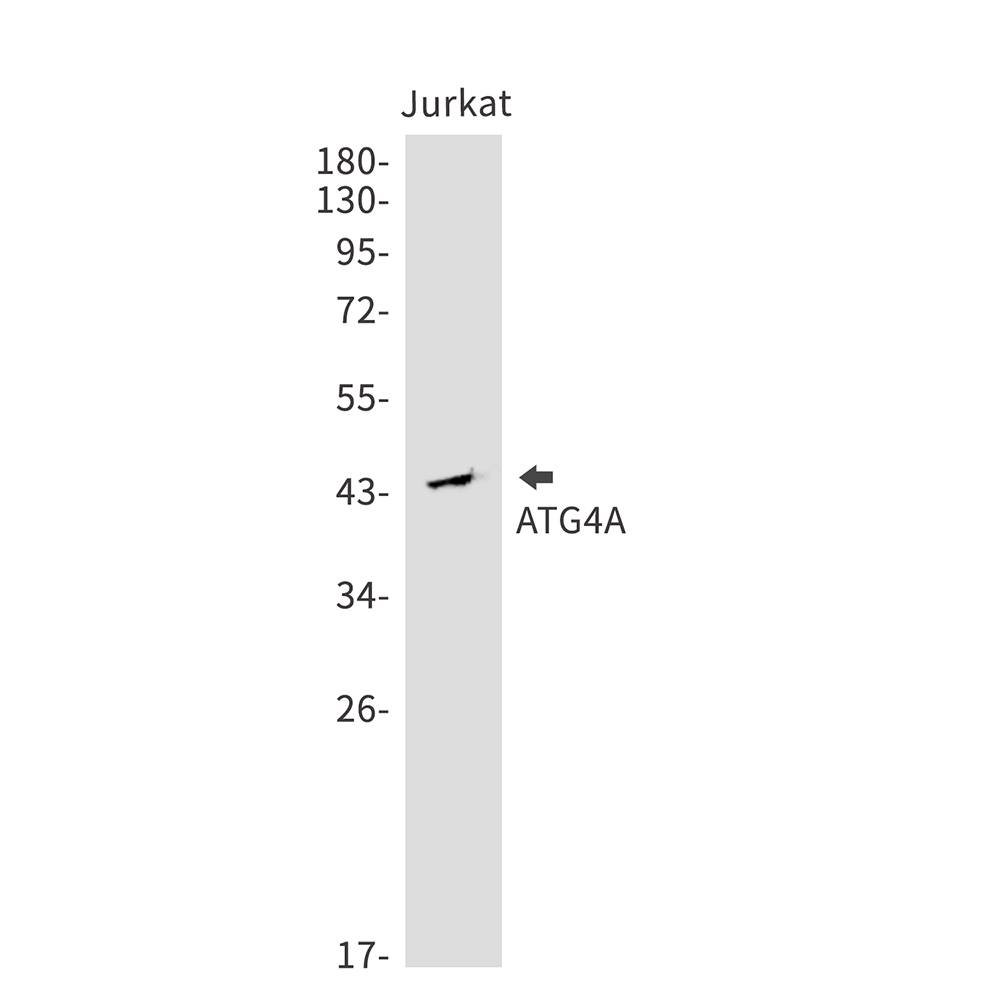

Anti-ATG4A antibody [R05-3H3] (STJA0034050)
SPECIFICATIONS
ClonalityMonoclonal
HostRabbit
ConjugationUnconjugated
IsotypeIgG
ImmunogenA synthetic peptide of human ATG4A
General Information
| Short Description | Rabbit monoclonal anti-ATG4A for use in WB, IHC-P and IP in Human samples. Datasheet included with dilution recommendations, and related reagents. |
| Applications | WB/IHC-P/IP |
| Host | Rabbit |
| Reactivity | Human |
| Note | STRICTLY FOR FURTHER SCIENTIFIC RESEARCH USE ONLY (RUO). MUST NOT TO BE USED IN DIAGNOSTIC OR THERAPEUTIC APPLICATIONS. |
Product Properties
| Clonality | Monoclonal |
| Clone ID | R05-3H3 |
| Isotype | IgG |
| Conjugation | Unconjugated |
| Concentration | 0.3 mg/mL |
| Purification | Affinity Purified |
| Dilution Range | WB 1:500-1:1000IHC 1:50-1:100IP 1:20 |
| Formulation | 50mM Tris-Glycine (pH 7.4) , 0.15M NaCl, 40% Glycerol, 0.01% Sodium azide and 0.05% BSA |
| Storage Instruction | Store at 4°C short term. Aliquot and store at-20°C long term. Avoid freeze/thaw cycles. |
Target Information
| Gene Symbol | ATG4A |
| Gene ID | 115201 |
| Uniprot ID | ATG4A_HUMAN |
| Immunogen | A synthetic peptide of human ATG4A |
Additional Info
| Function | Cysteine protease that plays a key role in autophagy by mediating both proteolytic activation and delipidation of ATG8 family proteins. The protease activity is required for proteolytic activation of ATG8 family proteins: cleaves the C-terminal amino acid of ATG8 proteins to reveal a C-terminal glycine. Exposure of the glycine at the C-terminus is essential for ATG8 proteins conjugation to phosphatidylethanolamine (PE) and insertion to membranes, which is necessary for autophagy. Preferred substrate is GABARAPL2 followed by MAP1LC3A and GABARAP. Protease activity is also required to counteract formation of high-molecular weight conjugates of ATG8 proteins (ATG8ylation): acts as a deubiquitinating-like enzyme that removes ATG8 conjugated to other proteins, such as ATG3. In addition to the protease activity, also mediates delipidation of ATG8 family proteins. Catalyzes delipidation of PE-conjugated forms of ATG8 proteins during macroautophagy. Compared to ATG4B, the major protein for proteolytic activation of ATG8 proteins, shows weaker ability to cleave the C-terminal amino acid of ATG8 proteins, while it displays stronger delipidation activity. Involved in phagophore growth during mitophagy independently of its protease activity and of ATG8 proteins: acts by regulating ATG9A trafficking to mitochondria and promoting phagophore-endoplasmic reticulum contacts during the lipid transfer phase of mitophagy. |
| Protein Name | Cysteine Protease Atg4aAut-Like 2 Cysteine EndopeptidaseAutophagy-Related Cysteine Endopeptidase 2Autophagin-2Autophagy-Related Protein 4 Homolog AHsapg4aHapg4a |
| Database Links | Reactome: R-HSA-1632852 |
| Cellular Localisation | Cytoplasm |
| Alternative Antibody Names | Anti-Cysteine Protease Atg4a antibodyAnti-Aut-Like 2 Cysteine Endopeptidase antibodyAnti-Autophagy-Related Cysteine Endopeptidase 2 antibodyAnti-Autophagin-2 antibodyAnti-Autophagy-Related Protein 4 Homolog A antibodyAnti-Hsapg4a antibodyAnti-Hapg4a antibodyAnti-ATG4A antibodyAnti-APG4A antibodyAnti-AUTL2 antibody |
Information sourced from Uniprot.org