



Anti-ASNA1 antibody (1-348aa) [AT2A1] (STJA0041683)
SPECIFICATIONS
ClonalityMonoclonal
HostMouse
ConjugationUnconjugated
IsotypeIgG2bk
ImmunogenRecombinant human ASNA1 (1-348aa) purified from E. coli
General Information
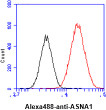
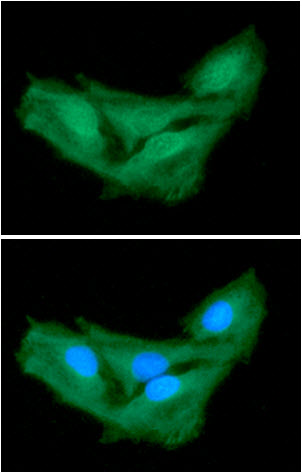
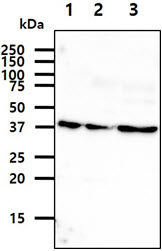
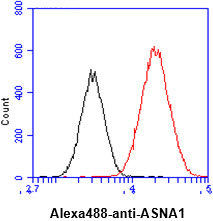
| Short Description | Mouse monoclonal anti-ASNA1 (1-348aa) for use in ELISA, WB, ICC, IF and FACS in Human samples. Datasheet included with dilution recommendations, and related reagents. |
| Applications | ELISA/WB/ICC/IF/FACS |
| Host | Mouse |
| Reactivity | Human |
| Note | STRICTLY FOR FURTHER SCIENTIFIC RESEARCH USE ONLY (RUO). MUST NOT TO BE USED IN DIAGNOSTIC OR THERAPEUTIC APPLICATIONS. |
Product Properties
| Clonality | Monoclonal |
| Clone ID | AT2A1 |
| Isotype | IgG2bk |
| Conjugation | Unconjugated |
| Concentration | 1 mg/mL |
| Purification | By protein-A affinity chromatography |
| Formulation | Liquid in phosphate-Buffered Saline (pH 7.4) with 0.02% Sodium Azide, 10% Glycerol |
| Storage Instruction | For short term storage, keep at +2C to +8C for up to 1 week. For long term storage, aliquot and store at-20C, and avoid repeat freeze-thaw cycles. |
Target Information
| Gene Symbol | GET3 |
| Gene ID | 439 |
| Uniprot ID | GET3_HUMAN |
| Accession Number | NP_004308 |
| Immunogen | Recombinant human ASNA1 (1-348aa) purified from E. coli |
| Immunogen Region | 1-348aa |
Additional Info
| Tissue Specificity | Expressed in the epithelial cells of the liver, kidney, and stomach wall, in the adrenal medulla, in the islet cells of the pancreas, in the red pulp of the spleen, and in cardiac and skeletal muscle. |
| Function | ATPase required for the post-translational delivery of tail-anchored (TA) proteins to the endoplasmic reticulum. Recognizes and selectively binds the transmembrane domain of TA proteins in the cytosol. This complex then targets to the endoplasmic reticulum by membrane-bound receptors GET1/WRB and CAMLG/GET2, where the tail-anchored protein is released for insertion. This process is regulated by ATP binding and hydrolysis. ATP binding drives the homodimer towards the closed dimer state, facilitating recognition of newly synthesized TA membrane proteins. ATP hydrolysis is required for insertion. Subsequently, the homodimer reverts towards the open dimer state, lowering its affinity for the GET1-CAMLG receptor, and returning it to the cytosol to initiate a new round of targeting. May be involved in insulin signaling. |
| Protein Name | Atpase Get3Arsenical Pump-Driving AtpaseArsenite-Stimulated AtpaseGuided Entry Of Tail-Anchored Proteins Factor 3 - AtpaseTransmembrane Domain Recognition Complex 40 Kda Atpase SubunitHarsa-IHasna-I |
| Database Links | Reactome: R-HSA-9609523 |
| Cellular Localisation | CytoplasmEndoplasmic ReticulumNucleusNucleolus |
| Alternative Antibody Names | Anti-Atpase Get3 antibodyAnti-Arsenical Pump-Driving Atpase antibodyAnti-Arsenite-Stimulated Atpase antibodyAnti-Guided Entry Of Tail-Anchored Proteins Factor 3 - Atpase antibodyAnti-Transmembrane Domain Recognition Complex 40 Kda Atpase Subunit antibodyAnti-Harsa-I antibodyAnti-Hasna-I antibodyAnti-GET3 antibodyAnti-ARSA antibodyAnti-ASNA1 antibodyAnti-TRC40 antibody |
Information sourced from Uniprot.org