

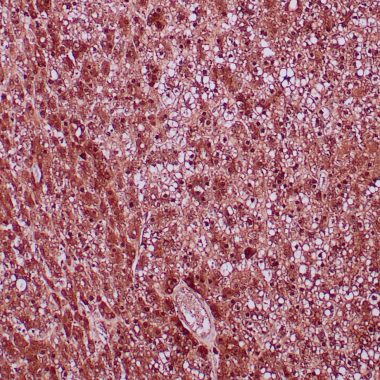

Anti-Arginase-1 antibody (300-400aa) [ZR368] (STJ180486)
SPECIFICATIONS
ClonalityMonoclonal
HostRabbit
ConjugationUnconjugated
IsotypeIgG
ImmunogenRecombinant human ARG1 protein fragment (aa300-400) (Exact sequence is proprietary)
General Information
| Short Description | Rabbit monoclonal Arginase-1 (300-400aa) antibody for use in IHC-P in human samples. Datasheet included with dilution recommendations, and related reagents. |
| Applications | IHC-P |
| Host | Rabbit |
| Reactivity | Human |
| Note | STRICTLY FOR FURTHER SCIENTIFIC RESEARCH USE ONLY (RUO). MUST NOT TO BE USED IN DIAGNOSTIC OR THERAPEUTIC APPLICATIONS. |
Product Properties
| Clonality | Monoclonal |
| Clone ID | ZR368 |
| Isotype | IgG |
| Conjugation | Unconjugated |
| Purification | Affinity purified |
| Dilution Range | 1:100-200 |
| Formulation | Tris-HCI buffer containing stabilizing protein (BSA) and <0.1% ProClin |
| Storage Instruction | Store at 2‐8°C for up to 24 months. Predilute: Ready to use, no reconstitution necessary. Concentrate: Use dilution range and appropriate lab‐standardized diluent. Stability after dilution: 7 days at 24°C, 3 months at 2‐8°C, 6months at ‐20°C. |
Target Information
| Gene Symbol | ARG1 |
| Gene ID | 383 |
| Uniprot ID | ARGI1_HUMAN |
| Immunogen | Recombinant human ARG1 protein fragment (aa300-400) (Exact sequence is proprietary) |
| Immunogen Region | 300-400aa |
| Specificity | Positive Control: Liver |
Additional Info
| Tissue Specificity | Within the immune system initially reported to be selectively expressed in granulocytes (polymorphonuclear leukocytes PMNs). Also detected in macrophages mycobacterial granulomas. Expressed in group2 innate lymphoid cells (ILC2s) during lung disease. |
| Function | Key element of the urea cycle converting L-arginine to urea and L-ornithine, which is further metabolized into metabolites proline and polyamides that drive collagen synthesis and bioenergetic pathways critical for cell proliferation, respectively.the urea cycle takes place primarily in the liver and, to a lesser extent, in the kidneys. Functions in L-arginine homeostasis in nonhepatic tissues characterized by the competition between nitric oxide synthase (NOS) and arginase for the available intracellular substrate arginine. Arginine metabolism is a critical regulator of innate and adaptive immune responses. Involved in an antimicrobial effector pathway in polymorphonuclear granulocytes (PMN). Upon PMN cell death is liberated from the phagolysosome and depletes arginine in the microenvironment leading to suppressed T cell and natural killer (NK) cell proliferation and cytokine secretion. In group 2 innate lymphoid cells (ILC2s) promotes acute type 2 inflammation in the lung and is involved in optimal ILC2 proliferation but not survival. In humans, the immunological role in the monocytic/macrophage/dendritic cell (DC) lineage is unsure. |
| Protein Name | Arginase-1Liver-Type ArginaseType I Arginase |
| Database Links | Reactome: R-HSA-6798695Reactome: R-HSA-70635 |
| Cellular Localisation | CytoplasmCytoplasmic GranuleLocalized In Azurophil Granules Of Neutrophils |
| Alternative Antibody Names | Anti-Arginase-1 antibodyAnti-Liver-Type Arginase antibodyAnti-Type I Arginase antibodyAnti-ARG1 antibody |
Information sourced from Uniprot.org