
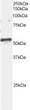


Anti-ARFGAP3 antibody (C-Term) (STJ70078)
SPECIFICATIONS
ClonalityPolyclonal
HostGoat
ConjugationUnconjugated
IsotypeIgG
General Information
| Short Description | Goat polyclonal antibody anti-ARFGAP3 (C-Term) is suitable for use in ELISA and Western Blot research applications. |
| Applications | Pep-ELISA/WB |
| Host | Goat |
| Reactivity | Human/Mouse/Rat/Dog/Cow |
| Note | STRICTLY FOR FURTHER SCIENTIFIC RESEARCH USE ONLY (RUO). MUST NOT TO BE USED IN DIAGNOSTIC OR THERAPEUTIC APPLICATIONS. |
Product Properties
| Clonality | Polyclonal |
| Isotype | IgG |
| Conjugation | Unconjugated |
| Concentration | 0.5 mg/mL |
| Purification | Purified from goat serum by ammonium sulphate precipitation followed by antigen affinity chromatography using the immunizing peptide. |
| Dilution Range | Peptide ELISA: antibody detection limit dilution 1:8000.WB: Approx 55-60kDa band seen in mouse brain extracts. Recommended for use at 1-3µg/ml. |
| Formulation | 0.5 mg/ml in Tris saline, 0.02% sodium azide, pH7.3 with 0.5% bovine serum albumin. NA |
| Storage Instruction | Store at-20°C on receipt and minimise freeze-thaw cycles. |
Target Information
| Gene Symbol | ARFGAP3 |
| Gene ID | 26286 |
| Uniprot ID | ARFG3_HUMAN |
| Accession Number | NP_055385.3; NP_001135765.1 |
| Immunogen Region | C-Term |
| Immunogen Sequence | NGVVTSIQDRYGS |
| Specificity | This antibody is expected to recognize both reported isoforms (NP_055385.3; NP_001135765.1). |
Additional Info
| Function | GTPase-activating protein (GAP) for ADP ribosylation factor 1 (ARF1). Hydrolysis of ARF1-bound GTP may lead to dissociation of coatomer from Golgi-derived membranes to allow fusion with target membranes. |
| Protein Name | Adp-Ribosylation Factor Gtpase-Activating Protein 3Arf Gap 3 |
| Database Links | Reactome: R-HSA-6807878Reactome: R-HSA-6811434Reactome: R-HSA-9013148Reactome: R-HSA-9013408 |
| Cellular Localisation | CytoplasmGolgi Apparatus MembranePeripheral Membrane ProteinCytoplasmic SideAlso Found On Peripheral Punctate Structures Likely To Be Endoplasmic Reticulum-Golgi Intermediate Compartment |
| Alternative Antibody Names | Anti-Adp-Ribosylation Factor Gtpase-Activating Protein 3 antibodyAnti-Arf Gap 3 antibodyAnti-ARFGAP3 antibodyAnti-ARFGAP1 antibody |
Information sourced from Uniprot.org