
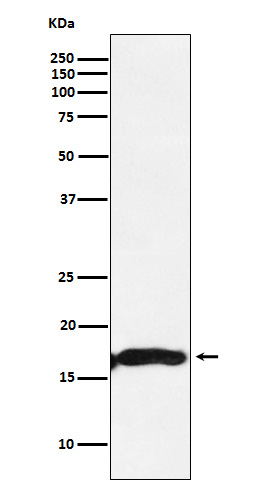

Anti-alpha A Crystallin antibody [R08-1F1] (STJA0037185)
SPECIFICATIONS
ClonalityMonoclonal
HostRabbit
ConjugationUnconjugated
IsotypeIgG
ImmunogenA synthesized peptide derived from human CRYAA
General Information
| Short Description | Rabbit monoclonal anti-alpha A Crystallin for use in WB, ICC and IF in Human, Mouse and Rat samples. Datasheet included with dilution recommendations, and related reagents. |
| Applications | WB/ICC/IF |
| Host | Rabbit |
| Reactivity | Human/Mouse/Rat |
| Note | STRICTLY FOR FURTHER SCIENTIFIC RESEARCH USE ONLY (RUO). MUST NOT TO BE USED IN DIAGNOSTIC OR THERAPEUTIC APPLICATIONS. |
Product Properties
| Clonality | Monoclonal |
| Clone ID | R08-1F1 |
| Isotype | IgG |
| Conjugation | Unconjugated |
| Purification | Affinity Purified |
| Dilution Range | WB 1:500-1:1000IF 1:50-1:200 |
| Formulation | Rabbit IgG in phosphate buffered saline, pH 7.4, 150mM NaCl, 0.02% sodium azide and 50% glycerol. |
| Storage Instruction | Store at 4°C short term. Aliquot and store at-20°C long term. Avoid freeze/thaw cycles. |
Target Information
| Gene Symbol | CRYAA |
| Gene ID | 102724652/1409 |
| Uniprot ID | CRYAA_HUMAN |
| Immunogen | A synthesized peptide derived from human CRYAA |
Additional Info
| Tissue Specificity | Expressed in the eye lens (at protein level). |
| Post Translational Modifications | O-glycosylated.contains N-acetylglucosamine side chains. Deamidation of Asn-101 in lens occurs mostly during the first 30 years of age, followed by a small additional amount of deamidation (approximately 5%) during the next approximately 38 years, resulting in a maximum of approximately 50% deamidation during the lifetime of the individual. Phosphorylation on Ser-122 seems to be developmentally regulated. Absent in the first months of life, it appears during the first 12 years of human lifetime. The relative amount of phosphorylated form versus unphosphorylated form does not change over the lifetime of the individual. Acetylation at Lys-70 may increase chaperone activity. Undergoes age-dependent proteolytical cleavage at the C-terminus. Alpha-crystallin A(1-172) is the most predominant form produced most rapidly during the first 12 years of age and after this age is present in approximately 50% of the lens molecules. In young individuals and during the first approximately 30 years of life, less than half molecules contain an intramolecular disulfide bond (oxidized form), while in the remaining fraction the cysteines are in the free sulfhydryl form (reduced form). With aging, the amount of oxidized form increases up to 90% and it becomes a major constituent of high molecular weight aggregates, concomitant with an age-dependent loss of its chaperone activity. The reduced form is undetectable in cataractous lenses. |
| Function | Contributes to the transparency and refractive index of the lens. In its oxidized form (absence of intramolecular disulfide bond), acts as a chaperone, preventing aggregation of various proteins under a wide range of stress conditions. Required for the correct formation of lens intermediate filaments as part of a complex composed of BFSP1, BFSP2 and CRYAA. |
| Protein Name | Alpha-Crystallin A ChainHeat Shock Protein Beta-4Hspb4Heat Shock Protein Family B Member 4 Cleaved Into - Alpha-Crystallin A(1-172 - Alpha-Crystallin A(1-168 - Alpha-Crystallin A(1-162 |
| Database Links | |
| Cellular Localisation | CytoplasmNucleusTranslocates To The Nucleus During Heat Shock And Resides In Sub-Nuclear Structures Known As Sc35 Speckles Or Nuclear Splicing Speckles |
| Alternative Antibody Names | Anti-Alpha-Crystallin A Chain antibodyAnti-Heat Shock Protein Beta-4 antibodyAnti-Hspb4 antibodyAnti-Heat Shock Protein Family B Member 4 Cleaved Into - Alpha-Crystallin A(1-172 - Alpha-Crystallin A(1-168 - Alpha-Crystallin A(1-162 antibodyAnti-CRYAA antibodyAnti-CRYA1 antibodyAnti-HSPB4 antibody |
Information sourced from Uniprot.org