

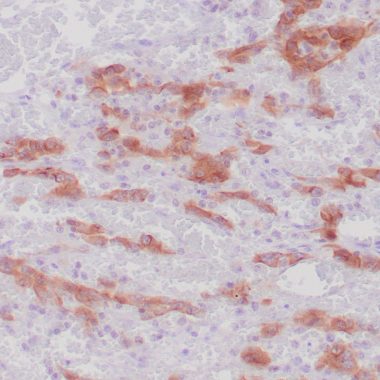

Anti-ALK-p80 antibody (1058-1620aa) [ZR305] (STJ180426)
SPECIFICATIONS
ClonalityMonoclonal
HostRabbit
ConjugationUnconjugated
IsotypeIgG
ImmunogenHuman ALK-1 protein fragment around aa 1058-1620
General Information
| Short Description | Rabbit monoclonal ALK-p80 (1058-1620aa) antibody for use in IHC-P in human samples. Datasheet included with dilution recommendations, and related reagents. |
| Applications | IHC-P |
| Host | Rabbit |
| Reactivity | Human |
| Note | STRICTLY FOR FURTHER SCIENTIFIC RESEARCH USE ONLY (RUO). MUST NOT TO BE USED IN DIAGNOSTIC OR THERAPEUTIC APPLICATIONS. |
Product Properties
| Clonality | Monoclonal |
| Clone ID | ZR305 |
| Isotype | IgG |
| Conjugation | Unconjugated |
| Purification | Affinity purified |
| Dilution Range | 1:100-200 |
| Formulation | Tris-HCI buffer containing stabilizing protein (BSA) and <0.1% ProClin |
| Storage Instruction | Store at 2‐8°C for up to 24 months. Predilute: Ready to use, no reconstitution necessary. Concentrate: Use dilution range and appropriate lab‐standardized diluent. Stability after dilution: 7 days at 24°C, 3 months at 2‐8°C, 6months at ‐20°C. |
Target Information
| Gene Symbol | ALK |
| Gene ID | 238 |
| Uniprot ID | ALK_HUMAN |
| Immunogen | Human ALK-1 protein fragment around aa 1058-1620 |
| Immunogen Region | 1058-1620aa |
| Specificity | Positive control: Anaplastic large cell lymphoma or Lung adenocarcinoma with ALK translocation |
Additional Info
| Tissue Specificity | Expressed in brain and CNS. Also expressed in the small intestine and testis, but not in normal lymphoid cells. |
| Post Translational Modifications | Phosphorylated at tyrosine residues by autocatalysis, which activates kinase activity. In cells not stimulated by a ligand, receptor protein tyrosine phosphatase beta and zeta complex (PTPRB/PTPRZ1) dephosphorylates ALK at the sites in ALK that are undergoing autophosphorylation through autoactivation. Phosphorylation at Tyr-1507 is critical for SHC1 association. N-glycosylated. |
| Function | Neuronal receptor tyrosine kinase that is essentially and transiently expressed in specific regions of the central and peripheral nervous systems and plays an important role in the genesis and differentiation of the nervous system. Also acts as a key thinness protein involved in the resistance to weight gain: in hypothalamic neurons, controls energy expenditure acting as a negative regulator of white adipose tissue lipolysis and sympathetic tone to fine-tune energy homeostasis. Following activation by ALKAL2 ligand at the cell surface, transduces an extracellular signal into an intracellular response. In contrast, ALKAL1 is not a potent physiological ligand for ALK. Ligand-binding to the extracellular domain induces tyrosine kinase activation, leading to activation of the mitogen-activated protein kinase (MAPK) pathway. Phosphorylates almost exclusively at the first tyrosine of the Y-x-x-x-Y-Y motif. Induces tyrosine phosphorylation of CBL, FRS2, IRS1 and SHC1, as well as of the MAP kinases MAPK1/ERK2 and MAPK3/ERK1. ALK activation may also be regulated by pleiotrophin (PTN) and midkine (MDK). PTN-binding induces MAPK pathway activation, which is important for the anti-apoptotic signaling of PTN and regulation of cell proliferation. MDK-binding induces phosphorylation of the ALK target insulin receptor substrate (IRS1), activates mitogen-activated protein kinases (MAPKs) and PI3-kinase, resulting also in cell proliferation induction. Drives NF-kappa-B activation, probably through IRS1 and the activation of the AKT serine/threonine kinase. Recruitment of IRS1 to activated ALK and the activation of NF-kappa-B are essential for the autocrine growth and survival signaling of MDK. |
| Protein Name | Alk Tyrosine Kinase ReceptorAnaplastic Lymphoma KinaseCd Antigen Cd246 |
| Database Links | Reactome: R-HSA-201556Reactome: R-HSA-9700645Reactome: R-HSA-9717264Reactome: R-HSA-9717301Reactome: R-HSA-9717316Reactome: R-HSA-9717319Reactome: R-HSA-9717323Reactome: R-HSA-9717326Reactome: R-HSA-9717329Reactome: R-HSA-9725370Reactome: R-HSA-9851151 |
| Cellular Localisation | Cell MembraneSingle-Pass Type I Membrane ProteinMembrane Attachment Is Essential For Promotion Of Neuron-Like Differentiation And Cell Proliferation Arrest Through Specific Activation Of The Map Kinase Pathway |
| Alternative Antibody Names | Anti-Alk Tyrosine Kinase Receptor antibodyAnti-Anaplastic Lymphoma Kinase antibodyAnti-Cd Antigen Cd246 antibodyAnti-ALK antibody |
Information sourced from Uniprot.org