

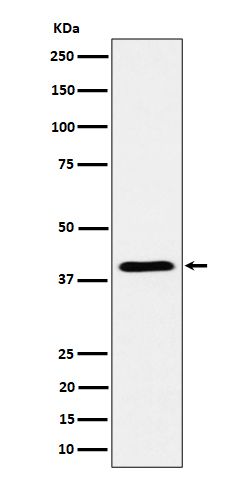

Anti-ADH4 antibody [R94-5J-6] (STJA0035577)
SPECIFICATIONS
ClonalityMonoclonal
HostRabbit
ConjugationUnconjugated
IsotypeIgG
ImmunogenA synthesized peptide derived from human ADH4
General Information
| Short Description | Rabbit monoclonal anti-ADH4 for use in WB, IHC-P, ICC and IF in Human samples. Datasheet included with dilution recommendations, and related reagents. |
| Applications | WB/IHC-P/ICC/IF |
| Host | Rabbit |
| Reactivity | Human |
| Note | STRICTLY FOR FURTHER SCIENTIFIC RESEARCH USE ONLY (RUO). MUST NOT TO BE USED IN DIAGNOSTIC OR THERAPEUTIC APPLICATIONS. |
Product Properties
| Clonality | Monoclonal |
| Clone ID | R94-5J-6 |
| Isotype | IgG |
| Conjugation | Unconjugated |
| Purification | Affinity Chromatography |
| Dilution Range | WB 1:500-1:1000IHC 1:100-1:200IF 1:50-1:200 |
| Formulation | Liquid in PBS, pH 7.4, 150mM NaCl, 0.02% sodium azide and 50% glycerol. |
| Storage Instruction | Store at 4°C short term. Aliquot and store at-20°C long term. Avoid freeze/thaw cycles. |
Target Information
| Gene Symbol | ADH4 |
| Gene ID | 127 |
| Uniprot ID | ADH4_HUMAN |
| Immunogen | A synthesized peptide derived from human ADH4 |
Additional Info
| Function | Catalyzes the NAD-dependent oxidation of either all-trans-retinol or 9-cis-retinol. Also oxidizes long chain omega-hydroxy fatty acids, such as 20-HETE, producing both the intermediate aldehyde, 20-oxoarachidonate and the end product, a dicarboxylic acid, (5Z,8Z,11Z,14Z)-eicosatetraenedioate. Also catalyzes the reduction of benzoquinones. |
| Protein Name | All-Trans-Retinol Dehydrogenase Nad(+ Adh4Alcohol Dehydrogenase 2Alcohol Dehydrogenase 4Alcohol Dehydrogenase Class Ii Pi Chain |
| Database Links | Reactome: R-HSA-5365859Reactome: R-HSA-71384 |
| Cellular Localisation | Cytoplasm |
| Alternative Antibody Names | Anti-All-Trans-Retinol Dehydrogenase Nad(+ Adh4 antibodyAnti-Alcohol Dehydrogenase 2 antibodyAnti-Alcohol Dehydrogenase 4 antibodyAnti-Alcohol Dehydrogenase Class Ii Pi Chain antibodyAnti-ADH4 antibodyAnti-ADH2 antibody |
Information sourced from Uniprot.org