
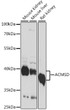


| Host: | Rabbit |
| Applications: | WB/ELISA |
| Reactivity: | Mouse/Rat |
| Note: | STRICTLY FOR FURTHER SCIENTIFIC RESEARCH USE ONLY (RUO). MUST NOT TO BE USED IN DIAGNOSTIC OR THERAPEUTIC APPLICATIONS. |
| Clonality : | Polyclonal |
| Conjugation: | Unconjugated |
| Isotype: | IgG |
| Formulation: | PBS with 0.01% Thimerosal, 50% Glycerol, pH 7.3. |
| Purification: | Affinity purification |
| Concentration: | Lot specific |
| Dilution Range: | WB:1:500-1:2000ELISA:Recommended starting concentration is 1 Mu g/mL. Please optimize the concentration based on your specific assay requirements. |
| Storage Instruction: | Store at-20°C for up to 1 year from the date of receipt, and avoid repeat freeze-thaw cycles. |
| Gene Symbol: | ACMSD |
| Gene ID: | 130013 |
| Uniprot ID: | ACMSD_HUMAN |
| Immunogen Region: | 1-336 |
| Specificity: | Recombinant fusion protein containing a sequence corresponding to amino acids 1-336 of human ACMSD (NP_612199.2). |
| Immunogen Sequence: | MKIDIHSHILPKEWPDLKKR FGYGGWVQLQHHSKGEAKLL KDGKVFRVVRENCWDPEVRI REMDQKGVTVQALSTVPVMF SYWAKPEDTLNLCQLLNNDL ASTVVSYPRRFVGLGTLPMQ APELAVKEMERCVKELGFPG VQIGTHVNEWDLNAQELFPV YAAAERLKCSLFVHPWDMQM DGRMAKYWLPWLVGMPAETT IAICSMIMGGVFEKFPKLKV CFAHGGGAFPFTVGRISHG |
| Function | Converts alpha-amino-beta-carboxymuconate-epsilon-semialdehyde (ACMS) to alpha-aminomuconate semialdehyde (AMS). ACMS can be converted non-enzymatically to quinolate (QA), a key precursor of NAD, and a potent endogenous excitotoxin of neuronal cells which is implicated in the pathogenesis of various neurodegenerative disorders. In the presence of ACMSD, ACMS is converted to AMS, a benign catabolite. ACMSD ultimately controls the metabolic fate of tryptophan catabolism along the kynurenine pathway. |
| Protein Name | 2-Amino-3-Carboxymuconate-6-Semialdehyde DecarboxylasePicolinate Carboxylase |
| Database Links | Reactome: R-HSA-71240 |
| Cellular Localisation | |
| Alternative Antibody Names | Anti-2-Amino-3-Carboxymuconate-6-Semialdehyde Decarboxylase antibodyAnti-Picolinate Carboxylase antibodyAnti-ACMSD antibody |
Information sourced from Uniprot.org


