


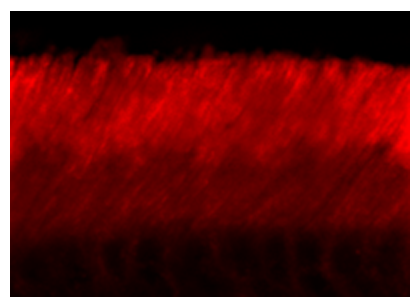
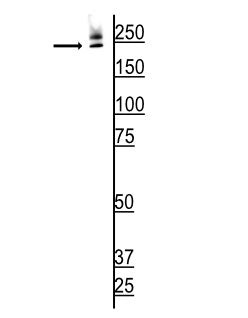

Anti-ABCA4 Rim Protein antibody [3F4] (STJA0003574)
SPECIFICATIONS
ClonalityMonoclonal
HostMouse
ConjugationUnconjugated
IsotypeIgG1
ImmunogenPartially purification bovine 220-kDa disc rim protein.
General Information
| Short Description | Mouse monoclonal anti-ABCA4 Rim Protein for use in WB and IHC in Bovine, Human, Mouse and Xenopus samples. Datasheet included with dilution recommendations, and related reagents. |
| Applications | WB/IHC |
| Host | Mouse |
| Reactivity | Bovine/Human/Mouse/Xenopus |
| Note | STRICTLY FOR FURTHER SCIENTIFIC RESEARCH USE ONLY (RUO). MUST NOT TO BE USED IN DIAGNOSTIC OR THERAPEUTIC APPLICATIONS. |
Product Properties
| Clonality | Monoclonal |
| Clone ID | 3F4 |
| Isotype | IgG1 |
| Conjugation | Unconjugated |
| Purification | This antibody was protein g purified culture from supernatant. |
| Dilution Range | WB 1:1000IHC 1:100 |
| Formulation | 100 µl in 10 mM HEPES (pH 7.5) , 150 mM NaCl, 100 µg per ml BSA and 50% Glycerol. |
| Storage Instruction | Store at-20°C for up to 1 year from the date of receipt, and avoid repeat freeze-thaw cycles. |
Target Information
| Gene Symbol | Abca4 |
| Gene ID | 11304 |
| Uniprot ID | ABCA4_MOUSE |
| Immunogen | Partially purification bovine 220-kDa disc rim protein. |
Additional Info
| Tissue Specificity | Retinal-specific. Seems to be exclusively found in the rims of rod photoreceptor cells. |
| Post Translational Modifications | N-glycosylated. Proteolytic cleavage by trypsin leads to a 120-kDa N-terminal fragment and a 115-kDa C-terminal fragment that are linked through disulfide bonds. Phosphorylation is independent of light exposure and modulates ATPase activity. |
| Function | Flippase that catalyzes in an ATP-dependent manner the transport of retinal-phosphatidylethanolamine conjugates like the 11-cis and all-trans isomers of N-retinylidene-phosphatidylethanolamine from the lumen to the cytoplasmic leaflet of photoreceptor outer segment disk membranes, where N-cis-retinylidene-phosphatidylethanolamine (N-cis-R-PE) is then isomerized to its all-trans isomer (N-trans-R-PE) and reduced by RDH8 to produce all-trans-retinol (all-trans-rol) and therefore prevents the accumulation of excess of 11-cis-retinal and its schiff-base conjugate and the formation of toxic bisretinoid. Displays ATPase activity in vitro in absence of retinal substrate. May display GTPase activity that is strongly influenced by the lipid environment and the presence of retinoid compounds. Binds the unprotonated form of N-retinylidene-phosphatidylethanolamine with high affinity in the absence of ATP and ATP binding and hydrolysis induce a protein conformational change that causes the dissociation of N-retinylidene-phosphatidylethanolamine. |
| Protein Name | Retinal-Specific Phospholipid-Transporting Atpase Abca4Atp-Binding Cassette Sub-Family A Member 4Rim Abc TransporterRim ProteinRmpRetinal-Specific Atp-Binding Cassette Transporter |
| Database Links | Reactome: R-MMU-2453902Reactome: -MMU-382556 |
| Cellular Localisation | MembraneMulti-Pass Membrane ProteinEndoplasmic ReticulumCell ProjectionCiliumPhotoreceptor Outer SegmentLocalized To The Rim And Incisures Of Rod Outer Segments Disks |
| Alternative Antibody Names | Anti-Retinal-Specific Phospholipid-Transporting Atpase Abca4 antibodyAnti-Atp-Binding Cassette Sub-Family A Member 4 antibodyAnti-Rim Abc Transporter antibodyAnti-Rim Protein antibodyAnti-Rmp antibodyAnti-Retinal-Specific Atp-Binding Cassette Transporter antibodyAnti-Abca4 antibodyAnti-Abcr antibody |
Information sourced from Uniprot.org