

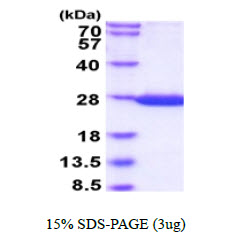

S. Japonicum Glutathione S-transferase/GST protein (Recombinant) (No-Tag) (STJP019388)
SPECIFICATIONS
HostE.coli
ImmunogenSchistosoma japonicum
General Information
| Short Description | Recombinant-S. Japonicum Glutathione S-transferase/GST-No-Tag protein was developed from e.coli and has a target region of No-Tag. For use in research applications. |
| Applications | SDS-PAGE/Enzyme Activity |
| Host | E.coli |
| Note | STRICTLY FOR FURTHER SCIENTIFIC RESEARCH USE ONLY (RUO). MUST NOT TO BE USED IN DIAGNOSTIC OR THERAPEUTIC APPLICATIONS. |
Product Properties
| Concentration | 1 mg/mL |
| Formulation | Liquid in phosphate-Buffered Saline (pH 7.4) containing 10% Glycerol |
| Storage Instruction | For short term storage, keep at +2C to +8C for up to 1 week. For long term storage, aliquot and store at-20C, and avoid repeat freeze-thaw cycles. |
| Endotoxin | < 1 EU per 1ug of protein (determined by LAL method) |
| Immunoreactivity | Specific activity is > 30unit/mg, and is defined as the amount of enzyme that conjugate 1.0 umole of 1-chloro-2, 4-dinitrobenzene (CDNB) with reduced glutathione per minute at pH 6.5 at 25C. |
Target Information
| Accession Number | AAB59203 |
| Immunogen | Schistosoma japonicum |
| Immunogen Region | 1-218aa |
| Immunogen Sequence | MSPILGYWKI KGLVQPTRLL LEYLEEKYEE HLYERDEGDK WRNKKFELGL EFPNLPYYID GDVKLTQSMA IIRYIADKHN MLGGCPKERA EISMLEGAVL DIRYGVSRIA YSKDFETLKV DFLSKLPEML KMFEDRLCHK TYLNGDHVTH PDFMLYDALD VVLYMDPMCL DAFPKLVCFK KRIEAIPQID KYLKSSKYIA WPLQGWQATF GGGDHPPK |
Additional Info
| Background | GST, also known as, Glutathione S-transferase, represents a major group of detoxification enzymes. GST acts by catalyzing the reaction of glutathione with an acceptor molecule to form an S-substituted glutathione (S=sulfur). The reactions utilizing glutathione contribute the transformation of a wide range of compounds, including carcinogens, therapeutic drugs, and products of oxidative stress. As well as its enzymatic activities, GST may also bind toxins and function as transport protein. Because of this, an early term for GSTs was ligandin. GST was originally separated from Schistosomajaponicum but currently isolated from recombinant E. coli source. Recombinant Schistosoma japonicum GST was expressed in E. coli and purified by conventional chromatography techniques. |
Information sourced from Uniprot.org