
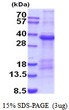
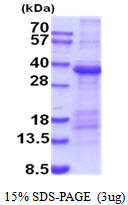

Human TIM-1/KIM-1/HAVCR protein (Recombinant) (His-Tag) (STJP019119)
SPECIFICATIONS
HostE.coli
ImmunogenHuman
General Information
| Short Description | Recombinant-Human TIM-1/KIM-1/HAVCR-His-Tag protein was developed from e.coli and has a target region of His-Tag. For use in research applications. |
| Applications | SDS-PAGE/Denatured |
| Host | E.coli |
| Note | STRICTLY FOR FURTHER SCIENTIFIC RESEARCH USE ONLY (RUO). MUST NOT TO BE USED IN DIAGNOSTIC OR THERAPEUTIC APPLICATIONS. |
Product Properties
| Concentration | 1 mg/mL |
| Formulation | Liquid in 20mM Tris-HCl buffer (pH 8.0) containing 10% Glycerol |
| Storage Instruction | For short term storage, keep at +2C to +8C for up to 1 week. For long term storage, aliquot and store at-20C, and avoid repeat freeze-thaw cycles. |
Target Information
| Gene Symbol | HAVCR1 |
| Gene ID | 26762 |
| Uniprot ID | HAVR1_HUMAN |
| Accession Number | NP_001166864 |
| Immunogen | Human |
| Immunogen Region | 21-295aa |
| Immunogen Sequence | MGSSHHHHHH SSGLVPRGSH MGSSVKVGGE AGPSVTLPCH YSGAVTSMCW NRGSCSLFTC QNGIVWTNGT HVTYRKDTRY KLLGDLSRRD VSLTIENTAV SDSGVYCCRV EHRGWFNDMK ITVSLEIVPP KVTTTPIVTT VPTVTTVRTS TTVPTTTTVP MTTVPTTTVP TTMSIPTTTT VLTTMTVSTT TSVPTTTSIP TTTSVPVTTT VSTFVPPMPL PRQNHEPV |
Additional Info
| Tissue Specificity | Widely expressed, with highest levels in kidney and testis. Expressed by activated CD4+ T-cells during the development of helper T-cells responses. |
| Post Translational Modifications | Ubiquitinated at two lysine residues Lys-338 and Lys-346 on its cytoplasmic domain. Ubiquitination promotes receptor endocytosis and target receptors for lysosomal degradation and termination of receptor signaling. (Microbial infection) Ubiquitination is required for Dengue virus endocytosis. |
| Function | Phosphatidylserine receptor that plays an important functional role in regulatory B-cells homeostasis including generation, expansion and suppressor functions. As P-selectin/SELPLG ligand, plays a specialized role in activated but not naive T-cell trafficking during inflammatory responses. Controls thereby T-cell accumulation in the inflamed central nervous system (CNS) and the induction of autoimmune disease. Also regulates expression of various anti-inflammatory cytokines and co-inhibitory ligands including IL10. Acts as a regulator of T-cell proliferation. May play a role in kidney injury and repair. (Microbial infection) Acts as a receptor for Hepatitis A virus. (Microbial infection) Acts as a receptor for Ebolavirus and Marburg virus by binding exposed phosphatidyl-serine at the surface of virion membrane. Serves as a dual receptor for Ebolavirus by also interacting with envelope glycoprotein GP. (Microbial infection) Acts as a receptor for Dengue virus by binding exposed phosphatidyl-serine at the surface of virion membrane. TIM1 and Dengue virus are co-internalized during virus entry. (Microbial infection) Acts as a receptor for Zika virus by binding to envelope protein E. (Microbial infection) Plays a positive role in Chikungunya virus cell entry. |
| Protein Name | Hepatitis A Virus Cellular Receptor 1Havcr-1Kidney Injury Molecule 1Kim-1T-Cell Immunoglobulin And Mucin Domain-Containing Protein 1Timd-1T-Cell Immunoglobulin Mucin Receptor 1TimTim-1T-Cell Membrane Protein 1Cd Antigen Cd365 |
| Database Links | Reactome: R-HSA-9694614 |
| Cellular Localisation | Cell MembraneSingle-Pass Type I Membrane Protein |
| Alternative Protein Names | Hepatitis A Virus Cellular Receptor 1 proteinHavcr-1 proteinKidney Injury Molecule 1 proteinKim-1 proteinT-Cell Immunoglobulin And Mucin Domain-Containing Protein 1 proteinTimd-1 proteinT-Cell Immunoglobulin Mucin Receptor 1 proteinTim proteinTim-1 proteinT-Cell Membrane Protein 1 proteinCd Antigen Cd365 proteinHAVCR1 proteinKIM1 proteinTIM1 proteinTIMD1 protein |
Information sourced from Uniprot.org