
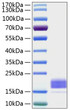


Human TIGIT protein (Recombinant) (C-His) (STJP000856)
SPECIFICATIONS
HostHEK293 cells
ConjugationUnconjugated
ImmunogenRecombinant Human TIGIT Protein is produced by HEK293 expression system. The target protein is expressed with sequence (Met22-Pro141) of human TIGIT (Accession #NP_776160.2) fused with a 6×His tag at the C-terminus.
General Information
| Short Description | Recombinant-Human TIGIT-C-His protein was developed in hek293 cells using the region Met22-Pro141. For use in research applications. |
| Host | HEK293 cells |
| Note | STRICTLY FOR FURTHER SCIENTIFIC RESEARCH USE ONLY (RUO). MUST NOT TO BE USED IN DIAGNOSTIC OR THERAPEUTIC APPLICATIONS. |
Product Properties
| Conjugation | Unconjugated |
| Formulation | Lyophilised from a 0.22 Mu m filtered solution of PBS, pH 7.4. |
| Storage Instruction | Store at-20°C for up to 1 year from the date of receipt, and avoid repeat freeze-thaw cycles. |
| Immunoreactivity | Measured by its binding ability in a functional ELISA. Immobilized Human TIGIT at 1.5 Mu g/mL (100 Mu L/well) can bind Human CD155 with a linear range of 0.15-1.2 Mu g/mL. |
| Determination Method | < 0.1 EU/Mu g of the protein by LAL method. |
Target Information
| Gene Symbol | TIGIT |
| Gene ID | 201633 |
| Uniprot ID | TIGIT_HUMAN |
| Immunogen | Recombinant Human TIGIT Protein is produced by HEK293 expression system. The target protein is expressed with sequence (Met22-Pro141) of human TIGIT (Accession #NP_776160.2) fused with a 6×His tag at the C-terminus. |
| Immunogen Region | Met22-Pro141 |
| Immunogen Sequence | MMTGTIETTGNISAEKGGSI ILQCHLSSTTAQVTQVNWEQ QDQLLAICNADLGWHISPSF KDRVAPGPGLGLTLQSLTVN DTGEYFCIYHTYPDGTYTGR IFLEVLESSVAEHGARFQIP |
Additional Info
| Tissue Specificity | Expressed at low levels on peripheral memory and regulatory CD4+ T-cells and NK cells and is up-regulated following activation of these cells (at protein level). |
| Function | Inhibitory receptor that plays a role in the modulation of immune responses. Suppresses T-cell activation by promoting the generation of mature immunoregulatory dendritic cells. Upon binding to its ligands PVR/CD155 or NECTIN2/CD112, which are expressed on antigen-presenting cells, sends inhibitory signals to the T-cell or NK cell. Mechanistically, interaction with ligand leads to phosphorylation of the cytoplasmic tail by Src family tyrosine kinases such as FYN or LCK, allowing subsequent binding to adapter GRB2 and SHIP1/INPP5D. In turn, inhibits PI3K and MAPK signaling cascades. In addition, associates with beta-arrestin-2/ARRB2 to recruit SHIP1/INPP5D that suppresses autoubiquitination of TRAF6 and subsequently inhibits NF-kappa-B signaling pathway. Also acts as a receptor for NECTIN4 to inhibit NK cell cytotoxicity. |
| Protein Name | T-Cell Immunoreceptor With Ig And Itim DomainsV-Set And Immunoglobulin Domain-Containing Protein 9V-Set And Transmembrane Domain-Containing Protein 3 |
| Database Links | |
| Cellular Localisation | Cell MembraneSingle-Pass Type I Membrane ProteinClustered To The Immunological Synapse Where It Disrupts Granule Polarization And Cytotoxicity Of Nk Cells Once Engaged With Pvr |
| Alternative Protein Names | T-Cell Immunoreceptor With Ig And Itim Domains proteinV-Set And Immunoglobulin Domain-Containing Protein 9 proteinV-Set And Transmembrane Domain-Containing Protein 3 proteinTIGIT proteinVSIG9 proteinVSTM3 protein |
Information sourced from Uniprot.org