

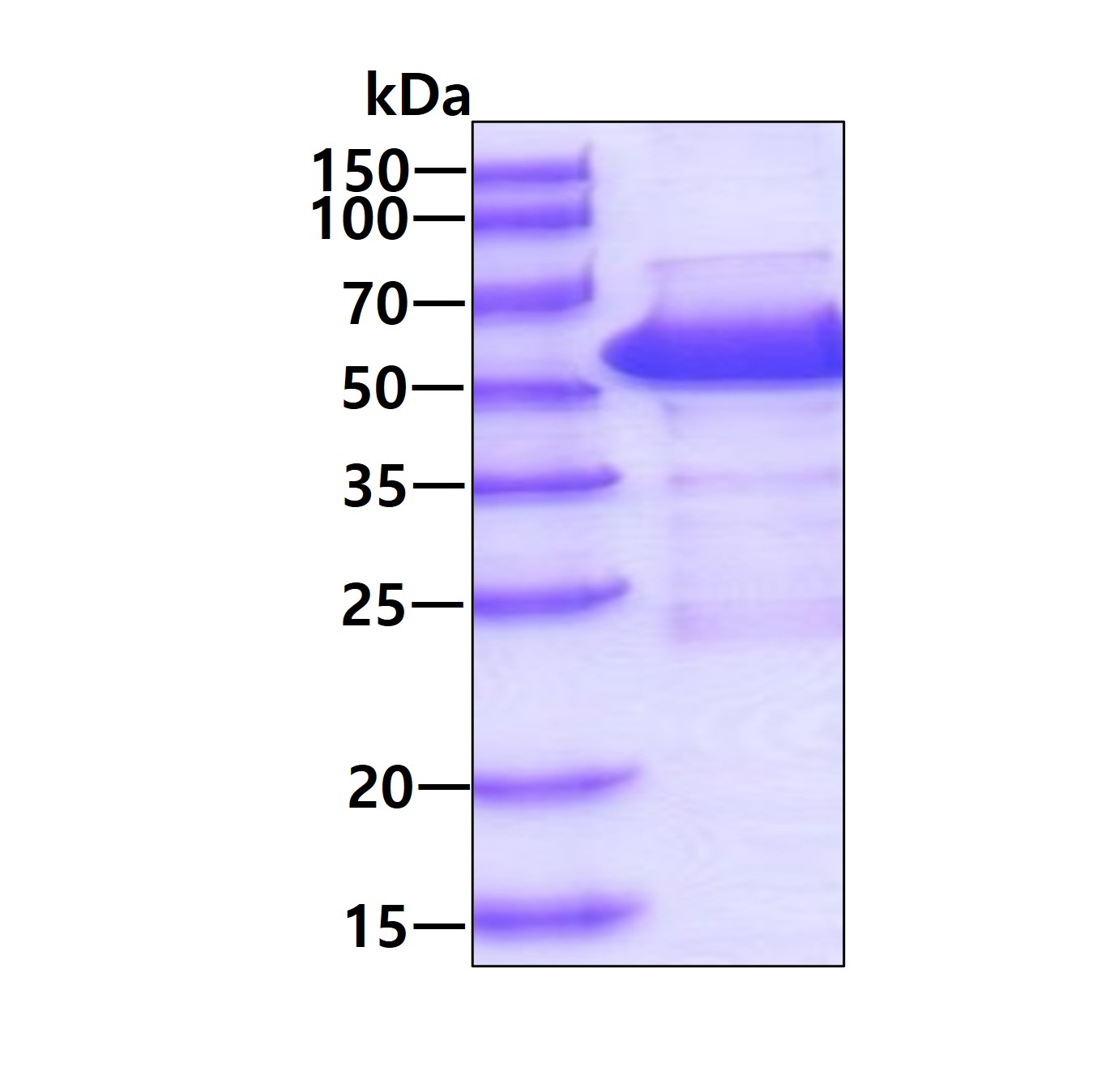

Human SUFU protein (Recombinant) (His-Tag) (STJP017348)
SPECIFICATIONS
HostE.coli
ImmunogenHuman
General Information
| Short Description | Recombinant-Human SUFU-His-Tag protein was developed from e.coli and has a target region of His-Tag. For use in research applications. |
| Applications | SDS-PAGE |
| Host | E.coli |
| Note | STRICTLY FOR FURTHER SCIENTIFIC RESEARCH USE ONLY (RUO). MUST NOT TO BE USED IN DIAGNOSTIC OR THERAPEUTIC APPLICATIONS. |
Product Properties
| Concentration | 0.5 mg/mL |
| Formulation | Liquid in phosphate-Buffered Saline (pH 7.4) containing 10% Glycerol |
| Storage Instruction | For short term storage, keep at +2C to +8C for up to 1 week. For long term storage, aliquot and store at-20C, and avoid repeat freeze-thaw cycles. |
Target Information
| Gene Symbol | SUFU |
| Gene ID | 51684 |
| Uniprot ID | SUFU_HUMAN |
| Accession Number | NP_057253 |
| Immunogen | Human |
| Immunogen Region | 1-484aa |
| Immunogen Sequence |
Additional Info
| Tissue Specificity | Ubiquitous in adult tissues. Detected in osteoblasts of the perichondrium in the developing limb of 12-week old embryos. Isoform 1 is detected in fetal brain, lung, kidney and testis. Isoform 2 is detected in fetal testis, and at much lower levels in fetal brain, lung and kidney. |
| Post Translational Modifications | Polyubiquitinated at Lys-257 by the SCF(FBXL17) complex, leading to its subsequent degradation and allowing the release of GLI1 for proper hedgehog/smoothened signal transduction. Ubiquitination is impaired by phosphorylation at Ser-342, Ser-346, Ser-352 and Thr-353. Phosphorylation at Ser-342, Ser-346, Ser-352 and Thr-353 prevents ubiquitination by the SCF(FBXL17) complex. |
| Function | Negative regulator in the hedgehog/smoothened signaling pathway. Down-regulates GLI1-mediated transactivation of target genes. Down-regulates GLI2-mediated transactivation of target genes. Part of a corepressor complex that acts on DNA-bound GLI1. May also act by linking GLI1 to BTRC and thereby targeting GLI1 to degradation by the proteasome. Sequesters GLI1, GLI2 and GLI3 in the cytoplasm, this effect is overcome by binding of STK36 to both SUFU and a GLI protein. Negative regulator of beta-catenin signaling. Regulates the formation of either the repressor form (GLI3R) or the activator form (GLI3A) of the full-length form of GLI3 (GLI3FL). GLI3FL is complexed with SUFU in the cytoplasm and is maintained in a neutral state. Without the Hh signal, the SUFU-GLI3 complex is recruited to cilia, leading to the efficient processing of GLI3FL into GLI3R. When Hh signaling is initiated, SUFU dissociates from GLI3FL and the latter translocates to the nucleus, where it is phosphorylated, destabilized, and converted to a transcriptional activator (GLI3A). Required for normal embryonic development. Required for the proper formation of hair follicles and the control of epidermal differentiation. |
| Protein Name | Suppressor Of Fused HomologSufuh |
| Database Links | Reactome: R-HSA-5610780Reactome: R-HSA-5610783Reactome: R-HSA-5610785Reactome: R-HSA-5610787Reactome: R-HSA-5632684 |
| Cellular Localisation | CytoplasmNucleus |
| Alternative Protein Names | Suppressor Of Fused Homolog proteinSufuh proteinSUFU proteinUNQ650 proteinPRO1280 protein |
Information sourced from Uniprot.org