

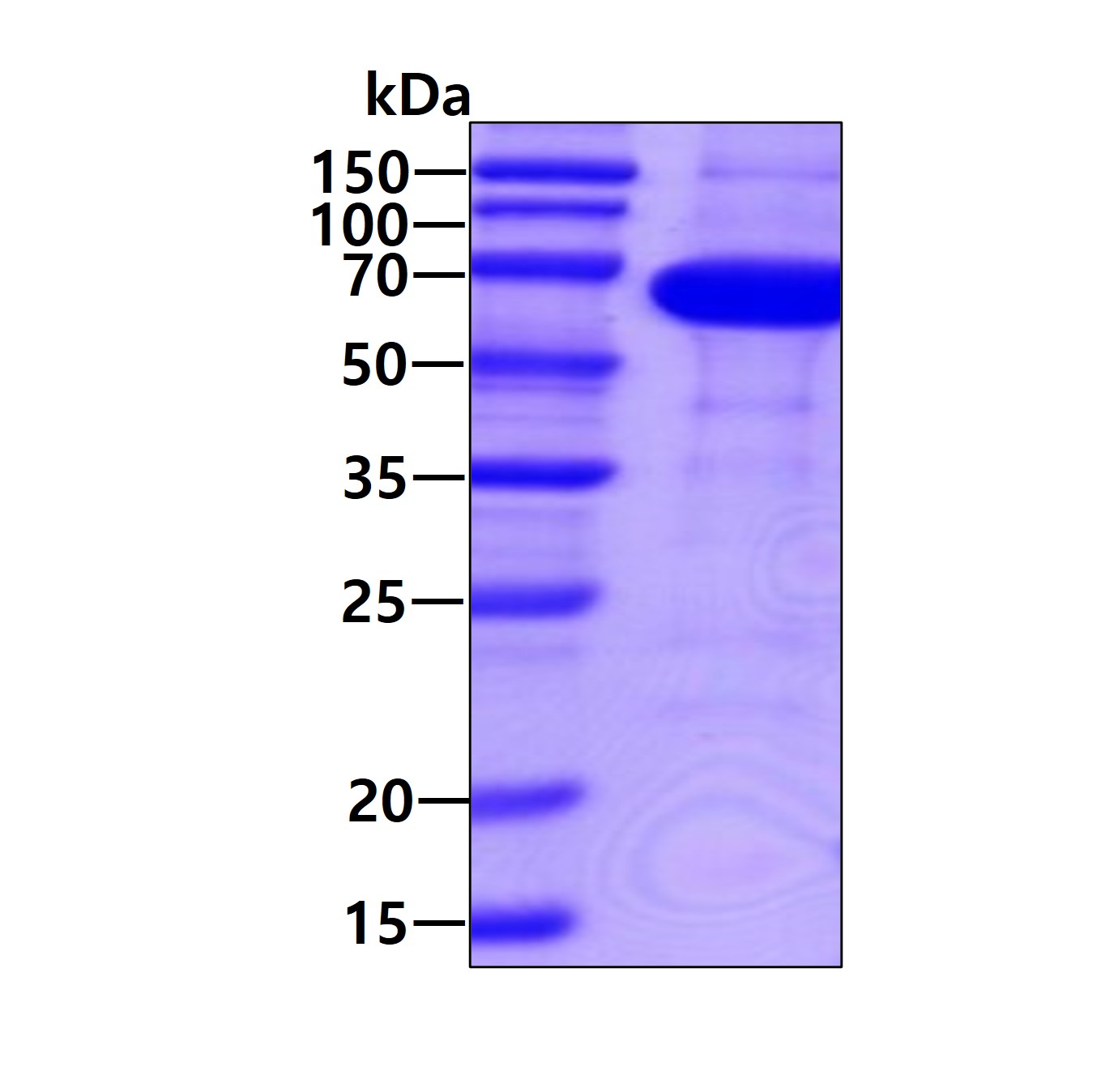

Human Smad4 protein (Recombinant) (His-Tag) (STJP019762)
SPECIFICATIONS
HostE.coli
ImmunogenHuman
General Information
| Short Description | Recombinant-Human Smad4-His-Tag protein was developed from e.coli and has a target region of His-Tag. For use in research applications. |
| Applications | SDS-PAGE |
| Host | E.coli |
| Note | STRICTLY FOR FURTHER SCIENTIFIC RESEARCH USE ONLY (RUO). MUST NOT TO BE USED IN DIAGNOSTIC OR THERAPEUTIC APPLICATIONS. |
Product Properties
| Concentration | 1 mg/mL |
| Formulation | Liquid in 20mM Tris-HCl buffer (pH 8.0) containing 20% Glycerol |
| Storage Instruction | For short term storage, keep at +2C to +8C for up to 1 week. For long term storage, aliquot and store at-20C, and avoid repeat freeze-thaw cycles. |
Target Information
| Gene Symbol | SMAD4 |
| Gene ID | 4089 |
| Uniprot ID | SMAD4_HUMAN |
| Accession Number | NP_005350 |
| Immunogen | Human |
| Immunogen Region | 1-552aa |
| Immunogen Sequence |
Additional Info
| Post Translational Modifications | Phosphorylated by PDPK1. Monoubiquitinated on Lys-519 by E3 ubiquitin-protein ligase TRIM33. Monoubiquitination hampers its ability to form a stable complex with activated SMAD2/3 resulting in inhibition of TGF-beta/BMP signaling cascade. Deubiquitination by USP9X restores its competence to mediate TGF-beta signaling. |
| Function | In muscle physiology, plays a central role in the balance between atrophy and hypertrophy. When recruited by MSTN, promotes atrophy response via phosphorylated SMAD2/4. MSTN decrease causes SMAD4 release and subsequent recruitment by the BMP pathway to promote hypertrophy via phosphorylated SMAD1/5/8. Acts synergistically with SMAD1 and YY1 in bone morphogenetic protein (BMP)-mediated cardiac-specific gene expression. Binds to SMAD binding elements (SBEs) (5'-GTCT/AGAC-3') within BMP response element (BMPRE) of cardiac activating regions. Common SMAD (co-SMAD) is the coactivator and mediator of signal transduction by TGF-beta (transforming growth factor). Component of the heterotrimeric SMAD2/SMAD3-SMAD4 complex that forms in the nucleus and is required for the TGF-mediated signaling. Promotes binding of the SMAD2/SMAD4/FAST-1 complex to DNA and provides an activation function required for SMAD1 or SMAD2 to stimulate transcription. Component of the multimeric SMAD3/SMAD4/JUN/FOS complex which forms at the AP1 promoter site.required for synergistic transcriptional activity in response to TGF-beta. May act as a tumor suppressor. Positively regulates PDPK1 kinase activity by stimulating its dissociation from the 14-3-3 protein YWHAQ which acts as a negative regulator. |
| Protein Name | Mothers Against Decapentaplegic Homolog 4Mad Homolog 4Mothers Against Dpp Homolog 4Deletion Target In Pancreatic Carcinoma 4Smad Family Member 4Smad 4Smad4Hsmad4 |
| Database Links | Reactome: R-HSA-1181150Reactome: R-HSA-1502540Reactome: R-HSA-201451Reactome: R-HSA-2173789Reactome: R-HSA-2173795Reactome: R-HSA-2173796Reactome: R-HSA-3311021Reactome: R-HSA-3315487Reactome: R-HSA-452723Reactome: R-HSA-5689880Reactome: R-HSA-8941326Reactome: R-HSA-8941855Reactome: R-HSA-8952158Reactome: R-HSA-9615017Reactome: R-HSA-9617828Reactome: R-HSA-9733709Reactome: R-HSA-9735871Reactome: R-HSA-9754189Reactome: R-HSA-9823730Reactome: R-HSA-9839394Reactome: R-HSA-9844594 |
| Cellular Localisation | CytoplasmNucleusCytoplasmic In The Absence Of LigandMigrates To The Nucleus When Complexed With R-SmadPdpk1 Prevents Its Nuclear Translocation In Response To Tgf-Beta |
| Alternative Protein Names | Mothers Against Decapentaplegic Homolog 4 proteinMad Homolog 4 proteinMothers Against Dpp Homolog 4 proteinDeletion Target In Pancreatic Carcinoma 4 proteinSmad Family Member 4 proteinSmad 4 proteinSmad4 proteinHsmad4 proteinSMAD4 proteinDPC4 proteinMADH4 protein |
Information sourced from Uniprot.org