

Human Smad3 protein (Recombinant) (His-Tag) (STJP016563)
SPECIFICATIONS
HostE.coli
ImmunogenHuman
General Information
| Short Description | Recombinant-Human Smad3-His-Tag protein was developed from e.coli and has a target region of His-Tag. For use in research applications. |
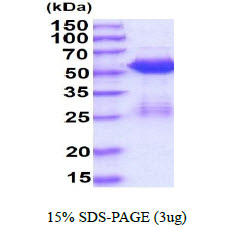
| Applications | SDS-PAGE |
| Host | E.coli |
| Note | STRICTLY FOR FURTHER SCIENTIFIC RESEARCH USE ONLY (RUO). MUST NOT TO BE USED IN DIAGNOSTIC OR THERAPEUTIC APPLICATIONS. |
Product Properties
| Concentration | 0.5 mg/mL |
| Formulation | Liquid in 20mM Tris-HCl buffer (pH 8.0) containing 20% Glycerol, 0.1M NaCl and 1mM DTT |
| Storage Instruction | For short term storage, keep at +2C to +8C for up to 1 week. For long term storage, aliquot and store at-20C, and avoid repeat freeze-thaw cycles. |
| Endotoxin | < 1 EU per 1ug of protein (determined by LAL method) |
Target Information
| Gene Symbol | SMAD3 |
| Gene ID | 4088 |
| Uniprot ID | SMAD3_HUMAN |
| Accession Number | NP_005893 |
| Immunogen | Human |
| Immunogen Region | 1-425aa |
| Immunogen Sequence |
Additional Info
| Post Translational Modifications | Phosphorylated on serine and threonine residues. Enhanced phosphorylation in the linker region on Thr-179, Ser-204 and Ser-208 on EGF and TGF-beta treatment. Ser-208 is the main site of MAPK-mediated phosphorylation. CDK-mediated phosphorylation occurs in a cell-cycle dependent manner and inhibits both the transcriptional activity and antiproliferative functions of SMAD3. This phosphorylation is inhibited by flavopiridol. Maximum phosphorylation at the G(1)/S junction. Also phosphorylated on serine residues in the C-terminal SXS motif by TGFBR1 and ACVR1. TGFBR1-mediated phosphorylation at these C-terminal sites is required for interaction with SMAD4, nuclear location and transactivational activity, and appears to be a prerequisite for the TGF-beta mediated phosphorylation in the linker region. Dephosphorylated in the C-terminal SXS motif by PPM1A. This dephosphorylation disrupts the interaction with SMAD4, promotes nuclear export and terminates TGF-beta-mediated signaling. Phosphorylation at Ser-418 by CSNK1G2/CK1 promotes ligand-dependent ubiquitination and subsequent proteasome degradation, thus inhibiting SMAD3-mediated TGF-beta responses. Phosphorylated by PDPK1. Acetylation in the nucleus by EP300 in the MH2 domain regulates positively its transcriptional activity and is enhanced by TGF-beta. Poly-ADP-ribosylated by PARP1 and PARP2. ADP-ribosylation negatively regulates SMAD3 transcriptional responses during the course of TGF-beta signaling. Ubiquitinated. Monoubiquitinated, leading to prevent DNA-binding. Deubiquitination by USP15 alleviates inhibition and promotes activation of TGF-beta target genes. Ubiquitinated by RNF111, leading to its degradation: only SMAD3 proteins that are 'in use' are targeted by RNF111, RNF111 playing a key role in activating SMAD3 and regulating its turnover. Undergoes STUB1-mediated ubiquitination and degradation. |
| Function | Receptor-regulated SMAD (R-SMAD) that is an intracellular signal transducer and transcriptional modulator activated by TGF-beta (transforming growth factor) and activin type 1 receptor kinases. Binds the TRE element in the promoter region of many genes that are regulated by TGF-beta and, on formation of the SMAD3/SMAD4 complex, activates transcription. Also can form a SMAD3/SMAD4/JUN/FOS complex at the AP-1/SMAD site to regulate TGF-beta-mediated transcription. Has an inhibitory effect on wound healing probably by modulating both growth and migration of primary keratinocytes and by altering the TGF-mediated chemotaxis of monocytes. This effect on wound healing appears to be hormone-sensitive. Regulator of chondrogenesis and osteogenesis and inhibits early healing of bone fractures. Positively regulates PDPK1 kinase activity by stimulating its dissociation from the 14-3-3 protein YWHAQ which acts as a negative regulator. |
| Protein Name | Mothers Against Decapentaplegic Homolog 3Mad Homolog 3Mad3Mothers Against Dpp Homolog 3Hmad-3Jv15-2Smad Family Member 3Smad 3Smad3Hsmad3 |
| Database Links | Reactome: R-HSA-1181150Reactome: R-HSA-1502540Reactome: R-HSA-2173788Reactome: R-HSA-2173789Reactome: R-HSA-2173795Reactome: R-HSA-2173796Reactome: R-HSA-3304356Reactome: R-HSA-3311021Reactome: R-HSA-3315487Reactome: R-HSA-3656532Reactome: R-HSA-5689880Reactome: R-HSA-8941855Reactome: R-HSA-8952158Reactome: R-HSA-9008059Reactome: R-HSA-9013695Reactome: R-HSA-9615017Reactome: R-HSA-9617828Reactome: R-HSA-9735871Reactome: R-HSA-9754189Reactome: R-HSA-9796292Reactome: R-HSA-9823730Reactome: R-HSA-9839394 |
| Cellular Localisation | CytoplasmNucleusCytoplasmic And Nuclear In The Absence Of Tgf-BetaOn Tgf-Beta StimulationMigrates To The Nucleus When Complexed With Smad4Through The Action Of The Phosphatase Ppm1aReleased From The Smad2/Smad4 ComplexAnd Exported Out Of The Nucleus By Interaction With Ranbp1Co-Localizes With Lemd3 At The Nucleus Inner MembraneMapk-Mediated Phosphorylation Appears To Have No Effect On Nuclear ImportPdpk1 Prevents Its Nuclear Translocation In Response To Tgf-BetaLocalized Mainly To The Nucleus In The Early Stages Of Embryo Development With Expression Becoming Evident In The Cytoplasm Of The Inner Cell Mass At The Blastocyst Stage |
| Alternative Protein Names | Mothers Against Decapentaplegic Homolog 3 proteinMad Homolog 3 proteinMad3 proteinMothers Against Dpp Homolog 3 proteinHmad-3 proteinJv15-2 proteinSmad Family Member 3 proteinSmad 3 proteinSmad3 proteinHsmad3 proteinSMAD3 proteinMADH3 protein |
Information sourced from Uniprot.org