

Human Slug protein (Recombinant) (His-Tag) (STJP019158)
SPECIFICATIONS
HostE.coli
ImmunogenHuman
General Information
| Short Description | Recombinant-Human Slug-His-Tag protein was developed from e.coli and has a target region of His-Tag. For use in research applications. |
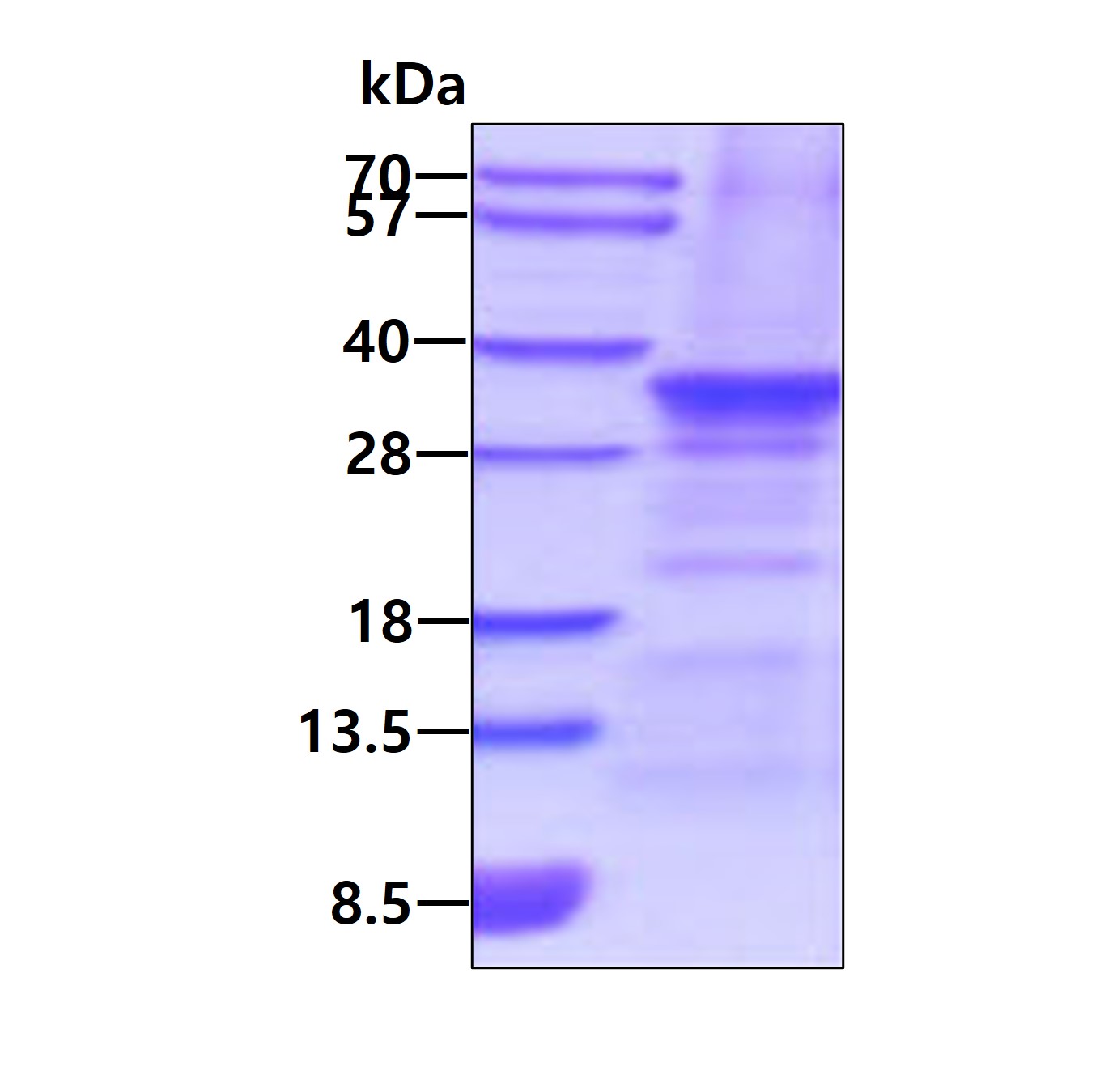
| Applications | SDS-PAGE/Denatured |
| Host | E.coli |
| Note | STRICTLY FOR FURTHER SCIENTIFIC RESEARCH USE ONLY (RUO). MUST NOT TO BE USED IN DIAGNOSTIC OR THERAPEUTIC APPLICATIONS. |
Product Properties
| Concentration | 0.5 mg/mL |
| Formulation | Liquid in 20mM Tris-HCl buffer (pH 8.0) containing 10% Glycerol |
| Storage Instruction | For short term storage, keep at +2C to +8C for up to 1 week. For long term storage, aliquot and store at-20C, and avoid repeat freeze-thaw cycles. |
Target Information
| Gene Symbol | SNAI2 |
| Gene ID | 6591 |
| Uniprot ID | SNAI2_HUMAN |
| Accession Number | NP_003059.1 |
| Immunogen | Human |
| Immunogen Region | 1-268aa |
| Immunogen Sequence |
Additional Info
| Tissue Specificity | Expressed in most adult human tissues, including spleen, thymus, prostate, testis, ovary, small intestine, colon, heart, brain, placenta, lung, liver, skeletal muscle, kidney and pancreas. Not detected in peripheral blood leukocyte. Expressed in the dermis and in all layers of the epidermis, with high levels of expression in the basal layers (at protein level). Expressed in osteoblasts (at protein level). Expressed in mesenchymal stem cells (at protein level). Expressed in breast tumor cells (at protein level). |
| Post Translational Modifications | Phosphorylated by GSK3B. Once phosphorylated, it becomes a target for ubiquitination. Ubiquitinated by the SCF(FBXO11) complex.ubiquitination requires previous GSK3B-mediated SNAI2 phosphorylation. |
| Function | Transcriptional repressor that modulates both activator-dependent and basal transcription. Involved in the generation and migration of neural crest cells. Plays a role in mediating RAF1-induced transcriptional repression of the TJ protein, occludin (OCLN) and subsequent oncogenic transformation of epithelial cells. Represses BRCA2 expression by binding to its E2-box-containing silencer and recruiting CTBP1 and HDAC1 in breast cells. In epidermal keratinocytes, binds to the E-box in ITGA3 promoter and represses its transcription. Involved in the regulation of ITGB1 and ITGB4 expression and cell adhesion and proliferation in epidermal keratinocytes. Binds to E-box2 domain of BSG and activates its expression during TGFB1-induced epithelial-mesenchymal transition (EMT) in hepatocytes. Represses E-Cadherin/CDH1 transcription via E-box elements. Involved in osteoblast maturation. Binds to RUNX2 and SOC9 promoters and may act as a positive and negative transcription regulator, respectively, in osteoblasts. Binds to CXCL12 promoter via E-box regions in mesenchymal stem cells and osteoblasts. Plays an essential role in TWIST1-induced EMT and its ability to promote invasion and metastasis. |
| Protein Name | Zinc Finger Protein Snai2Neural Crest Transcription Factor SlugProtein Snail Homolog 2 |
| Database Links | Reactome: R-HSA-8943724Reactome: R-HSA-9856649 |
| Cellular Localisation | NucleusCytoplasmObserved In Discrete Foci In Interphase NucleiThese Nuclear Foci Do Not Overlap With The NucleoliThe Sp100 And The Hp1 Heterochromatin Or The Coiled BodySuggesting Snai2 Is Associated With Active Transcription Or Active Splicing Regions |
| Alternative Protein Names | Zinc Finger Protein Snai2 proteinNeural Crest Transcription Factor Slug proteinProtein Snail Homolog 2 proteinSNAI2 proteinSLUG proteinSLUGH protein |
Information sourced from Uniprot.org