

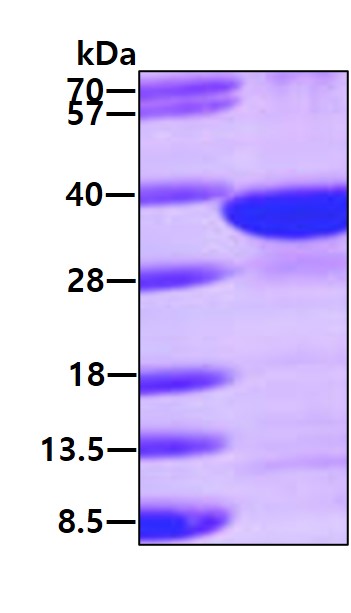

Human SDCBP protein (Recombinant) (His-Tag) (STJP016948)
SPECIFICATIONS
HostE.coli
ImmunogenHuman
General Information
| Short Description | Recombinant-Human SDCBP-His-Tag protein was developed from e.coli and has a target region of His-Tag. For use in research applications. |
| Applications | SDS-PAGE |
| Host | E.coli |
| Note | STRICTLY FOR FURTHER SCIENTIFIC RESEARCH USE ONLY (RUO). MUST NOT TO BE USED IN DIAGNOSTIC OR THERAPEUTIC APPLICATIONS. |
Product Properties
| Concentration | 0.5 mg/mL |
| Formulation | Liquid in 20mM Tris-HCl buffer (pH 8.0) containing 100mM NaCl, 40% Glycerol |
| Storage Instruction | For short term storage, keep at +2C to +8C for up to 1 week. For long term storage, aliquot and store at-20C, and avoid repeat freeze-thaw cycles. |
| Endotoxin | < 1 EU per 1ug of protein (determined by LAL method) |
Target Information
| Gene Symbol | SDCBP |
| Gene ID | 6386 |
| Uniprot ID | SDCB1_HUMAN |
| Accession Number | NP_005616.2 |
| Immunogen | Human |
| Immunogen Region | 1-298aa |
| Immunogen Sequence |
Additional Info
| Tissue Specificity | Expressed in lung cancers, including adenocarcinoma, squamous cell carcinoma and small-cell carcinoma (at protein level). Widely expressed. Expressed in fetal kidney, liver, lung and brain. In adult highest expression in heart and placenta. |
| Post Translational Modifications | Phosphorylated on tyrosine residues. |
| Function | Multifunctional adapter protein involved in diverse array of functions including trafficking of transmembrane proteins, neuro and immunomodulation, exosome biogenesis, and tumorigenesis. Positively regulates TGFB1-mediated SMAD2/3 activation and TGFB1-induced epithelial-to-mesenchymal transition (EMT) and cell migration in various cell types. May increase TGFB1 signaling by enhancing cell-surface expression of TGFR1 by preventing the interaction between TGFR1 and CAV1 and subsequent CAV1-dependent internalization and degradation of TGFR1. In concert with SDC1/4 and PDCD6IP, regulates exosome biogenesis. Regulates migration, growth, proliferation, and cell cycle progression in a variety of cancer types. In adherens junctions may function to couple syndecans to cytoskeletal proteins or signaling components. Seems to couple transcription factor SOX4 to the IL-5 receptor (IL5RA). May also play a role in vesicular trafficking. Seems to be required for the targeting of TGFA to the cell surface in the early secretory pathway. |
| Protein Name | Syntenin-1Melanoma Differentiation-Associated Protein 9Mda-9Pro-Tgf-Alpha Cytoplasmic Domain-Interacting Protein 18Tacip18Scaffold Protein Pbp1Syndecan-Binding Protein 1 |
| Database Links | Reactome: R-HSA-3928664Reactome: R-HSA-447043Reactome: R-HSA-5213460Reactome: R-HSA-5675482Reactome: R-HSA-6798695 |
| Cellular Localisation | Cell JunctionFocal AdhesionAdherens JunctionCell MembranePeripheral Membrane ProteinEndoplasmic Reticulum MembraneNucleusMelanosomeCytoplasmCytosolCytoskeletonSecretedExtracellular ExosomeMembrane RaftMainly Membrane-AssociatedLocalized To Adherens JunctionsFocal Adhesions And Endoplasmic ReticulumColocalized With Actin Stress FibersAlso Found In The NucleusIdentified By Mass Spectrometry In Melanosome Fractions From Stage I To Stage IvAssociated To The Plasma Membrane In The Presence Of Fzd7 And Phosphatidylinositol 45-Bisphosphate (Pip2) |
| Alternative Protein Names | Syntenin-1 proteinMelanoma Differentiation-Associated Protein 9 proteinMda-9 proteinPro-Tgf-Alpha Cytoplasmic Domain-Interacting Protein 18 proteinTacip18 proteinScaffold Protein Pbp1 proteinSyndecan-Binding Protein 1 proteinSDCBP proteinMDA9 proteinSYCL protein |
Information sourced from Uniprot.org