

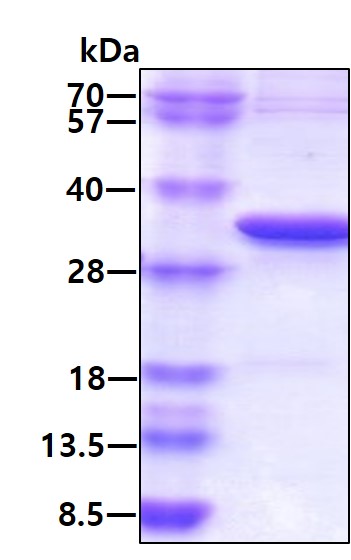

Human RPA2 protein (Recombinant) (His-Tag) (STJP016932)
SPECIFICATIONS
HostE.coli
ImmunogenHuman
General Information
| Short Description | Recombinant-Human RPA2-His-Tag protein was developed from e.coli and has a target region of His-Tag. For use in research applications. |
| Applications | SDS-PAGE |
| Host | E.coli |
| Note | STRICTLY FOR FURTHER SCIENTIFIC RESEARCH USE ONLY (RUO). MUST NOT TO BE USED IN DIAGNOSTIC OR THERAPEUTIC APPLICATIONS. |
Product Properties
| Concentration | 0.5 mg/mL |
| Formulation | Liquid in 20mM Tris-HCl buffer (pH 8.0) containing 20% Glycerol, 0.1M NaCl, 2mM DTT |
| Storage Instruction | For short term storage, keep at +2C to +8C for up to 1 week. For long term storage, aliquot and store at-20C, and avoid repeat freeze-thaw cycles. |
Target Information
| Gene Symbol | RPA2 |
| Gene ID | 6118 |
| Uniprot ID | RFA2_HUMAN |
| Accession Number | NP_002937 |
| Immunogen | Human |
| Immunogen Region | 1-270aa |
| Immunogen Sequence |
Additional Info
| Post Translational Modifications | Differentially phosphorylated throughout the cell cycle, becoming phosphorylated at the G1-S transition and dephosphorylated in late mitosis. Mainly phosphorylated at Ser-23 and Ser-29, by cyclin A-CDK2 and cyclin B-CDK1, respectively during DNA replication and mitosis. Dephosphorylation may require the serine/threonine-protein phosphatase 4. Phosphorylation at Ser-23 and Ser-29 is a prerequisite for further phosphorylation. Becomes hyperphosphorylated on additional residues including Ser-4, Ser-8, Thr-21 and Ser-33 in response to DNA damage. Hyperphosphorylation is mediated by ATM, ATR and PRKDC. Primarily recruited to DNA repair nuclear foci as a hypophosphorylated form it undergoes subsequent hyperphosphorylation, catalyzed by ATR. Hyperphosphorylation is required for RAD51 recruitment to chromatin and efficient DNA repair. Phosphorylation at Thr-21 depends upon RFWD3 presence. DNA damage-induced 'Lys-63'-linked polyubiquitination by PRPF19 mediates ATRIP recruitment to the RPA complex at sites of DNA damage and activation of ATR. Ubiquitinated by RFWD3 at stalled replication forks in response to DNA damage: ubiquitination by RFWD3 does not lead to degradation by the proteasome and promotes removal of the RPA complex from stalled replication forks, promoting homologous recombination. |
| Function | As part of the heterotrimeric replication protein A complex (RPA/RP-A), binds and stabilizes single-stranded DNA intermediates that form during DNA replication or upon DNA stress. It prevents their reannealing and in parallel, recruits and activates different proteins and complexes involved in DNA metabolism. Thereby, it plays an essential role both in DNA replication and the cellular response to DNA damage. In the cellular response to DNA damage, the RPA complex controls DNA repair and DNA damage checkpoint activation. Through recruitment of ATRIP activates the ATR kinase a master regulator of the DNA damage response. It is required for the recruitment of the DNA double-strand break repair factors RAD51 and RAD52 to chromatin in response to DNA damage. Also recruits to sites of DNA damage proteins like XPA and XPG that are involved in nucleotide excision repair and is required for this mechanism of DNA repair. Also plays a role in base excision repair (BER) probably through interaction with UNG. Also recruits SMARCAL1/HARP, which is involved in replication fork restart, to sites of DNA damage. May also play a role in telomere maintenance. RPA stimulates 5'-3' helicase activity of BRIP1/FANCJ. |
| Protein Name | Replication Protein A 32 Kda SubunitRp-A P32Replication Factor A Protein 2Rf-A Protein 2Replication Protein A 34 Kda SubunitRp-A P34 |
| Database Links | Reactome: R-HSA-110312Reactome: R-HSA-110314Reactome: R-HSA-110320Reactome: R-HSA-174437Reactome: R-HSA-176187Reactome: R-HSA-3371453Reactome: R-HSA-3371511Reactome: R-HSA-5358565Reactome: R-HSA-5358606Reactome: R-HSA-5651801Reactome: R-HSA-5655862Reactome: R-HSA-5656121Reactome: R-HSA-5656169Reactome: R-HSA-5685938Reactome: R-HSA-5685942Reactome: R-HSA-5693607Reactome: R-HSA-5693616Reactome: R-HSA-5696395Reactome: R-HSA-5696397Reactome: R-HSA-5696400Reactome: R-HSA-6782135Reactome: R-HSA-6782210Reactome: R-HSA-6783310Reactome: R-HSA-6804756Reactome: R-HSA-68962Reactome: R-HSA-69166Reactome: R-HSA-69473Reactome: R-HSA-912446Reactome: R-HSA-9709570 |
| Cellular Localisation | NucleusPml BodyRedistributes To Discrete Nuclear Foci Upon Dna Damage In An Atr-Dependent Manner |
| Alternative Protein Names | Replication Protein A 32 Kda Subunit proteinRp-A P32 proteinReplication Factor A Protein 2 proteinRf-A Protein 2 proteinReplication Protein A 34 Kda Subunit proteinRp-A P34 proteinRPA2 proteinREPA2 proteinRPA32 proteinRPA34 protein |
Information sourced from Uniprot.org