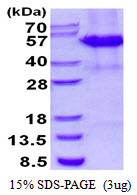
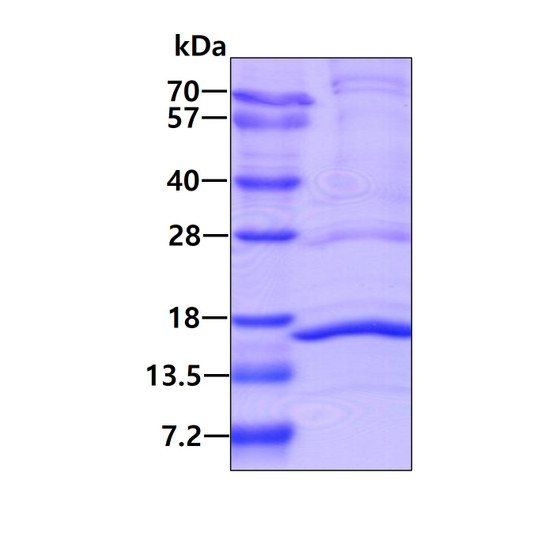
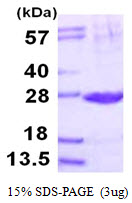
| Short Description : | Recombinant-Human PSMB2-His-Tag protein was developed from e.coli and has a target region of His-Tag. For use in research applications. |
| Applications: | SDS-PAGE |
| Host: | E.coli |
| Note: | STRICTLY FOR FURTHER SCIENTIFIC RESEARCH USE ONLY (RUO). MUST NOT TO BE USED IN DIAGNOSTIC OR THERAPEUTIC APPLICATIONS. |
| Concentration: | 0.5 mg/mL |
| Formulation: | Liquid in 20mM Tris-HCl buffer (pH 8.0) containing 1mM DTT, 30% Glycerol, 0.1M NaCl |
| Storage Instruction: | For short term storage, keep at +2C to +8C for up to 1 week. For long term storage, aliquot and store at-20C, and avoid repeat freeze-thaw cycles. |
| Gene Symbol: | PSMB2 |
| Gene ID: | 5690 |
| Uniprot ID: | PSB2_HUMAN |
| Accession Number: | NP_002785 |
| Immunogen: | Human |
| Immunogen Region: | 1-201aa |
| Immunogen Sequence: | MGSSHHHHHH SSGLVPRGSH MEYLIGIQGP DYVLVASDRV AASNIVQMKD DHDKMFKMSE KILLLCVGEA GDTVQFAEYI QKNVQLYKMR NGYELSPTAA ANFTRRNLAD CLRSRTPYHV NLLLAGYDEH EGPALYYMDY LAALAKAPFA AHGYGAFLTL SILDRYYTPT ISRERAVELL RKCLEELQKR FILNLPTFSV RIIDKNGIHD LDNISFPKQG S |
| Function | Non-catalytic component of the 20S core proteasome complex involved in the proteolytic degradation of most intracellular proteins. This complex plays numerous essential roles within the cell by associating with different regulatory particles. Associated with two 19S regulatory particles, forms the 26S proteasome and thus participates in the ATP-dependent degradation of ubiquitinated proteins. The 26S proteasome plays a key role in the maintenance of protein homeostasis by removing misfolded or damaged proteins that could impair cellular functions, and by removing proteins whose functions are no longer required. Associated with the PA200 or PA28, the 20S proteasome mediates ubiquitin-independent protein degradation. This type of proteolysis is required in several pathways including spermatogenesis (20S-PA200 complex) or generation of a subset of MHC class I-presented antigenic peptides (20S-PA28 complex). |
| Protein Name | Proteasome Subunit Beta Type-2Macropain Subunit C7-IMulticatalytic Endopeptidase Complex Subunit C7-IProteasome Component C7-IProteasome Subunit Beta-4Beta-4 |
| Database Links | Reactome: R-HSA-1169091Reactome: R-HSA-1234176Reactome: R-HSA-1236974Reactome: R-HSA-1236978Reactome: R-HSA-174084Reactome: R-HSA-174113Reactome: R-HSA-174154Reactome: R-HSA-174178Reactome: R-HSA-174184Reactome: R-HSA-180534Reactome: R-HSA-180585Reactome: R-HSA-187577Reactome: R-HSA-195253Reactome: R-HSA-202424Reactome: R-HSA-211733Reactome: R-HSA-2467813Reactome: R-HSA-2871837Reactome: R-HSA-349425Reactome: R-HSA-350562Reactome: R-HSA-382556Reactome: R-HSA-450408Reactome: R-HSA-4608870Reactome: R-HSA-4641257Reactome: R-HSA-4641258Reactome: R-HSA-5358346Reactome: R-HSA-5362768Reactome: R-HSA-5607761Reactome: R-HSA-5607764Reactome: R-HSA-5610780Reactome: R-HSA-5610783Reactome: R-HSA-5610785Reactome: R-HSA-5632684Reactome: R-HSA-5658442Reactome: R-HSA-5668541Reactome: R-HSA-5676590Reactome: R-HSA-5678895Reactome: R-HSA-5687128Reactome: R-HSA-5689603Reactome: R-HSA-5689880Reactome: R-HSA-68867Reactome: R-HSA-68949Reactome: R-HSA-69017Reactome: R-HSA-69481Reactome: R-HSA-69601Reactome: R-HSA-75815Reactome: R-HSA-8852276Reactome: R-HSA-8854050Reactome: R-HSA-8939236Reactome: R-HSA-8939902Reactome: R-HSA-8941858Reactome: R-HSA-8948751Reactome: R-HSA-8951664Reactome: R-HSA-9010553Reactome: R-HSA-9020702Reactome: R-HSA-9604323Reactome: R-HSA-9755511Reactome: R-HSA-9762114Reactome: R-HSA-9824272Reactome: R-HSA-983168Reactome: R-HSA-9907900 |
| Cellular Localisation | CytoplasmNucleusTranslocated From The Cytoplasm Into The Nucleus Following Interaction With Akirin2Which Bridges The Proteasome With The Nuclear Import Receptor Ipo9 |
| Alternative Protein Names | Proteasome Subunit Beta Type-2 proteinMacropain Subunit C7-I proteinMulticatalytic Endopeptidase Complex Subunit C7-I proteinProteasome Component C7-I proteinProteasome Subunit Beta-4 proteinBeta-4 proteinPSMB2 protein |
Information sourced from Uniprot.org