

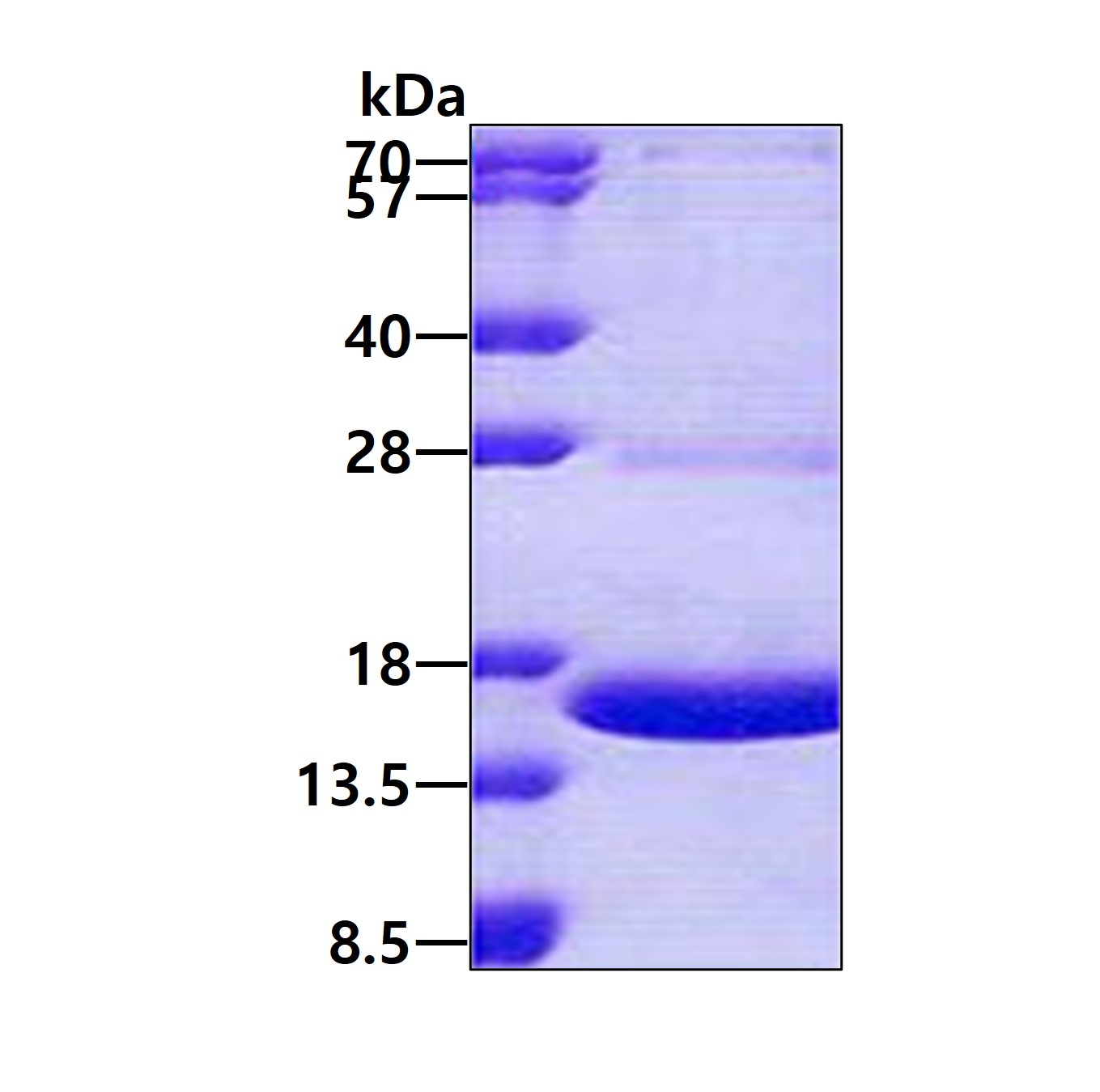

Human MPZL1 protein (Recombinant) (His-Tag) (STJP018330)
SPECIFICATIONS
HostE.coli
ImmunogenHuman
General Information
| Short Description | Recombinant-Human MPZL1-His-Tag protein was developed from e.coli and has a target region of His-Tag. For use in research applications. |
| Applications | SDS-PAGE |
| Host | E.coli |
| Note | STRICTLY FOR FURTHER SCIENTIFIC RESEARCH USE ONLY (RUO). MUST NOT TO BE USED IN DIAGNOSTIC OR THERAPEUTIC APPLICATIONS. |
Product Properties
| Concentration | 0.5 mg/mL |
| Formulation | Liquid in 20mM Tris-HCl buffer (pH 8.0) containing 0.15M NaCl, 20% Glycerol, 1mM DTT |
| Storage Instruction | For short term storage, keep at +2C to +8C for up to 1 week. For long term storage, aliquot and store at-20C, and avoid repeat freeze-thaw cycles. |
Target Information
| Gene Symbol | MPZL1 |
| Gene ID | 9019 |
| Uniprot ID | MPZL1_HUMAN |
| Accession Number | NP_078845 |
| Immunogen | Human |
| Immunogen Region | 38-162aa |
| Immunogen Sequence |
Additional Info
| Tissue Specificity | Widely expressed with highest levels in heart, placenta, kidney and pancreas. Isoform 3 is relatively abundant in hematopoietic tissues and fetal liver. Isoform 1 and isoform 3 are expressed in CD14- PB monocytes and pre-B cell progenitors. Isoform 3 appears to be the major isoform in CD34- promyelocytic and promonocytic cells. During differentiation in monocytic cells, the expression level of isoform 3 decreases and that of isoform 1 increases. Isoform 1 is prominent in stromal cells and, to a lesser extent, in umbilical vein endothelial cells and erythroid progenitors. Isoform 2 is expressed in a erythroid progenitor cell line. |
| Post Translational Modifications | Phosphorylated on tyrosine residues upon stimulation with pervanadate and concanavalin-A (ConA). Phosphorylation at Tyr-241 and Tyr-263 is required for interaction with PTPN11/SHP-2. Dephosphorylated by PTPN11/SHP-2 (in vitro). N-glycosylated. N-glycosylation is required for concanavalin A binding. |
| Function | Cell surface receptor, which is involved in signal transduction processes. Recruits PTPN11/SHP-2 to the cell membrane and is a putative substrate of PTPN11/SHP-2. Is a major receptor for concanavalin-A (ConA) and is involved in cellular signaling induced by ConA, which probably includes Src family tyrosine-protein kinases. Isoform 3 seems to have a dominant negative role.it blocks tyrosine phosphorylation of MPZL1 induced by ConA. Isoform 1, but not isoform 2 and isoform 3, may be involved in regulation of integrin-mediated cell motility. |
| Protein Name | Myelin Protein Zero-Like Protein 1Protein Zero-Related |
| Database Links | |
| Cellular Localisation | MembraneSingle-Pass Type I Membrane Protein |
| Alternative Protein Names | Myelin Protein Zero-Like Protein 1 proteinProtein Zero-Related proteinMPZL1 proteinPZR proteinUNQ849 proteinPRO1787 protein |
Information sourced from Uniprot.org