




Human/Mouse/Rat TGF-beta 3 protein (Recombinant) (No tag) (STJP002647)
SPECIFICATIONS
HostHEK293 cells
ConjugationUnconjugated
ImmunogenRecombinant Human/Mouse/Rat TGF-beta 3 Protein is produced by Human cells expression system. The target protein is expressed with sequence (Ala301-Ser412 (Tyr340Phe) ) of human TGF-beta 3/TGFB3 (Accession #P10600).
General Information
| Short Description | Recombinant-Human/Mouse/Rat TGF-beta 3-No tag protein was developed in hek293 cells using the region Tyr340Phe. For use in research applications. |
| Host | HEK293 cells |
| Note | STRICTLY FOR FURTHER SCIENTIFIC RESEARCH USE ONLY (RUO). MUST NOT TO BE USED IN DIAGNOSTIC OR THERAPEUTIC APPLICATIONS. |
Product Properties
| Conjugation | Unconjugated |
| Formulation | Lyophilised from a 0.2 Mu m filtered solution of 50mM Glycine-HCl, 150mM NaCl, pH 2.5. |
| Storage Instruction | Store at-20°C for up to 1 year from the date of receipt, and avoid repeat freeze-thaw cycles. |
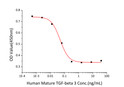
| Immunoreactivity | Measured by its ability to inhibit the IL-4-dependent proliferation of HT-2 mouse T cells. The ED50 for this effect is 24.2-96.6 pg/mL, corresponding to a specific activity of 1.04×10⁷~4.17×10⁷ units/mg. |
| Determination Method | < 1 EU/Mu g of the protein by LAL method. |
Target Information
| Gene Symbol | TGFB3 |
| Gene ID | 7043 |
| Uniprot ID | TGFB3_HUMAN |
| Immunogen | Recombinant Human/Mouse/Rat TGF-beta 3 Protein is produced by Human cells expression system. The target protein is expressed with sequence (Ala301-Ser412 (Tyr340Phe) ) of human TGF-beta 3/TGFB3 (Accession #P10600). |
| Immunogen Region | Tyr340Phe |
| Immunogen Sequence | ALDTNYCFRNLEENCCVRPL YIDFRQDLGWKWVHEPKGYF ANFCSGPCPYLRSADTTHST VLGLYNTLNPEASASPCCVP QDLEPLTILYYVGRTPKVEQ LSNMVVKSCKCS |
Additional Info
| Function | Transforming growth factor beta-3 proprotein: Precursor of the Latency-associated peptide (LAP) and Transforming growth factor beta-3 (TGF-beta-3) chains, which constitute the regulatory and active subunit of TGF-beta-3, respectively. Latency-associated peptide: Required to maintain the Transforming growth factor beta-3 (TGF-beta-3) chain in a latent state during storage in extracellular matrix. Associates non-covalently with TGF-beta-3 and regulates its activation via interaction with 'milieu molecules', such as LTBP1 and LRRC32/GARP, that control activation of TGF-beta-3. Interaction with integrins results in distortion of the Latency-associated peptide chain and subsequent release of the active TGF-beta-3. Transforming growth factor beta-3: Multifunctional protein that regulates embryogenesis and cell differentiation and is required in various processes such as secondary palate development. Activation into mature form follows different steps: following cleavage of the proprotein in the Golgi apparatus, Latency-associated peptide (LAP) and Transforming growth factor beta-3 (TGF-beta-3) chains remain non-covalently linked rendering TGF-beta-3 inactive during storage in extracellular matrix. At the same time, LAP chain interacts with 'milieu molecules', such as LTBP1 and LRRC32/GARP that control activation of TGF-beta-3 and maintain it in a latent state during storage in extracellular milieus. TGF-beta-3 is released from LAP by integrins: integrin-binding results in distortion of the LAP chain and subsequent release of the active TGF-beta-3. Once activated following release of LAP, TGF-beta-3 acts by binding to TGF-beta receptors (TGFBR1 and TGFBR2), which transduce signal. |
| Protein Name | Transforming Growth Factor Beta-3 Proprotein Cleaved Into - Latency-Associated PeptideLap - Transforming Growth Factor Beta-3Tgf-Beta-3 |
| Database Links | Reactome: R-HSA-114608Reactome: R-HSA-2129379Reactome: R-HSA-2173789Reactome: R-HSA-3000178 |
| Cellular Localisation | Latency-Associated Peptide: SecretedExtracellular SpaceExtracellular MatrixTransforming Growth Factor Beta-3: Secreted |
| Alternative Protein Names | Transforming Growth Factor Beta-3 Proprotein Cleaved Into - Latency-Associated Peptide proteinLap - Transforming Growth Factor Beta-3 proteinTgf-Beta-3 proteinTGFB3 protein |
Information sourced from Uniprot.org