

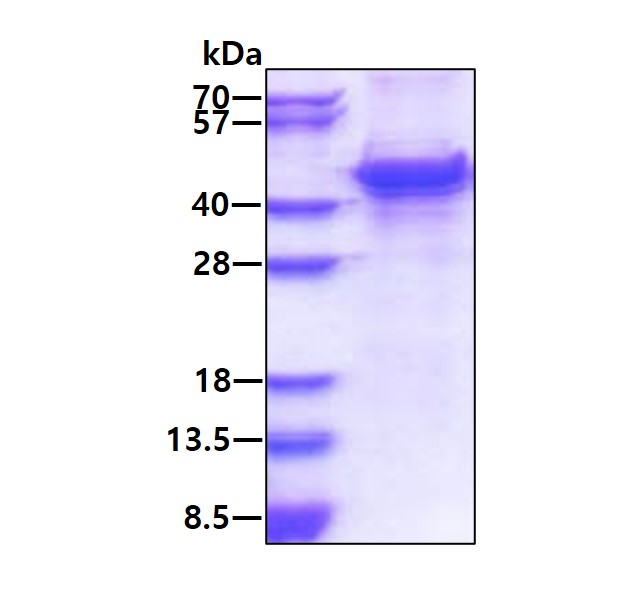

Human MMP-13 protein (Recombinant) (His-Tag) (STJP018639)
SPECIFICATIONS
HostE.coli
ImmunogenHuman
General Information
| Short Description | Recombinant-Human MMP-13-His-Tag protein was developed from e.coli and has a target region of His-Tag. For use in research applications. |
| Applications | SDS-PAGE |
| Host | E.coli |
| Note | STRICTLY FOR FURTHER SCIENTIFIC RESEARCH USE ONLY (RUO). MUST NOT TO BE USED IN DIAGNOSTIC OR THERAPEUTIC APPLICATIONS. |
Product Properties
| Concentration | 0.5 mg/mL |
| Formulation | Liquid in 20mM Tris-HCl buffer (pH 8.0) containing 10% Glycerol, 0.15M NaCl, 1mM DTT |
| Storage Instruction | For short term storage, keep at +2C to +8C for up to 1 week. For long term storage, aliquot and store at-20C, and avoid repeat freeze-thaw cycles. |
Target Information
| Gene Symbol | MMP13 |
| Gene ID | 4322 |
| Uniprot ID | MMP13_HUMAN |
| Accession Number | NP_002418.1 |
| Immunogen | Human |
| Immunogen Region | 104-471aa |
| Immunogen Sequence |
Additional Info
| Tissue Specificity | Detected in fetal cartilage and calvaria, in chondrocytes of hypertrophic cartilage in vertebrae and in the dorsal end of ribs undergoing ossification, as well as in osteoblasts and periosteal cells below the inner periosteal region of ossified ribs. Detected in chondrocytes from in joint cartilage that have been treated with TNF and IL1B, but not in untreated chondrocytes. Detected in T lymphocytes. Detected in breast carcinoma tissue. |
| Post Translational Modifications | The proenzyme is activated by removal of the propeptide.this cleavage can be effected by other matrix metalloproteinases, such as MMP2, MMP3 and MMP14 and may involve several cleavage steps. Cleavage can also be autocatalytic, after partial maturation by another protease or after treatment with 4-aminophenylmercuric acetate (APMA) (in vitro). N-glycosylated. Tyrosine phosphorylated by PKDCC/VLK. |
| Function | Plays a role in the degradation of extracellular matrix proteins including fibrillar collagen, fibronectin, TNC and ACAN. Cleaves triple helical collagens, including type I, type II and type III collagen, but has the highest activity with soluble type II collagen. Can also degrade collagen type IV, type XIV and type X. May also function by activating or degrading key regulatory proteins, such as TGFB1 and CCN2. Plays a role in wound healing, tissue remodeling, cartilage degradation, bone development, bone mineralization and ossification. Required for normal embryonic bone development and ossification. Plays a role in the healing of bone fractures via endochondral ossification. Plays a role in wound healing, probably by a mechanism that involves proteolytic activation of TGFB1 and degradation of CCN2. Plays a role in keratinocyte migration during wound healing. May play a role in cell migration and in tumor cell invasion. |
| Protein Name | Collagenase 3Matrix Metalloproteinase-13Mmp-13 |
| Database Links | Reactome: R-HSA-1442490Reactome: R-HSA-1474228Reactome: R-HSA-1592389Reactome: R-HSA-2022090Reactome: R-HSA-8941332 |
| Cellular Localisation | SecretedExtracellular SpaceExtracellular Matrix |
| Alternative Protein Names | Collagenase 3 proteinMatrix Metalloproteinase-13 proteinMmp-13 proteinMMP13 protein |
Information sourced from Uniprot.org