



Human IGF-1 protein (Recombinant) (No-Tag) (STJP019676)
SPECIFICATIONS
HostE.coli
ImmunogenHuman
General Information
| Short Description | Recombinant-Human IGF-1-No-Tag protein was developed from e.coli and has a target region of No-Tag. For use in research applications. |
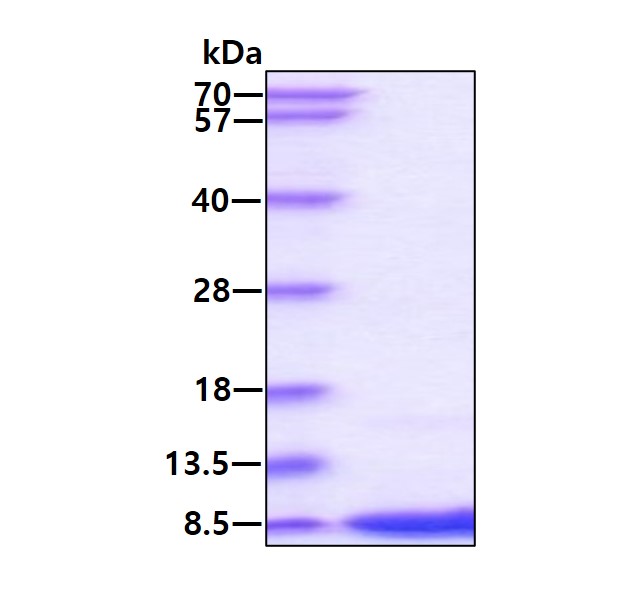
| Applications | SDS-PAGE/Bioactivity |
| Host | E.coli |
| Note | STRICTLY FOR FURTHER SCIENTIFIC RESEARCH USE ONLY (RUO). MUST NOT TO BE USED IN DIAGNOSTIC OR THERAPEUTIC APPLICATIONS. |
Product Properties
| Concentration | 1 mg/mL |
| Formulation | Liquid in phosphate-Buffered Saline (pH 7.4) |
| Storage Instruction | For short term storage, keep at +2C to +8C for up to 1 week. For long term storage, aliquot and store at-20C, and avoid repeat freeze-thaw cycles. |
| Endotoxin | < 1 EU per 1ug of protein (determined by LAL method) |
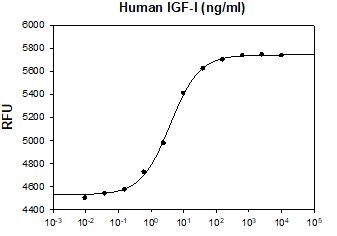
| Immunoreactivity | Measured in a cell proliferation assay using MCF-7 human breast cancer cells. The ED50 range ≤ 5ng/ml. |
Target Information
| Gene Symbol | IGF1 |
| Gene ID | 3479 |
| Uniprot ID | IGF1_HUMAN |
| Accession Number | NP_000609.1 |
| Immunogen | Human |
| Immunogen Region | 49-118aa |
| Immunogen Sequence | MGPETLCGAE LVDALQFVCG DRGFYFNKPT GYGSSSRRAP QTGIVDECCF RSCDLRRLEM YCAPLKPAKS A |
Additional Info
| Function | The insulin-like growth factors, isolated from plasma, are structurally and functionally related to insulin but have a much higher growth-promoting activity. May be a physiological regulator of 1-14C-2-deoxy-D-glucose (2DG) transport and glycogen synthesis in osteoblasts. Stimulates glucose transport in bone-derived osteoblastic (PyMS) cells and is effective at much lower concentrations than insulin, not only regarding glycogen and DNA synthesis but also with regard to enhancing glucose uptake. May play a role in synapse maturation. Ca(2+)-dependent exocytosis of IGF1 is required for sensory perception of smell in the olfactory bulb. Acts as a ligand for IGF1R. Binds to the alpha subunit of IGF1R, leading to the activation of the intrinsic tyrosine kinase activity which autophosphorylates tyrosine residues in the beta subunit thus initiating a cascade of down-stream signaling events leading to activation of the PI3K-AKT/PKB and the Ras-MAPK pathways. Binds to integrins ITGAV:ITGB3 and ITGA6:ITGB4. Its binding to integrins and subsequent ternary complex formation with integrins and IGFR1 are essential for IGF1 signaling. Induces the phosphorylation and activation of IGFR1, MAPK3/ERK1, MAPK1/ERK2 and AKT1. As part of the MAPK/ERK signaling pathway, acts as a negative regulator of apoptosis in cardiomyocytes via promotion of STUB1/CHIP-mediated ubiquitination and degradation of ICER-type isoforms of CREM. |
| Protein Name | Insulin-Like Growth Factor 1Insulin-Like Growth Factor IIgf-IMechano Growth FactorMgfSomatomedin-C |
| Database Links | Reactome: R-HSA-114608Reactome: R-HSA-2404192Reactome: R-HSA-2428928Reactome: R-HSA-2428933Reactome: R-HSA-381426Reactome: R-HSA-422085 |
| Cellular Localisation | Secreted |
| Alternative Protein Names | Insulin-Like Growth Factor 1 proteinInsulin-Like Growth Factor I proteinIgf-I proteinMechano Growth Factor proteinMgf proteinSomatomedin-C proteinIGF1 proteinIBP1 proteinIGF-1 protein |
Information sourced from Uniprot.org