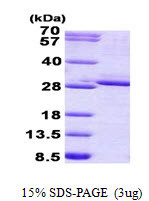
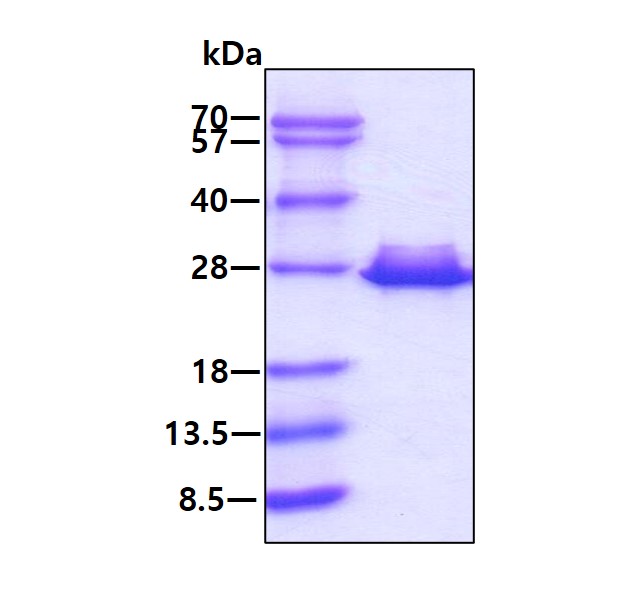
| Short Description : | Recombinant-Human FGF-19-His-Tag protein was developed from hek293 cells and has a target region of His-Tag. For use in research applications. |
| Applications: | SDS-PAGE |
| Host: | HEK293 Cells |
| Note: | STRICTLY FOR FURTHER SCIENTIFIC RESEARCH USE ONLY (RUO). MUST NOT TO BE USED IN DIAGNOSTIC OR THERAPEUTIC APPLICATIONS. |
| Concentration: | 0.5 mg/mL |
| Formulation: | Liquid In 20mM Tris-HCl (pH8.0) containing 0.1M NaCl, 20% Glycerol |
| Storage Instruction: | For short term storage, keep at +2C to +8C for up to 1 week. For long term storage, aliquot and store at-20C, and avoid repeat freeze-thaw cycles. |
| Endotoxin: | < 1 EU per 1ug of protein (determined by LAL method) |
| Gene Symbol: | FGF19 |
| Gene ID: | 9965 |
| Uniprot ID: | FGF19_HUMAN |
| Accession Number: | NP_005108.1 |
| Immunogen: | Human |
| Immunogen Region: | 23-216aa |
| Immunogen Sequence: | RPLAF SDAGPHVHYG WGDPIRLRHL YTSGPHGLSS CFLRIRADGV VDCARGQSAH SLLEIKAVAL RTVAIKGVHS VRYLCMGADG KMQGLLQYSE EDCAFEEEIR PDGYNVYRSE KHRLPVSLSS AKQRQLYKNR GFLPLSHFLP MLPMVPEEPE DLRGHLESDM FSSPLETDSM DPFGLVTGLE AVRSPSFEK |
Information sourced from Uniprot.org