

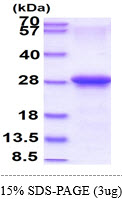

Human CXADR protein (Recombinant) (His-Tag) (STJP018307)
SPECIFICATIONS
HostE.coli
ImmunogenHuman
General Information
| Short Description | Recombinant-Human CXADR-His-Tag protein was developed from e.coli and has a target region of His-Tag. For use in research applications. |
| Applications | SDS-PAGE |
| Host | E.coli |
| Note | STRICTLY FOR FURTHER SCIENTIFIC RESEARCH USE ONLY (RUO). MUST NOT TO BE USED IN DIAGNOSTIC OR THERAPEUTIC APPLICATIONS. |
Product Properties
| Concentration | 0.5 mg/mL |
| Formulation | Liquid in 20mM Tris-HCl buffer (pH 8.0) containing 0.15M NaCl, 10% Glycerol, 1mM DTT |
| Storage Instruction | For short term storage, keep at +2C to +8C for up to 1 week. For long term storage, aliquot and store at-20C, and avoid repeat freeze-thaw cycles. |
Target Information
| Gene Symbol | CXADR |
| Gene ID | 1525 |
| Uniprot ID | CXAR_HUMAN |
| Accession Number | NP_001329 |
| Immunogen | Human |
| Immunogen Region | 20-237aa |
| Immunogen Sequence | MGSSHHHHHH SSGLVPRGSH MGSLSITTPE EMIEKAKGET AYLPCKFTLS PEDQGPLDIE WLISPADNQK VDQVIILYSG DKIYDDYYPD LKGRVHFTSN DLKSGDASIN VTNLQLSDIG TYQCKVKKAP GVANKKIHLV VLVKPSGARC YVDGSEEIGS DFKIKCEPKE GSLPLQYEWQ KLSDSQKMPT SWLAEMTSSV ISVKNASSEY SGTYSCTVRN RVGSDQCL |
Additional Info
| Tissue Specificity | Expressed in pancreas, brain, heart, small intestine, testis, prostate and at a lower level in liver and lung. Isoform 5 is ubiquitously expressed. Isoform 3 is expressed in heart, lung and pancreas. In skeletal muscle, isoform 1 is found at the neuromuscular junction and isoform 2 is found in blood vessels. In cardiac muscle, isoform 1 and isoform 2 are found at intercalated disks. In heart expressed in subendothelial layers of the vessel wall but not in the luminal endothelial surface. Expression is elevated in hearts with dilated cardiomyopathy. |
| Post Translational Modifications | N-glycosylated. Palmitoylated on Cys-259 and/or Cys-260.required for proper localization to the plasma membrane. |
| Function | Component of the epithelial apical junction complex that may function as a homophilic cell adhesion molecule and is essential for tight junction integrity. Also involved in transepithelial migration of leukocytes through adhesive interactions with JAML a transmembrane protein of the plasma membrane of leukocytes. The interaction between both receptors also mediates the activation of gamma-delta T-cells, a subpopulation of T-cells residing in epithelia and involved in tissue homeostasis and repair. Upon epithelial CXADR-binding, JAML induces downstream cell signaling events in gamma-delta T-cells through PI3-kinase and MAP kinases. It results in proliferation and production of cytokines and growth factors by T-cells that in turn stimulate epithelial tissues repair. (Microbial infection) Acts as a receptor for adenovirus type C. (Microbial infection) Acts as a receptor for Coxsackievirus B1 to B6. |
| Protein Name | Coxsackievirus And Adenovirus ReceptorCarHcarCvb3-Binding ProteinCoxsackievirus B-Adenovirus ReceptorHcvadr |
| Database Links | Reactome: R-HSA-198933Reactome: R-HSA-202733 |
| Cellular Localisation | Isoform 1: Cell MembraneSingle-Pass Type I Membrane ProteinBasolateral Cell MembraneCell JunctionTight JunctionAdherens JunctionIn Epithelial Cells Localizes To The Apical Junction Complex Composed Of Tight And Adherens JunctionsIn Airway Epithelial Cells Localized To Basolateral Membrane But Not To Apical SurfaceIsoform 3: SecretedIsoform 4: SecretedIsoform 5: Secreted |
| Alternative Protein Names | Coxsackievirus And Adenovirus Receptor proteinCar proteinHcar proteinCvb3-Binding Protein proteinCoxsackievirus B-Adenovirus Receptor proteinHcvadr proteinCXADR proteinCAR protein |
Information sourced from Uniprot.org