

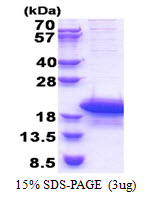

Human ARPP19 protein (Recombinant) (His-Tag) (STJP018549)
SPECIFICATIONS
HostE.coli
ImmunogenHuman
General Information
| Short Description | Recombinant-Human ARPP19-His-Tag protein was developed from e.coli and has a target region of His-Tag. For use in research applications. |
| Applications | SDS-PAGE |
| Host | E.coli |
| Note | STRICTLY FOR FURTHER SCIENTIFIC RESEARCH USE ONLY (RUO). MUST NOT TO BE USED IN DIAGNOSTIC OR THERAPEUTIC APPLICATIONS. |
Product Properties
| Concentration | 0.5 mg/mL |
| Formulation | Liquid in 20mM Tris-HCl buffer (pH 8.0) containing 0.15M NaCl, 10% Glycerol |
| Storage Instruction | For short term storage, keep at +2C to +8C for up to 1 week. For long term storage, aliquot and store at-20C, and avoid repeat freeze-thaw cycles. |
Target Information
| Gene Symbol | ARPP19 |
| Gene ID | 10776 |
| Uniprot ID | ARP19_HUMAN |
| Accession Number | NP_006619 |
| Immunogen | Human |
| Immunogen Region | 1-112aa |
| Immunogen Sequence | MGSSHHHHHH SSGLVPRGSH MGSMSAEVPE AASAEEQKEM EDKVTSPEKA EEAKLKARYP HLGQKPGGSD FLRKRLQKGQ KYFDSGDYNM AKAKMKNKQL PTAAPDKTEV TGDHIPTPQD LPQRKPSLVA SKLAG |
Additional Info
| Post Translational Modifications | Phosphorylation at Ser-62 by MASTL/GWL during mitosis is essential for interaction with PPP2R2D (PR55-delta) and subsequent inactivation of PP2A. Phosphorylated by PKA. |
| Function | Protein phosphatase inhibitor that specifically inhibits protein phosphatase 2A (PP2A) during mitosis. Inhibition of PP2A is enhanced when ARPP19 is phosphorylated. When phosphorylated at Ser-62 during mitosis, specifically interacts with PPP2R2D (PR55-delta) and inhibits its activity, leading to inactivation of PP2A, an essential condition to keep cyclin-B1-CDK1 activity high during M phase. May indirectly enhance GAP-43 expression. |
| Protein Name | Camp-Regulated Phosphoprotein 19Arpp-19 |
| Database Links | Reactome: R-HSA-2465910 |
| Cellular Localisation | Cytoplasm |
| Alternative Protein Names | Camp-Regulated Phosphoprotein 19 proteinArpp-19 proteinARPP19 protein |
Information sourced from Uniprot.org