
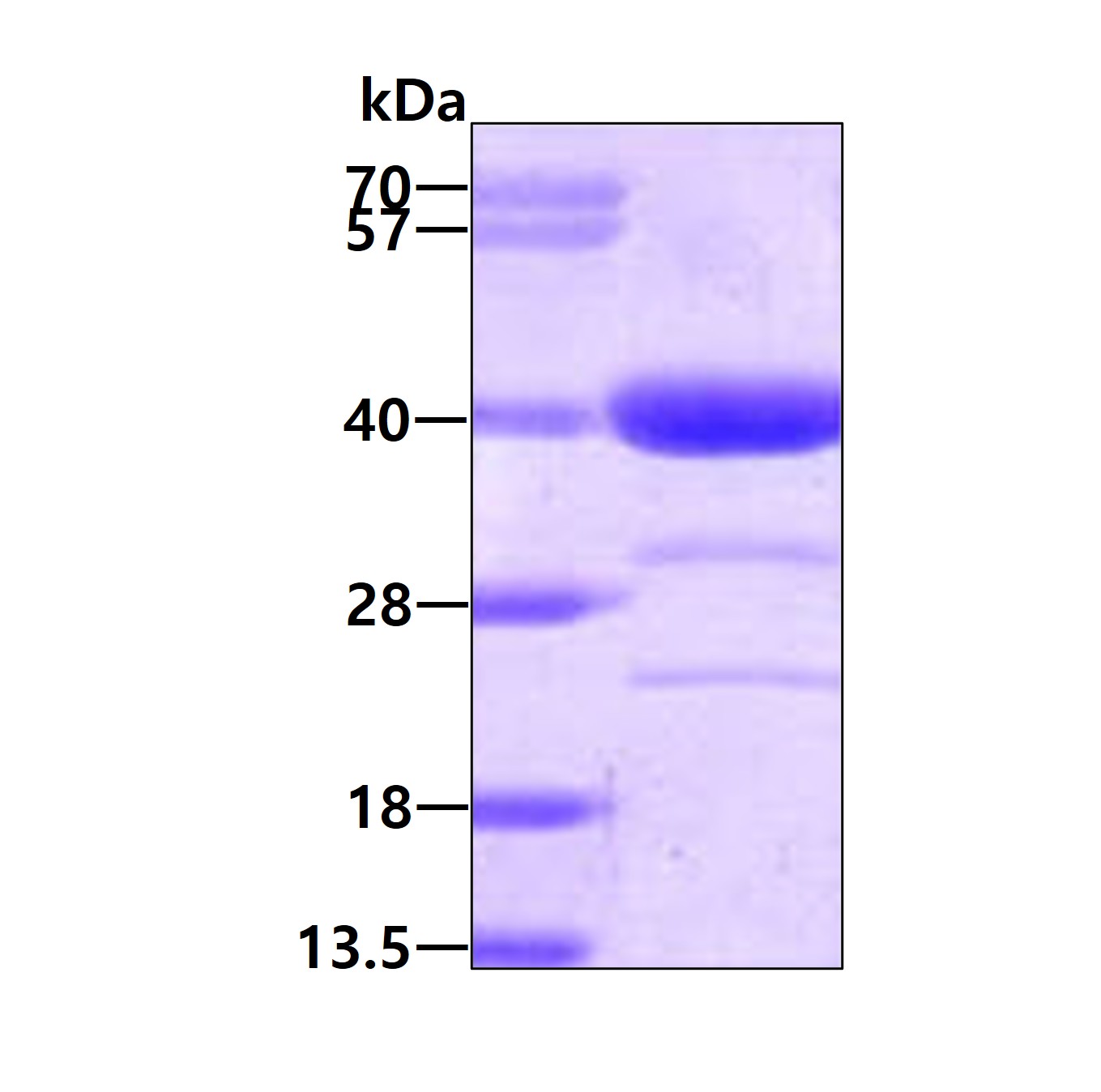

Human Aldo-keto reductase 1A1/AKR1A1 protein (Recombinant) (No-Tag) (STJP016575)
SPECIFICATIONS
HostE.coli
ImmunogenHuman
General Information
| Short Description | Recombinant-Human Aldo-keto reductase 1A1/AKR1A1-No-Tag protein was developed from e.coli and has a target region of No-Tag. For use in research applications. |
| Applications | SDS-PAGE |
| Host | E.coli |
| Note | STRICTLY FOR FURTHER SCIENTIFIC RESEARCH USE ONLY (RUO). MUST NOT TO BE USED IN DIAGNOSTIC OR THERAPEUTIC APPLICATIONS. |
Product Properties
| Concentration | 1 mg/mL |
| Formulation | Liquid in 20mM Tris-HCl buffer (pH 8.0) containing 50mM NaCl, 10% Glycerol |
| Storage Instruction | For short term storage, keep at +2C to +8C for up to 1 week. For long term storage, aliquot and store at-20C, and avoid repeat freeze-thaw cycles. |
Target Information
| Gene Symbol | AKR1A1 |
| Gene ID | 10327 |
| Uniprot ID | AK1A1_HUMAN |
| Accession Number | NP_006057 |
| Immunogen | Human |
| Immunogen Region | 1-325aa |
| Immunogen Sequence | MAASCVLLHT GQKMPLIGLG TWKSEPGQVK AAVKYALSVG YRHIDCAAIY GNEPEIGEAL KEDVGPGKAV PREELFVTSK LWNTKHHPED VEPALRKTLA DLQLEYLDLY LMHWPYAFER GDNPFPKNAD GTICYDSTHY KETWKALEAL VAKGLVQALG LSNFNSRQID DILSVASVRP AVLQVECHPY LAQNELIAHC QARGLEVTAY SPLGSSDRAW RDPDEPVL |
Additional Info
| Tissue Specificity | Widely expressed. Highly expressed in kidney, salivary gland and liver. Detected in trachea, stomach, brain, lung, prostate, placenta, mammary gland, small intestine and lung. |
| Function | Catalyzes the NADPH-dependent reduction of a wide variety of carbonyl-containing compounds to their corresponding alcohols. Displays enzymatic activity towards endogenous metabolites such as aromatic and aliphatic aldehydes, ketones, monosaccharides and bile acids, with a preference for negatively charged substrates, such as glucuronate and succinic semialdehyde. Functions as a detoxifiying enzyme by reducing a range of toxic aldehydes. Reduces methylglyoxal and 3-deoxyglucosone, which are present at elevated levels under hyperglycemic conditions and are cytotoxic. Involved also in the detoxification of lipid-derived aldehydes like acrolein. Plays a role in the activation of procarcinogens, such as polycyclic aromatic hydrocarbon trans-dihydrodiols, and in the metabolism of various xenobiotics and drugs, including the anthracyclines doxorubicin (DOX) and daunorubicin (DAUN). Also acts as an inhibitor of protein S-nitrosylation by mediating degradation of S-nitroso-coenzyme A (S-nitroso-CoA), a cofactor required to S-nitrosylate proteins. S-nitroso-CoA reductase activity is involved in reprogramming intermediary metabolism in renal proximal tubules, notably by inhibiting protein S-nitrosylation of isoform 2 of PKM (PKM2). Also acts as a S-nitroso-glutathione reductase by catalyzing the NADPH-dependent reduction of S-nitrosoglutathione. Displays no reductase activity towards retinoids. |
| Protein Name | Aldo-Keto Reductase Family 1 Member A1 Alcohol Dehydrogenase Nadp(+Aldehyde ReductaseGlucuronate ReductaseGlucuronolactone ReductaseS-Nitroso-Coa ReductaseScorr |
| Database Links | Reactome: R-HSA-156590Reactome: R-HSA-5661270 |
| Cellular Localisation | CytoplasmCytosolApical Cell Membrane |
| Alternative Protein Names | Aldo-Keto Reductase Family 1 Member A1 proteinAlcohol Dehydrogenase Nadp(+ proteinAldehyde Reductase proteinGlucuronate Reductase proteinGlucuronolactone Reductase proteinS-Nitroso-Coa Reductase proteinScorr proteinAKR1A1 proteinALDR1 proteinALR protein |
Information sourced from Uniprot.org