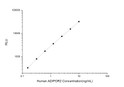
This human ADIPOR2 kit is a highly sensitive in-vitro chemiluminescent immunoassay for the measurement of trace amounts of analytes in serum, plasma and other biological fluids.
Applications
CLIA
Reactivity
Human
Sensitivity
0.09ng/mL
Detection Limit
0.16~10ng/mL
Note
FOR SCIENTIFIC EDUCATIONAL RESEARCH USE ONLY (RUO). MUST NOT BE USED IN DIAGNOSTIC OR OTHER MEDICAL APPLICATIONS.
Product Properties
Storage Instruction
If unopened the kit may be stored at 2-8°C for up to 1 month. If the kit will not be used within 1 month, store the components separately, according to the component table in the manual.
This kit recognizes Human ADIPOR2 in samples. No significant cross-reactivity or interference between Human ADIPOR2 and analogues was observed.
Sample Type
Serum, plasma and other biological fluids
Additional Info
Tissue Specificity
Ubiquitous. Highly expressed in skeletal muscle, liver and placenta. Weakly expressed in brain, heart, colon, spleen, kidney, thymus, small intestine, peripheral blood leukocytes and lung.
Function
Receptor for ADIPOQ, an essential hormone secreted by adipocytes that regulates glucose and lipid metabolism. Required for normal body fat and glucose homeostasis. ADIPOQ-binding activates a signaling cascade that leads to increased PPARA activity, and ultimately to increased fatty acid oxidation and glucose uptake. Has intermediate affinity for globular and full-length adiponectin. Required for normal revascularization after chronic ischemia caused by severing of blood vessels.
Protein Name
Adiponectin Receptor Protein 2Progestin And Adipoq Receptor Family Member 2Progestin And Adipoq Receptor Family Member Ii
Cell MembraneMulti-Pass Membrane ProteinLocalized To The Cell Membrane And Intracellular Organelles
Alternative CLIA Names
Adiponectin Receptor Protein 2 CLIA kitProgestin And Adipoq Receptor Family Member 2 CLIA kitProgestin And Adipoq Receptor Family Member Ii CLIA kitADIPOR2 CLIA kitPAQR2 CLIA kit
Specificity
This kit recognizes Human ADIPOR2 in samples. No significant cross-reactivity or interference between Human ADIPOR2 and analogues was observed.