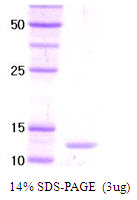
| Short Description : | Recombinant-drosophila melanogaster GAGA-POZ-No-Tag protein was developed from e.coli and has a target region of No-Tag. For use in research applications. |
| Applications: | SDS-PAGE |
| Host: | E.coli |
| Note: | STRICTLY FOR FURTHER SCIENTIFIC RESEARCH USE ONLY (RUO). MUST NOT TO BE USED IN DIAGNOSTIC OR THERAPEUTIC APPLICATIONS. |
| Concentration: | 1 mg/mL |
| Formulation: | Liquid in 10mM HEPES buffer (pH 7.4) containing 25mM NaCl |
| Storage Instruction: | For short term storage, keep at +2C to +8C for up to 1 week. For long term storage, aliquot and store at-20C, and avoid repeat freeze-thaw cycles. |
| Accession Number: | NP_996080 |
| Immunogen: | Drosophila melanogaster |
| Immunogen Region: | 1-130aa |
| Immunogen Sequence: | MSLPMNSLYS LTWGDYGTSL VSAIQLLRCH GDLVDCTLAA GGRSFPAHKI VLCAASPFLL DLLKNTPCKH PVVMLAGVNA NDLEALLEFV YRGEVSVDHA QLPSLLQAAQ CLNIQGLAPQ TVTKDDYTTH |
| Background | The GAGA factor is a sequence-specific DNA-binding protein, which participates in the regulation of the expression of a variety of different classes of genes in Drosophila such as many developmentally regulated genes, stress induced genes, and cell cycle regulated genes, as well as housekeeping genes. GAGA contains a C-terminal glutamine-rich domain and a highly conserved N-terminal POZ domain which reported to be involved in self-oligomerization in a number of other POZ domain containing proteins. In case of GAGA protein, the N-terminal POZ domain mediates the formation of oligomers both in vitro and in vivo. GAGA-POZ domain was overexpressed in E. coli and purified by using conventional chromatography techniques |
Information sourced from Uniprot.org