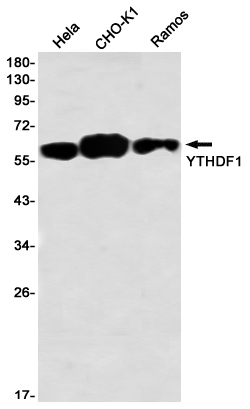
| Tissue Specificity | In brain, preferentially expressed in the hippocampus. |
| Post Translational Modifications | Ubiquitinated by the CUL7-FBXW8 E3 ligase complex leading to degradation. Deubiquitinated and stabilized by USP5 by removing 'Lys-11'-linked polyubiquitination. |
| Function | Specifically recognizes and binds N6-methyladenosine (m6A)-containing mRNAs, and regulates their stability. M6A is a modification present at internal sites of mRNAs and some non-coding RNAs and plays a role in mRNA stability and processing. Acts as a regulator of mRNA stability by promoting degradation of m6A-containing mRNAs via interaction with the CCR4-NOT complex. The YTHDF paralogs (YTHDF1, YTHDF2 and YTHDF3) share m6A-containing mRNAs targets and act redundantly to mediate mRNA degradation and cellular differentiation. Required to facilitate learning and memory formation in the hippocampus by binding to m6A-containing neuronal mRNAs. Acts as a regulator of axon guidance by binding to m6A-containing ROBO3 transcripts. Acts as a negative regulator of antigen cross-presentation in myeloid dendritic cells. In the context of tumorigenesis, negative regulation of antigen cross-presentation limits the anti-tumor response by reducing efficiency of tumor-antigen cross-presentation. Promotes formation of phase-separated membraneless compartments, such as P-bodies or stress granules, by undergoing liquid-liquid phase separation upon binding to mRNAs containing multiple m6A-modified residues: polymethylated mRNAs act as a multivalent scaffold for the binding of YTHDF proteins, juxtaposing their disordered regions and thereby leading to phase separation. The resulting mRNA-YTHDF complexes then partition into different endogenous phase-separated membraneless compartments, such as P-bodies, stress granules or neuronal RNA granules. |
| Protein Name | Yth Domain-Containing Family Protein 1Dermatomyositis Associated With Cancer Putative Autoantigen 1 HomologDaca-1 Homolog |
| Database Links | |
| Cellular Localisation | CytoplasmP-BodyStress Granule |
| Alternative Antibody Names | Anti-Yth Domain-Containing Family Protein 1 antibodyAnti-Dermatomyositis Associated With Cancer Putative Autoantigen 1 Homolog antibodyAnti-Daca-1 Homolog antibodyAnti-Ythdf1 antibody |
Information sourced from Uniprot.org