

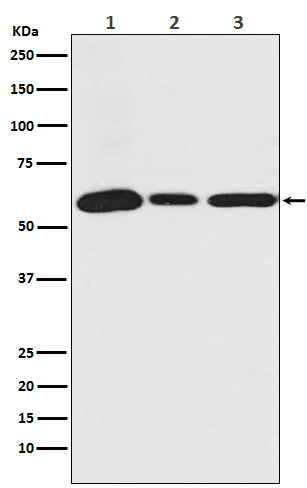

Anti-USP14 antibody [R09-8E9] (STJA0036438)
SPECIFICATIONS
ClonalityMonoclonal
HostRabbit
ConjugationUnconjugated
IsotypeIgG
ImmunogenA synthesized peptide derived from human USP14
General Information
| Short Description | Rabbit monoclonal anti-USP14 for use in WB, ICC, IF and FC in Human, Mouse and Rat samples. Datasheet included with dilution recommendations, and related reagents. |
| Applications | WB/ICC/IF/FC |
| Host | Rabbit |
| Reactivity | Human/Mouse/Rat |
| Note | STRICTLY FOR FURTHER SCIENTIFIC RESEARCH USE ONLY (RUO). MUST NOT TO BE USED IN DIAGNOSTIC OR THERAPEUTIC APPLICATIONS. |
Product Properties
| Clonality | Monoclonal |
| Clone ID | R09-8E9 |
| Isotype | IgG |
| Conjugation | Unconjugated |
| Purification | Affinity Chromatography |
| Dilution Range | WB 1:500-1:1000IF 1:50-1:200FC 1:50-1:100 |
| Formulation | Rabbit IgG in phosphate buffered saline, pH 7.4, 150mM NaCl, 0.02% sodium azide and 50% glycerol. |
| Storage Instruction | Store at 4°C short term. Aliquot and store at-20°C long term. Avoid freeze/thaw cycles. |
Target Information
| Gene Symbol | USP14 |
| Gene ID | 9097 |
| Uniprot ID | UBP14_HUMAN |
| Immunogen | A synthesized peptide derived from human USP14 |
Additional Info
| Function | Proteasome-associated deubiquitinase which releases ubiquitin from the proteasome targeted ubiquitinated proteins. Ensures the regeneration of ubiquitin at the proteasome. Is a reversibly associated subunit of the proteasome and a large fraction of proteasome-free protein exists within the cell. Required for the degradation of the chemokine receptor CXCR4 which is critical for CXCL12-induced cell chemotaxis. Also serves as a physiological inhibitor of endoplasmic reticulum-associated degradation (ERAD) under the non-stressed condition by inhibiting the degradation of unfolded endoplasmic reticulum proteins via interaction with ERN1. Indispensable for synaptic development and function at neuromuscular junctions (NMJs). Plays a role in the innate immune defense against viruses by stabilizing the viral DNA sensor CGAS and thus inhibiting its autophagic degradation. Inhibits OPTN-mediated selective autophagic degradation of KDM4D and thereby negatively regulates H3K9me2 and H3K9me3. |
| Protein Name | Ubiquitin Carboxyl-Terminal Hydrolase 14Deubiquitinating Enzyme 14Ubiquitin Thioesterase 14Ubiquitin-Specific-Processing Protease 14 |
| Database Links | Reactome: R-HSA-5689880Reactome: R-HSA-9758274 |
| Cellular Localisation | CytoplasmCell MembranePeripheral Membrane Protein |
| Alternative Antibody Names | Anti-Ubiquitin Carboxyl-Terminal Hydrolase 14 antibodyAnti-Deubiquitinating Enzyme 14 antibodyAnti-Ubiquitin Thioesterase 14 antibodyAnti-Ubiquitin-Specific-Processing Protease 14 antibodyAnti-USP14 antibodyAnti-TGT antibody |
Information sourced from Uniprot.org