


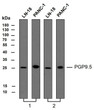


Anti-UCHL1 antibody (100-223 aa) [ABT-PGP9.5] (STJ196858)
SPECIFICATIONS
ClonalityMonoclonal
HostMouse
ConjugationUnconjugated
IsotypeIgG1k
ImmunogenSynthesized peptide derived from the human PGP 9.5 at the amino acid range 100-223
General Information
| Short Description | Mouse monoclonal anti-Ubiquitin carboxyl-terminal hydrolase isozyme L1 (100-223 aa) for use in IHC, IF and WB in Human, Mouse and Rat samples. Datasheet included with dilution recommendations, and related reagents. |
| Applications | IHC/IF/WB |
| Host | Mouse |
| Reactivity | Human/Mouse/Rat |
| Note | STRICTLY FOR FURTHER SCIENTIFIC RESEARCH USE ONLY (RUO). MUST NOT TO BE USED IN DIAGNOSTIC OR THERAPEUTIC APPLICATIONS. |
Product Properties
| Clonality | Monoclonal |
| Clone ID | ABT-PGP9.5 |
| Isotype | IgG1k |
| Conjugation | Unconjugated |
| Purification | The antibody was affinity-purified from mouse ascites by affinity-chromatography using specific immunogen. |
| Dilution Range | IHC-P 1:100-500WB 1:200-1000IF 1:100-500 |
| Formulation | Liquid in PBS containing 50% Glycerol, 0.5% BSA and 0.02% Sodium Azide. |
| Storage Instruction | Store at-20°C for up to 1 year from the date of receipt, and avoid repeat freeze-thaw cycles. |
Target Information
| Gene Symbol | UCHL1 |
| Gene ID | 7345 |
| Uniprot ID | UCHL1_HUMAN |
| Immunogen | Synthesized peptide derived from the human PGP 9.5 at the amino acid range 100-223 |
| Immunogen Region | 100-223 aa |
| Specificity | This antibody detects endogenous levels of human PGP 9.5. Heat-induced epitope retrieval (HIER) TRIS-EDTA of pH8.0 was highly recommended as antigen repair method in paraffin section |
Additional Info
| Post Translational Modifications | O-glycosylated. |
| Function | Deubiquitinase that plays a role in the regulation of several processes such as maintenance of synaptic function, cardiac function, inflammatory response or osteoclastogenesis. Abrogates the ubiquitination of multiple proteins including WWTR1/TAZ, EGFR, HIF1A and beta-site amyloid precursor protein cleaving enzyme 1/BACE1. In addition, recognizes and hydrolyzes a peptide bond at the C-terminal glycine of ubiquitin to maintain a stable pool of monoubiquitin that is a key requirement for the ubiquitin-proteasome and the autophagy-lysosome pathways. Regulates amyloid precursor protein/APP processing by promoting BACE1 degradation resulting in decreased amyloid beta production. Plays a role in the immune response by regulating the ability of MHC I molecules to reach cross-presentation compartments competent for generating Ag-MHC I complexes. Mediates the 'Lys-48'-linked deubiquitination of the transcriptional coactivator WWTR1/TAZ leading to its stabilization and inhibition of osteoclastogenesis. Deubiquitinates and stabilizes epidermal growth factor receptor EGFR to prevent its degradation and to activate its downstream mediators. Modulates oxidative activity in skeletal muscle by regulating key mitochondrial oxidative proteins. Enhances the activity of hypoxia-inducible factor 1-alpha/HIF1A by abrogateing its VHL E3 ligase-mediated ubiquitination and consequently inhibiting its degradation. |
| Protein Name | Ubiquitin Carboxyl-Terminal Hydrolase Isozyme L1Uch-L1Neuron Cytoplasmic Protein 9.5Pgp 9.5Pgp9.5Ubiquitin Thioesterase L1 |
| Database Links | Reactome: R-HSA-5689603 |
| Cellular Localisation | CytoplasmEndoplasmic Reticulum MembraneLipid-AnchorAbout 30% Of Total Uchl1 Is Associated With Membranes In BrainLocalizes Near And/Or Within Mitochondria To Potentially Interact With Mitochondrial Proteins |
| Alternative Antibody Names | Anti-Ubiquitin Carboxyl-Terminal Hydrolase Isozyme L1 antibodyAnti-Uch-L1 antibodyAnti-Neuron Cytoplasmic Protein 9.5 antibodyAnti-Pgp 9.5 antibodyAnti-Pgp9.5 antibodyAnti-Ubiquitin Thioesterase L1 antibodyAnti-UCHL1 antibody |
Information sourced from Uniprot.org