

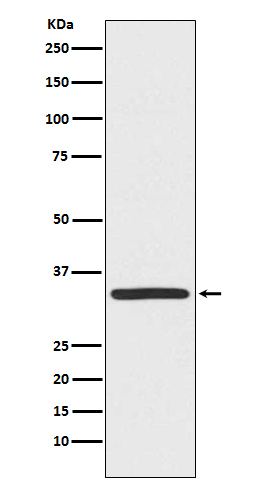

Anti-TRADD antibody (210-312 aa) [R03-7G5] (STJA0014295)
SPECIFICATIONS
ClonalityMonoclonal
HostRabbit
ConjugationUnconjugated
IsotypeIgG
ImmunogenA synthesized peptide derived from human TRADD
General Information
| Short Description | Rabbit monoclonal anti-TRADD (210-312 aa) for use in WB, IHC-P, ICC, IF and IP in Human, Mouse and Rat samples. Datasheet included with dilution recommendations, and related reagents. |
| Applications | WB/IHC-P/ICC/IF/IP |
| Host | Rabbit |
| Reactivity | Human/Mouse/Rat |
| Note | STRICTLY FOR FURTHER SCIENTIFIC RESEARCH USE ONLY (RUO). MUST NOT TO BE USED IN DIAGNOSTIC OR THERAPEUTIC APPLICATIONS. |
Product Properties
| Clonality | Monoclonal |
| Clone ID | R03-7G5 |
| Isotype | IgG |
| Conjugation | Unconjugated |
| Purification | Affinity Chromatography |
| Dilution Range | WB 1:500-1:1000IHC 1:50-1:100IF 1:50-1:200IP 1:10 |
| Formulation | Liquid in PBS pH7.4, 150mM NaCl, 0.02% Sodium Azide and 50% Glycerol. |
| Storage Instruction | Store at 4°C short term. Aliquot and store at-20°C long term. Avoid freeze/thaw cycles. |
Target Information
| Gene Symbol | TRADD |
| Gene ID | 8717 |
| Uniprot ID | TRADD_HUMAN |
| Immunogen | A synthesized peptide derived from human TRADD |
| Immunogen Region | 210-312 aa |
Additional Info
| Tissue Specificity | Found in all examined tissues. |
| Post Translational Modifications | (Microbial infection) Glycosylated at Arg-235 by enteropathogenic E.coli protein NleB1, C.rodentium protein NleB and S.typhimurium proteins Ssek1 and Ssek3: arginine GlcNAcylation prevents homotypic/heterotypic death domain interactions and assembly of the oligomeric TNFRSF1A/TNFR1 complex, thereby disrupting TNF signaling. |
| Function | Adapter molecule for TNFRSF1A/TNFR1 that specifically associates with the cytoplasmic domain of activated TNFRSF1A/TNFR1 mediating its interaction with FADD. Overexpression of TRADD leads to two major TNF-induced responses, apoptosis and activation of NF-kappa-B. The nuclear form acts as a tumor suppressor by preventing ubiquitination and degradation of isoform p19ARF/ARF of CDKN2A by TRIP12: acts by interacting with TRIP12, leading to disrupt interaction between TRIP12 and isoform p19ARF/ARF of CDKN2A. |
| Protein Name | Tumor Necrosis Factor Receptor Type 1-Associated Death Domain ProteinTnfr1-Associated Death Domain ProteinTnfrsf1a-Associated Via Death Domain |
| Database Links | Reactome: R-HSA-140534Reactome: R-HSA-3371378Reactome: R-HSA-5213460Reactome: R-HSA-5218900Reactome: R-HSA-5357786Reactome: R-HSA-5357905Reactome: R-HSA-5357956Reactome: R-HSA-5675482Reactome: R-HSA-69416Reactome: R-HSA-75893Reactome: R-HSA-9693928 |
| Cellular Localisation | NucleusCytoplasmCytoskeletonShuttles Between The Cytoplasm And The Nucleus |
| Alternative Antibody Names | Anti-Tumor Necrosis Factor Receptor Type 1-Associated Death Domain Protein antibodyAnti-Tnfr1-Associated Death Domain Protein antibodyAnti-Tnfrsf1a-Associated Via Death Domain antibodyAnti-TRADD antibody |
Information sourced from Uniprot.org