
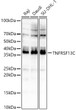


| Host: | Rabbit |
| Applications: | WB/ELISA |
| Reactivity: | Human/Mouse |
| Note: | STRICTLY FOR FURTHER SCIENTIFIC RESEARCH USE ONLY (RUO). MUST NOT TO BE USED IN DIAGNOSTIC OR THERAPEUTIC APPLICATIONS. |
| Clonality : | Polyclonal |
| Conjugation: | Unconjugated |
| Isotype: | IgG |
| Formulation: | PBS with 0.05% Proclin300, 50% Glycerol, pH 7.3. |
| Purification: | Affinity purification |
| Concentration: | Lot specific |
| Dilution Range: | WB:1:500-1:2000ELISA:Recommended starting concentration is 1 Mu g/mL. Please optimize the concentration based on your specific assay requirements. |
| Storage Instruction: | Store at-20°C for up to 1 year from the date of receipt, and avoid repeat freeze-thaw cycles. |
| Gene Symbol: | TNFRSF13C |
| Gene ID: | 115650 |
| Uniprot ID: | TR13C_HUMAN |
| Immunogen Region: | 1-80 |
| Specificity: | Recombinant fusion protein containing a sequence corresponding to amino acids 1-80 of human TNFRSF13C (NP_443177.1). |
| Immunogen Sequence: | MRRGPRSLRGRDAPAPTPCV PAECFDLLVRHCVACGLLRT PRPKPAGASSPAPRTALQPQ ESVGAGAGEAALPLPGLLFG |
| Tissue Specificity | Highly expressed in spleen and lymph node, and in resting B-cells. Detected at lower levels in activated B-cells, resting CD4+ T-cells, in thymus and peripheral blood leukocytes. |
| Function | B-cell receptor specific for TNFSF13B/TALL1/BAFF/BLyS. Promotes the survival of mature B-cells and the B-cell response. |
| Protein Name | Tumor Necrosis Factor Receptor Superfamily Member 13cB-Cell-Activating Factor ReceptorBaff ReceptorBaff-RBlys Receptor 3Cd Antigen Cd268 |
| Database Links | Reactome: R-HSA-5668541Reactome: R-HSA-5676594 |
| Cellular Localisation | MembraneSingle-Pass Type Iii Membrane Protein |
| Alternative Antibody Names | Anti-Tumor Necrosis Factor Receptor Superfamily Member 13c antibodyAnti-B-Cell-Activating Factor Receptor antibodyAnti-Baff Receptor antibodyAnti-Baff-R antibodyAnti-Blys Receptor 3 antibodyAnti-Cd Antigen Cd268 antibodyAnti-TNFRSF13C antibodyAnti-BAFFR antibodyAnti-BR3 antibody |
Information sourced from Uniprot.org


