


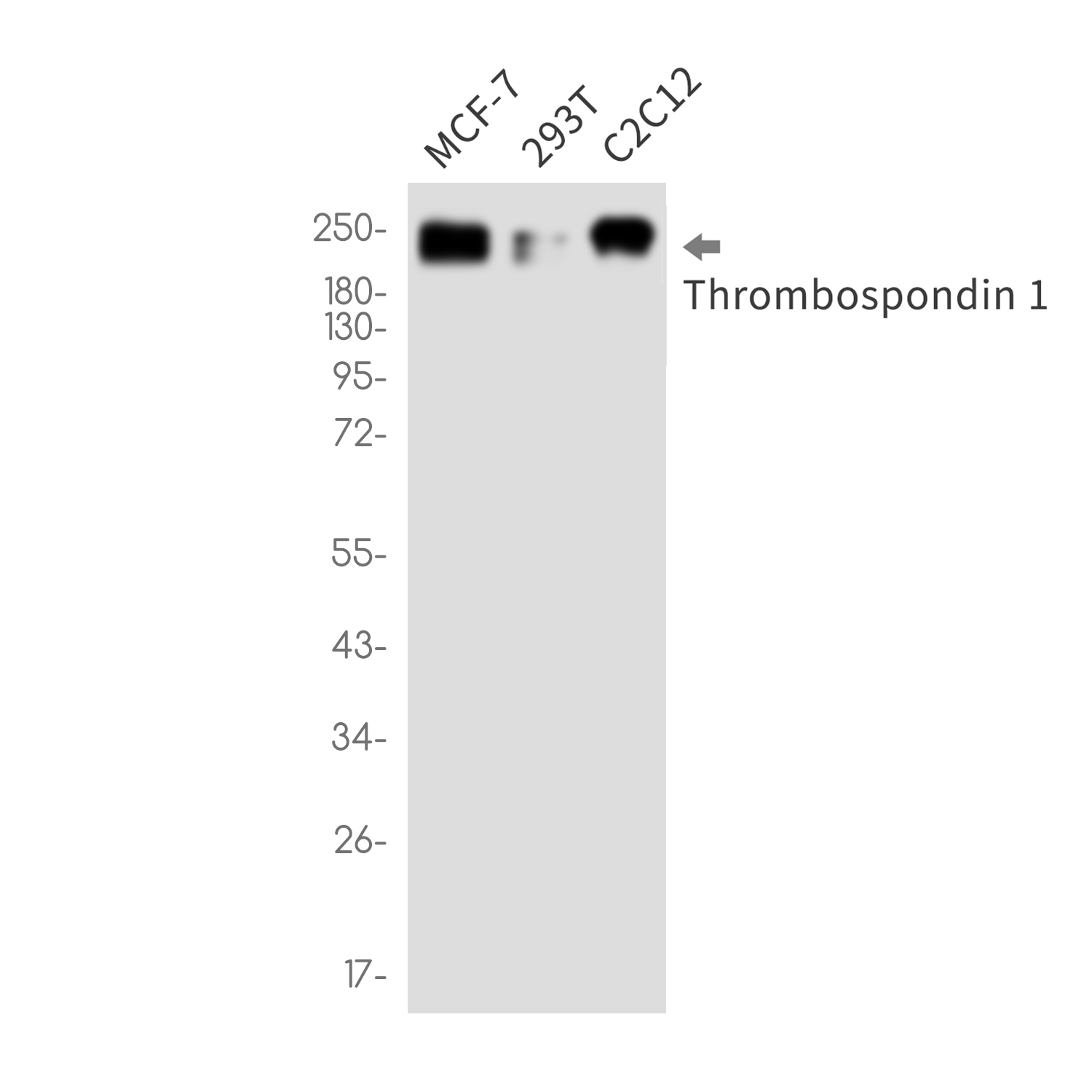
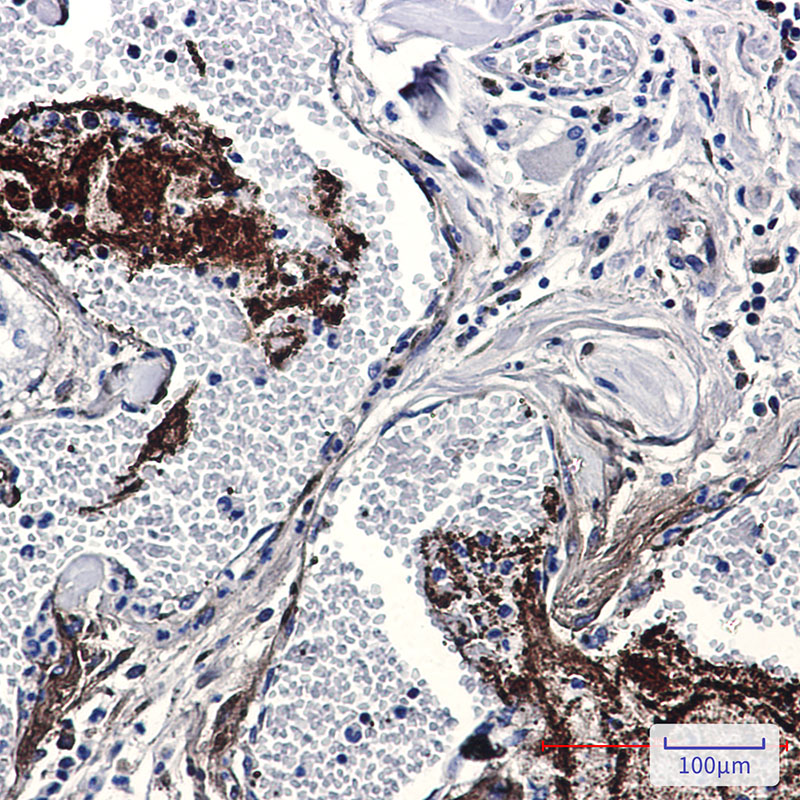

Anti-THBS1 antibody (547-1170 aa) [R06-5F3] (STJA0012618)
SPECIFICATIONS
ClonalityMonoclonal
HostRabbit
ConjugationUnconjugated
IsotypeIgG
ImmunogenRecombinant protein of human Thrombospondin 1
General Information
| Short Description | Rabbit monoclonal anti-Thrombospondin 1 (547-1170 aa) for use in WB, IHC-P and IP in Human and Mouse samples. Datasheet included with dilution recommendations, and related reagents. |
| Applications | WB/IHC-P/IP |
| Host | Rabbit |
| Reactivity | Human/Mouse |
| Note | STRICTLY FOR FURTHER SCIENTIFIC RESEARCH USE ONLY (RUO). MUST NOT TO BE USED IN DIAGNOSTIC OR THERAPEUTIC APPLICATIONS. |
Product Properties
| Clonality | Monoclonal |
| Clone ID | R06-5F3 |
| Isotype | IgG |
| Conjugation | Unconjugated |
| Concentration | 0.3 mg/mL |
| Purification | Affinity Purified |
| Dilution Range | WB 1:500-1:1000IHC 1:50-1:100IP 1:20 |
| Formulation | 50mM Tris-Glycine (pH7.4) , 0.15M NaCl, 40% Glycerol, 0.01% Sodium azide and 0.05% BSA |
| Storage Instruction | Store at 4°C short term. Aliquot and store at-20°C long term. Avoid freeze/thaw cycles. |
Target Information
| Gene Symbol | THBS1 |
| Gene ID | 7057 |
| Uniprot ID | TSP1_HUMAN |
| Immunogen | Recombinant protein of human Thrombospondin 1 |
| Immunogen Region | 547-1170 aa |
Additional Info
| Tissue Specificity | Expressed by platelets (at protein level). Expressed by monocyte-derived immature and mature dendritic cells (at protein level). |
| Function | Adhesive glycoprotein that mediates cell-to-cell and cell-to-matrix interactions. Multifunctional, involved in inflammation, angiogenesis, wound healing, reactive oxygen species (ROS) signaling, nitrous oxide (NO) signaling, apoptosis, senescence, aging, cellular self-renewal, stemness, and cardiovascular and metabolic homeostasis. Negatively modulates dendritic cell activation and cytokine release, as part of an autocrine feedback loop, contributing to the resolution of inflammation and immune homeostasis. Ligand for receptor CD47. Modulates nitrous oxide (NO) signaling via CD47, hence playing a role as a pressor agent, supporting blood pressure. Plays a role in endothelial cell senescence, acting via CD47, by increasing the abundance and activation of NADPH oxidase NOX1, and so generating excess ROS. Inhibits stem cell self-renewal, acting via CD47 signaling, probably by regulation of the stem cell transcription factors POU5F1/OCT4, SOX2, MYC/c-Myc and KLF4. Negatively modulates wound healing, acting via CD47. Ligand for receptor CD36. Involved in inducing apoptosis in podocytes in response to elevated free fatty acids, acting via CD36. Plays a role in suppressing angiogenesis, acting, depending on context, via CD36 or CD47. Promotes cellular senescence in a TP53-CDKN1A-RB1 signaling-dependent manner. Ligand for immunoglobulin-like cell surface receptor SIRPA. Involved in ROS signaling in non-phagocytic cells, stimulating NADPH oxidase-derived ROS production, acting via interaction with SIRPA. Plays a role in metabolic dysfunction in diet-induced obesity, perhaps acting by exacerbating adipose inflammatory activity.its effects may be mediated, at least in part, through enhanced adipocyte proliferation. Plays a role in ER stress response, via its interaction with the activating transcription factor 6 alpha (ATF6) which produces adaptive ER stress response factors. May be involved in age-related conditions, including metabolic dysregulation, during normal aging. |
| Protein Name | Thrombospondin-1Glycoprotein G |
| Database Links | Reactome: R-HSA-114608Reactome: R-HSA-186797Reactome: R-HSA-216083Reactome: R-HSA-3000170Reactome: R-HSA-5083635Reactome: R-HSA-5173214Reactome: R-HSA-8936459 |
| Cellular Localisation | SecretedCell SurfaceExtracellular SpaceExtracellular MatrixEndoplasmic ReticulumSarcoplasmic ReticulumSecreted By Thrombin-Activated Platelets And Binds To The Cell Surface In The Presence Of Extracellular Ca(2+)Incorporated Into The Extracellular Matrix (Ecm) Of FibroblastsThe C-Terminal Region In Trimeric Form Is Required For Retention In The EcmAlso Detected In The Endoplasmic Reticulum And Sarcoplasmic Reticulum Where It Plays A Role In The Er Stress Response |
| Alternative Antibody Names | Anti-Thrombospondin-1 antibodyAnti-Glycoprotein G antibodyAnti-THBS1 antibodyAnti-TSP antibodyAnti-TSP1 antibody |
Information sourced from Uniprot.org