


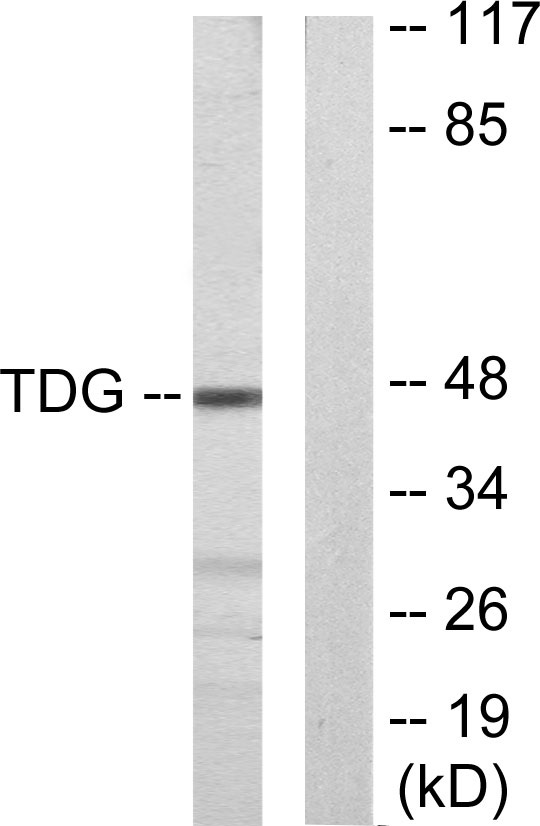
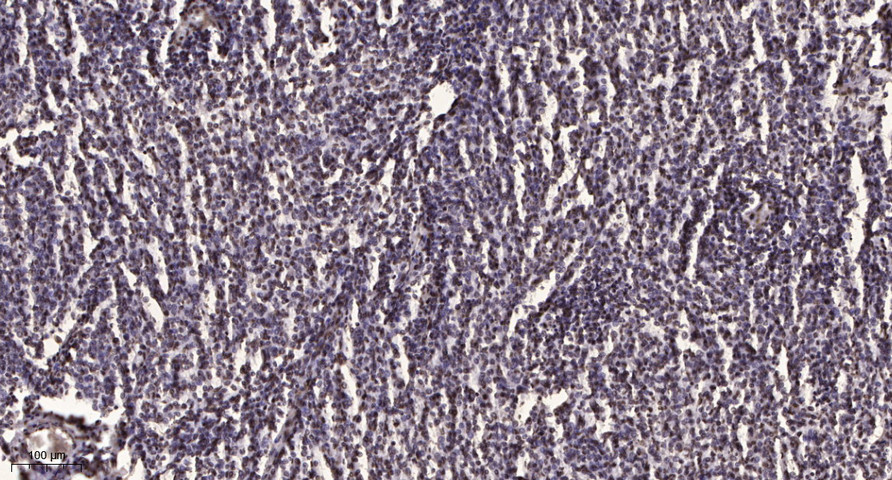

Anti-TDG antibody (31-80 aa) (STJ95958)
SPECIFICATIONS
ClonalityPolyclonal
HostRabbit
ConjugationUnconjugated
IsotypeIgG
ImmunogenThe antiserum was produced against synthesized peptide derived from the human TDG at the amino acid range 31-80
General Information
| Short Description | Rabbit polyclonal anti-G/T mismatch-specific thymine DNA glycosylase (31-80 aa) for use in WB, IHC, IF and ELISA in Human, Mouse and Rat samples. Datasheet included with dilution recommendations, and related reagents. |
| Applications | WB/IHC/IF/ELISA |
| Host | Rabbit |
| Reactivity | Human/Mouse/Rat |
| Note | STRICTLY FOR FURTHER SCIENTIFIC RESEARCH USE ONLY (RUO). MUST NOT TO BE USED IN DIAGNOSTIC OR THERAPEUTIC APPLICATIONS. |
Product Properties
| Clonality | Polyclonal |
| Isotype | IgG |
| Conjugation | Unconjugated |
| Concentration | 1 mg/mL |
| Purification | The antibody was affinity-purified from rabbit antiserum by affinity-chromatography using epitope-specific immunogen. |
| Dilution Range | WB 1:500-1:2000IHC 1:100-1:300IF 1:200-1:1000ELISA 1:5000 |
| Formulation | Liquid in PBS containing 50% Glycerol, 0.5% BSA and 0.02% Sodium Azide. |
| Storage Instruction | Store at-20°C for up to 1 year from the date of receipt, and avoid repeat freeze-thaw cycles. |
Target Information
| Gene Symbol | TDG |
| Gene ID | 6996 |
| Uniprot ID | TDG_HUMAN |
| Immunogen | The antiserum was produced against synthesized peptide derived from the human TDG at the amino acid range 31-80 |
| Immunogen Region | 31-80 aa |
| Specificity | TDG Polyclonal Antibody detects endogenous levels of TDG protein. |
Additional Info
| Function | DNA glycosylase that plays a key role in active DNA demethylation: specifically recognizes and binds 5-formylcytosine (5fC) and 5-carboxylcytosine (5caC) in the context of CpG sites and mediates their excision through base-excision repair (BER) to install an unmethylated cytosine. Cannot remove 5-hydroxymethylcytosine (5hmC). According to an alternative model, involved in DNA demethylation by mediating DNA glycolase activity toward 5-hydroxymethyluracil (5hmU) produced by deamination of 5hmC. Also involved in DNA repair by acting as a thymine-DNA glycosylase that mediates correction of G/T mispairs to G/C pairs: in the DNA of higher eukaryotes, hydrolytic deamination of 5-methylcytosine to thymine leads to the formation of G/T mismatches. Its role in the repair of canonical base damage is however minor compared to its role in DNA demethylation. It is capable of hydrolyzing the carbon-nitrogen bond between the sugar-phosphate backbone of the DNA and a mispaired thymine. In addition to the G/T, it can remove thymine also from C/T and T/T mispairs in the order G/T >> C/T > T/T. It has no detectable activity on apyrimidinic sites and does not catalyze the removal of thymine from A/T pairs or from single-stranded DNA. It can also remove uracil and 5-bromouracil from mispairs with guanine. |
| Protein Name | G/T Mismatch-Specific Thymine Dna GlycosylaseThymine-Dna GlycosylaseHtdg |
| Database Links | Reactome: R-HSA-110328Reactome: R-HSA-110329Reactome: R-HSA-110357Reactome: R-HSA-3108214Reactome: R-HSA-5221030 |
| Cellular Localisation | Nucleus |
| Alternative Antibody Names | Anti-G/T Mismatch-Specific Thymine Dna Glycosylase antibodyAnti-Thymine-Dna Glycosylase antibodyAnti-Htdg antibodyAnti-TDG antibody |
Information sourced from Uniprot.org