
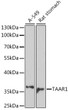


Anti-TAAR1 antibody (100-200) (STJ118606)
SPECIFICATIONS
ClonalityPolyclonal
HostRabbit
ConjugationUnconjugated
IsotypeIgG
General Information
| Short Description | Rabbit polyclonal TAAR1 (100-200) antibody for use in WB and ELISA in human, mouse and rat samples. Datasheet included with dilution recommendations, and related reagents. |
| Applications | WB/ELISA |
| Host | Rabbit |
| Reactivity | Human/Mouse/Rat |
| Note | STRICTLY FOR FURTHER SCIENTIFIC RESEARCH USE ONLY (RUO). MUST NOT TO BE USED IN DIAGNOSTIC OR THERAPEUTIC APPLICATIONS. |
Product Properties
| Clonality | Polyclonal |
| Isotype | IgG |
| Conjugation | Unconjugated |
| Concentration | Lot specific |
| Purification | Affinity purification |
| Dilution Range | WB:1:500-1:2000ELISA:Recommended starting concentration is 1 Mu g/mL. Please optimize the concentration based on your specific assay requirements. |
| Formulation | PBS with 0.01% Thimerosal, 50% Glycerol, pH 7.3. |
| Storage Instruction | Store at-20°C for up to 1 year from the date of receipt, and avoid repeat freeze-thaw cycles. |
Target Information
| Gene Symbol | TAAR1 |
| Gene ID | 134864 |
| Uniprot ID | TAAR1_HUMAN |
| Immunogen Region | 100-200 |
| Immunogen Sequence | TSTDIMLSSASIFHLSFISI DRYYAVCDPLRYKAKMNILV ICVMIFISWSVPAVFAFGMI FLELNFKGAEEIYYKHVHCR GGCSVFFSKISGVLTFMTSF Y |
| Specificity | A synthetic peptide corresponding to a sequence within amino acids 100-200 of human TAAR1 (NP_612200.1). |
Additional Info
| Tissue Specificity | Expressed at low level in both the central and peripheral nervous system. Moderately expressed in stomach. Low levels in amygdala, kidney, and lung, and small intestine. Trace amounts in cerebellum, dorsal root ganglia, hippocampus, hypothalamus, liver, medulla, pancreas, pituitary, pontine reticular formation, prostate, skeletal muscle and spleen. |
| Function | Intracellular G-protein coupled receptor for trace amines, which recognizes endogenous amine-containing metabolites such as beta-phenylethylamine (beta-PEA), 3-iodothyronamine (T1AM), isoamylamine (IAA), cadaverine (CAD), cyclohexylamine (CHA), p-tyramine (p-TYR), trimethylamine (TMA), octopamine and tryptamine. Also functions as a receptor for various drugs and psychoactive substances, such as amphetamine and methamphetamine. Unresponsive to classical biogenic amines, such as epinephrine and histamine and only partially activated by dopamine and serotonin. Expressed in both the central and peripheral nervous system: TAAR1 activation regulates the activity of several neurotransmitter signaling pathways by (1) decreasing the basal firing rates of the neurons involved and by (2) lowering the sensitivity of receptors to neurotransmitters. Ligand binding causes a conformation change that triggers signaling via guanine nucleotide-binding proteins (G proteins) and modulates the activity of downstream effectors. TAAR1 is coupled with different G(i)/G(o)-, G(s)- or G(q)/G(11) classes of G alpha proteins depending on the ligand. CAD-binding is coupled to G(i)/G(o) G alpha proteins and mediates inhibition of adenylate cyclase activity. T1AM- or beta-PEA-binding is coupled to G(s) G alpha proteins and mediates activation of adenylate cyclase activity. CHA- or IAA-binding is coupled to G(q)/G(11) G alpha proteins and activates phospholipase C-beta, releasing diacylglycerol (DAG) and inositol 1,4,5-trisphosphate (IP3) second messengers. TMA-binding is coupled with all three G(i)/G(o)-, G(s)- or G(q)/G(11) G alpha protein subtypes. Amphetamine-binding is coupled with G(s)- or G(12)/G(13) G alpha protein subtypes. |
| Protein Name | Trace Amine-Associated Receptor 1Tar-1Trace Amine Receptor 1 |
| Database Links | Reactome: R-HSA-375280Reactome: R-HSA-418555 |
| Cellular Localisation | Endomembrane SystemEndoplasmic Reticulum MembraneMulti-Pass Membrane ProteinCell MembraneLocalizes Mainly IntracellularlyPartially Colocalizes With The Endoplasmic ReticulumAlso Found At Lower Lever At The Plasma Membrane |
| Alternative Antibody Names | Anti-Trace Amine-Associated Receptor 1 antibodyAnti-Tar-1 antibodyAnti-Trace Amine Receptor 1 antibodyAnti-TAAR1 antibodyAnti-TA1 antibodyAnti-TAR1 antibodyAnti-TRAR1 antibody |
Information sourced from Uniprot.org