


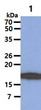


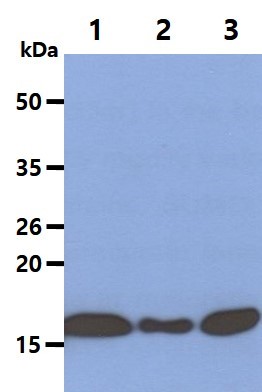
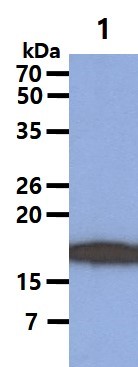
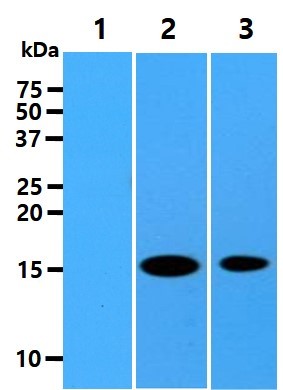


Anti-SUMO 2/3 antibody (1-93aa) [AT10F1] (STJA0041591)
SPECIFICATIONS
ClonalityMonoclonal
HostMouse
ConjugationUnconjugated
IsotypeIgG2bk
ImmunogenRecombinant human SUMO2 (1-93aa) purified from E.coli
General Information
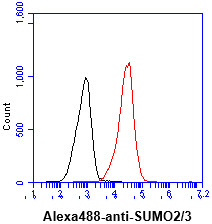
| Short Description | Mouse monoclonal anti-SUMO 2/3 (1-93aa) for use in ELISA, WB, ICC, IF, IHC and FACS in Human samples. Datasheet included with dilution recommendations, and related reagents. |
| Applications | ELISA/WB/ICC/IF/IHC/FACS |
| Host | Mouse |
| Reactivity | Human |
| Note | STRICTLY FOR FURTHER SCIENTIFIC RESEARCH USE ONLY (RUO). MUST NOT TO BE USED IN DIAGNOSTIC OR THERAPEUTIC APPLICATIONS. |
Product Properties
| Clonality | Monoclonal |
| Clone ID | AT10F1 |
| Isotype | IgG2bk |
| Conjugation | Unconjugated |
| Concentration | 1 mg/mL |
| Purification | By protein-G affinity chromatography |
| Formulation | Liquid in phosphate-Buffered Saline (pH 7.4) with 0.02% Sodium Azide, 10% Glycerol |
| Storage Instruction | For short term storage, keep at +2C to +8C for up to 1 week. For long term storage, aliquot and store at-20C, and avoid repeat freeze-thaw cycles. |
Target Information
| Gene Symbol | SUMO2 |
| Gene ID | 6613 |
| Uniprot ID | SUMO2_HUMAN |
| Accession Number | NP_008868 |
| Immunogen | Recombinant human SUMO2 (1-93aa) purified from E.coli |
| Immunogen Region | 1-93aa |
Additional Info
| Tissue Specificity | Broadly expressed. |
| Post Translational Modifications | Polymeric chains can be formed through Lys-11 cross-linking. Polymeric SUMO2 chains undergo 'Lys-6'-, 'Lys-11'-, 'Lys-48'- and 'Lys-63'-linked polyubiquitination by RNF4. Cleavage of precursor form by SENP1 or SENP2 is necessary for function. Monoubiquitinated N-terminally by UBE2W, which primes it for RNF4-dependent polyubiquitination by the UBE2V1-UBE2N heterodimer. |
| Function | Ubiquitin-like protein that can be covalently attached to proteins as a monomer or as a lysine-linked polymer. Covalent attachment via an isopeptide bond to its substrates requires prior activation by the E1 complex SAE1-SAE2 and linkage to the E2 enzyme UBE2I, and can be promoted by an E3 ligase such as PIAS1-4, RANBP2, CBX4 or ZNF451. This post-translational modification on lysine residues of proteins plays a crucial role in a number of cellular processes such as nuclear transport, DNA replication and repair, mitosis and signal transduction. Polymeric SUMO2 chains are also susceptible to polyubiquitination which functions as a signal for proteasomal degradation of modified proteins. Plays a role in the regulation of sumoylation status of SETX. |
| Protein Name | Small Ubiquitin-Related Modifier 2Sumo-2Hsmt3Smt3 Homolog 2Sumo-3Sentrin-2Ubiquitin-Like Protein Smt3bSmt3b |
| Database Links | Reactome: R-HSA-196791Reactome: R-HSA-3065676Reactome: R-HSA-3065678Reactome: R-HSA-3065679Reactome: R-HSA-3108214Reactome: R-HSA-3232118Reactome: R-HSA-3899300Reactome: R-HSA-4085377Reactome: R-HSA-4090294Reactome: R-HSA-4551638Reactome: R-HSA-4570464Reactome: R-HSA-4615885Reactome: R-HSA-5693607Reactome: R-HSA-5696395Reactome: R-HSA-9843940 |
| Cellular Localisation | NucleusPml Body |
| Alternative Antibody Names | Anti-Small Ubiquitin-Related Modifier 2 antibodyAnti-Sumo-2 antibodyAnti-Hsmt3 antibodyAnti-Smt3 Homolog 2 antibodyAnti-Sumo-3 antibodyAnti-Sentrin-2 antibodyAnti-Ubiquitin-Like Protein Smt3b antibodyAnti-Smt3b antibodyAnti-SUMO2 antibodyAnti-SMT3B antibodyAnti-SMT3H2 antibody |
Information sourced from Uniprot.org