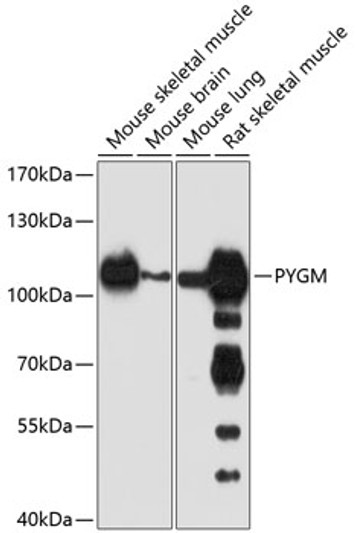
| Applications: | WB/IF/ICC/ELISA |
| Host: | Rabbit |
| Reactivity: | Human/Mouse/Rat |
| Note: | STRICTLY FOR FURTHER SCIENTIFIC RESEARCH USE ONLY (RUO). MUST NOT TO BE USED IN DIAGNOSTIC OR THERAPEUTIC APPLICATIONS. |
| Clonality : | Polyclonal |
| Isotype: | IgG |
| Conjugation: | Unconjugated |
| Concentration: | Lot specific |
| Purification: | Affinity purification |
| Dilution Range: | WB:1:1000-1:2000IF/ICC:1:50-1:200ELISA:Recommended starting concentration is 1 Mu g/mL. Please optimize the concentration based on your specific assay requirements. |
| Formulation: | PBS with 0.02% Sodium Azide, 50% Glycerol, pH 7.3. |
| Storage Instruction: | Store at-20°C for up to 1 year from the date of receipt, and avoid repeat freeze-thaw cycles. |
| Gene Symbol: | STRIP1 |
| Gene ID: | 85369 |
| Uniprot ID: | STRP1_HUMAN |
| Immunogen Region: | 743-837 |
| Immunogen Sequence: | VRHRLNDDWAYGNDLDARPW DFQAEECALRANIERFNARR YDRAHSNPDFLPVDNCLQSV LGQRVDLPEDFQMNYDLWLE REVFSKPISWEELLQ |
| Specificity: | Recombinant fusion protein containing a sequence corresponding to amino acids 743-837 of human STRIP1 (NP_149079.2). |
| Function | Plays a role in the regulation of cell morphology and cytoskeletal organization. Required in the cortical actin filament dynamics and cell shape. Part of the striatin-interacting phosphatase and kinase (STRIPAK) complexes. STRIPAK complexes have critical roles in protein (de)phosphorylation and are regulators of multiple signaling pathways including Hippo, MAPK, nuclear receptor and cytoskeleton remodeling. Different types of STRIPAK complexes are involved in a variety of biological processes such as cell growth, differentiation, apoptosis, metabolism and immune regulation. |
| Protein Name | Striatin-Interacting Protein 1Protein Fam40a |
| Database Links | |
| Cellular Localisation | CytoplasmEnriched On The Plasma Membrane |
| Alternative Antibody Names | Anti-Striatin-Interacting Protein 1 antibodyAnti-Protein Fam40a antibodyAnti-STRIP1 antibodyAnti-FAM40A antibodyAnti-KIAA1761 antibody |
Information sourced from Uniprot.org