


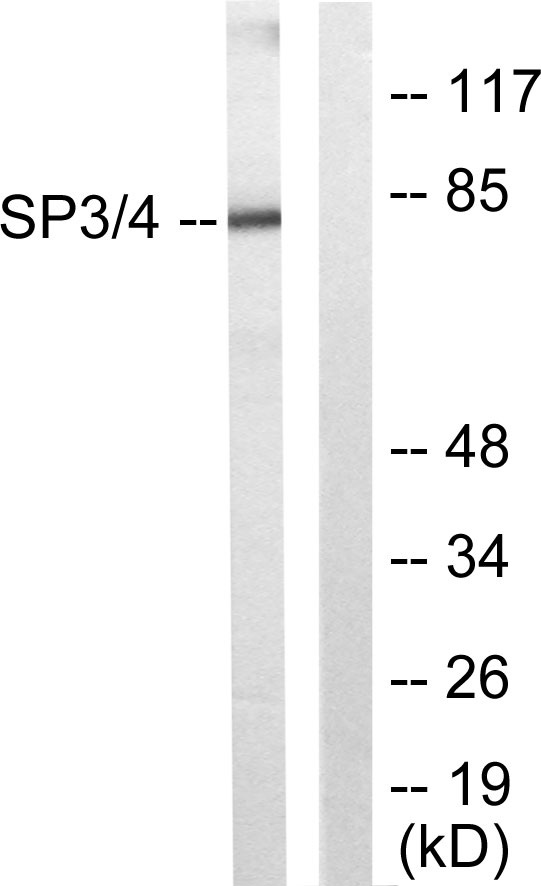
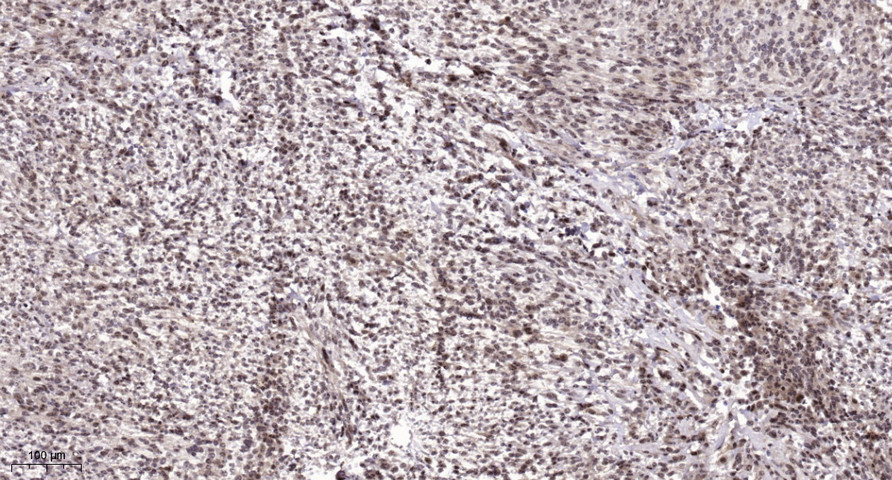

Anti-Sp3/4 antibody (671-720 aa) (STJ95741)
SPECIFICATIONS
ClonalityPolyclonal
HostRabbit
ConjugationUnconjugated
IsotypeIgG
ImmunogenThe antiserum was produced against synthesized peptide derived from the human SP3/4 at the amino acid range 671-720
General Information
| Short Description | Rabbit polyclonal anti-Transcription factor Sp3 and Transcription factor Sp4 (671-720 aa) for use in WB, IHC, IF and ELISA in Human, Mouse and Rat samples. Datasheet included with dilution recommendations, and related reagents. |
| Applications | WB/IHC/IF/ELISA |
| Host | Rabbit |
| Reactivity | Human/Mouse/Rat |
| Note | STRICTLY FOR FURTHER SCIENTIFIC RESEARCH USE ONLY (RUO). MUST NOT TO BE USED IN DIAGNOSTIC OR THERAPEUTIC APPLICATIONS. |
Product Properties
| Clonality | Polyclonal |
| Isotype | IgG |
| Conjugation | Unconjugated |
| Concentration | 1 mg/mL |
| Purification | The antibody was affinity-purified from rabbit antiserum by affinity-chromatography using epitope-specific immunogen. |
| Dilution Range | WB 1:500-1:2000IHC 1:100-1:300IF 1:200-1:1000ELISA 1:10000 |
| Formulation | Liquid in PBS containing 50% Glycerol, 0.5% BSA and 0.02% Sodium Azide. |
| Storage Instruction | Store at-20°C for up to 1 year from the date of receipt, and avoid repeat freeze-thaw cycles. |
Target Information
| Gene Symbol | SP4SP3 |
| Gene ID | 66716670 |
| Uniprot ID | SP4_HUMANSP3_HUMAN |
| Immunogen | The antiserum was produced against synthesized peptide derived from the human SP3/4 at the amino acid range 671-720 |
| Immunogen Region | 671-720 aa |
| Specificity | Sp3/4 Polyclonal Antibody detects endogenous levels of Sp3/4 protein. |
Additional Info
| Post Translational Modifications | Not glycosylated. Acetylated by histone acetyltransferase p300, deacetylated by HDACs. Acetylation/deacetylation states regulate transcriptional activity. Acetylation appears to activate transcription. Alternate sumoylation and acetylation at Lys-551 also control transcriptional activity. Ceramides can also regulate acetylation/deacetylation events through altering the interaction of HDAC with SP3. In vitro, C(18)-ceramides, but not C(16)-ceramides, increase the interaction of HDAC1 with SP3 and enhance the deacetylation of SP3 and the subsequent repression of the TERT promoter. Sumoylated on all isoforms. Sumoylated on 2 sites in longer isoforms with Lys-551 being the major site. Sumoylation at this site promotes nuclear localization to the nuclear periphery, nuclear dots and PML nuclear bodies. Sumoylation on Lys-551 represses the transactivation activity, except for the largest isoform, L-Sp3, which has little effect on transactivation. Alternate sumoylation and acetylation at Lys-551 also control transcriptional activity. |
| Function | Transcriptional factor that can act as an activator or repressor depending on isoform and/or post-translational modifications. Binds to GT and GC boxes promoter elements. Competes with SP1 for the GC-box promoters. Weak activator of transcription but can activate a number of genes involved in different processes such as cell-cycle regulation, hormone-induction and house-keeping. |
| Protein Name | Transcription Factor Sp3Spr-2 |
| Database Links | Reactome: R-HSA-3232118 |
| Cellular Localisation | NucleusPml BodyLocalizes To The Nuclear Periphery And In Nuclear Dots When SumoylatedSome Localization In Pml Nuclear Bodies |
| Alternative Antibody Names | Anti-Transcription Factor Sp3 antibodyAnti-Spr-2 antibodyAnti-SP3 antibody |
Information sourced from Uniprot.org