


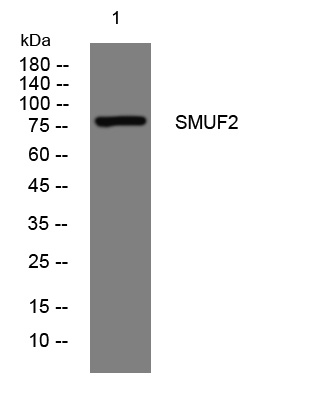
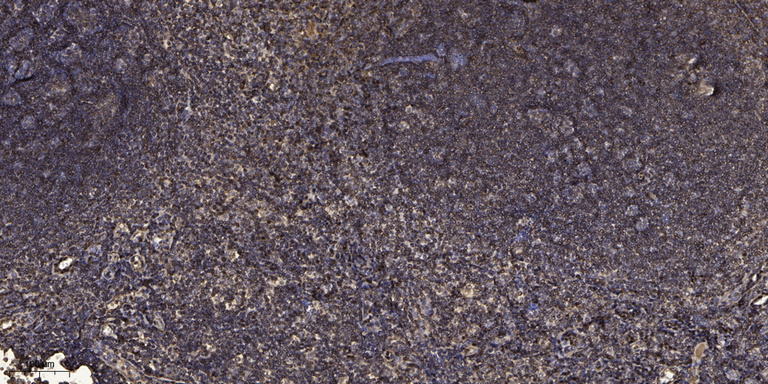

Anti-SMURF2 antibody (505-555 aa) (STJ195579)
SPECIFICATIONS
ClonalityPolyclonal
HostRabbit
ConjugationUnconjugated
IsotypeIgG
ImmunogenSynthesized peptide derived from the human SMUF2 at the amino acid range 505-555
General Information
| Short Description | Rabbit polyclonal anti-E3 ubiquitin-protein ligase SMURF2 (505-555 aa) for use in WB and IHC in Human and Mouse samples. Datasheet included with dilution recommendations, and related reagents. |
| Applications | WB/IHC |
| Host | Rabbit |
| Reactivity | Human/Mouse |
| Note | STRICTLY FOR FURTHER SCIENTIFIC RESEARCH USE ONLY (RUO). MUST NOT TO BE USED IN DIAGNOSTIC OR THERAPEUTIC APPLICATIONS. |
Product Properties
| Clonality | Polyclonal |
| Isotype | IgG |
| Conjugation | Unconjugated |
| Concentration | 1 mg/mL |
| Purification | The antibody was affinity-purified from rabbit antiserum by affinity-chromatography using epitope-specific immunogen. |
| Dilution Range | WB 1:500-2000IHC-P 1:50-300 |
| Formulation | Liquid in PBS containing 50% Glycerol, 0.5% BSA and 0.02% Sodium Azide. |
| Storage Instruction | Store at-20°C for up to 1 year from the date of receipt, and avoid repeat freeze-thaw cycles. |
Target Information
| Gene Symbol | SMURF2 |
| Gene ID | 64750 |
| Uniprot ID | SMUF2_HUMAN |
| Immunogen | Synthesized peptide derived from the human SMUF2 at the amino acid range 505-555 |
| Immunogen Region | 505-555 aa |
| Specificity | This antibody detects endogenous levels of SMUF2 at Human/Mouse |
Additional Info
| Post Translational Modifications | Auto-ubiquitinated and ubiquitinated in the presence of RNF11 and UBE2D1. Ubiquitinated by the SCF(FBXL15) complex and TTC3, leading to its degradation by the proteasome. 'Lys-48'-linked polyubiquitination mediated by TRAF4 at Lys-119 leads to SMURF2 proteasomal degradation. |
| Function | E3 ubiquitin-protein ligase which accepts ubiquitin from an E2 ubiquitin-conjugating enzyme in the form of a thioester and then directly transfers the ubiquitin to targeted substrates. Interacts with SMAD7 to trigger SMAD7-mediated transforming growth factor beta/TGF-beta receptor ubiquitin-dependent degradation, thereby down-regulating TGF-beta signaling. In addition, interaction with SMAD7 activates autocatalytic degradation, which is prevented by interaction with AIMP1. Also forms a stable complex with TGF-beta receptor-mediated phosphorylated SMAD1, SMAD2 and SMAD3, and targets SMAD1 and SMAD2 for ubiquitination and proteasome-mediated degradation. SMAD2 may recruit substrates, such as SNON, for ubiquitin-dependent degradation. Negatively regulates TGFB1-induced epithelial-mesenchymal transition and myofibroblast differentiation. (Microbial infection) In case of filoviruses Ebola/EBOV and Marburg/MARV infection, the complex formed by viral matrix protein VP40 and SMURF2 facilitates virus budding. |
| Protein Name | E3 Ubiquitin-Protein Ligase Smurf2Hsmurf2Hect-Type E3 Ubiquitin Transferase Smurf2Smad Ubiquitination Regulatory Factor 2Smad-Specific E3 Ubiquitin-Protein Ligase 2 |
| Database Links | Reactome: R-HSA-201451Reactome: R-HSA-2173788Reactome: R-HSA-2173795Reactome: R-HSA-4608870Reactome: R-HSA-4641257Reactome: R-HSA-5632684Reactome: R-HSA-5689880Reactome: R-HSA-8941858Reactome: R-HSA-983168 |
| Cellular Localisation | NucleusCytoplasmCell MembraneMembrane RaftCytoplasmic In The Presence Of Smad7Colocalizes With Cav1Smad7 And Tgf-Beta Receptor In Membrane Rafts |
| Alternative Antibody Names | Anti-E3 Ubiquitin-Protein Ligase Smurf2 antibodyAnti-Hsmurf2 antibodyAnti-Hect-Type E3 Ubiquitin Transferase Smurf2 antibodyAnti-Smad Ubiquitination Regulatory Factor 2 antibodyAnti-Smad-Specific E3 Ubiquitin-Protein Ligase 2 antibodyAnti-SMURF2 antibody |
Information sourced from Uniprot.org