

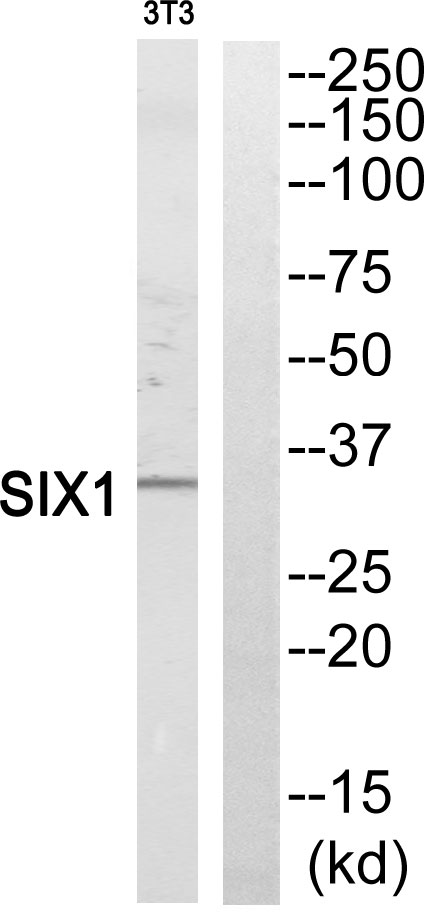
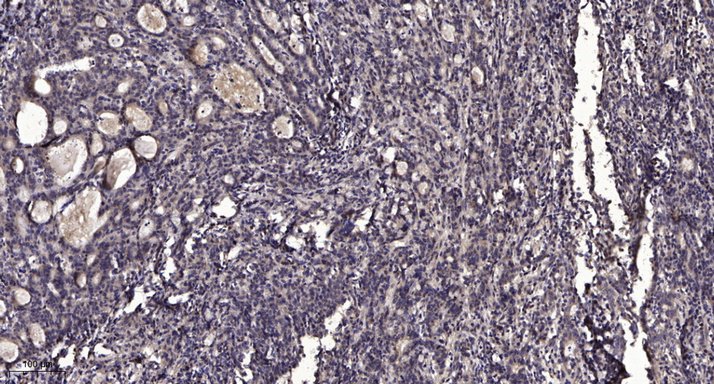

Anti-SIX1 antibody (111-160 aa) (STJ95670)
SPECIFICATIONS
ClonalityPolyclonal
HostRabbit
ConjugationUnconjugated
IsotypeIgG
ImmunogenThe antiserum was produced against synthesized peptide derived from the human SIX1 at the amino acid range 111-160
General Information
| Short Description | Rabbit polyclonal anti-Homeobox protein SIX1 (111-160 aa) for use in WB, ELISA and IHC in Human and Mouse samples. Datasheet included with dilution recommendations, and related reagents. |
| Applications | WB/ELISA/IHC |
| Host | Rabbit |
| Reactivity | Human/Mouse |
| Note | STRICTLY FOR FURTHER SCIENTIFIC RESEARCH USE ONLY (RUO). MUST NOT TO BE USED IN DIAGNOSTIC OR THERAPEUTIC APPLICATIONS. |
Product Properties
| Clonality | Polyclonal |
| Isotype | IgG |
| Conjugation | Unconjugated |
| Concentration | 1 mg/mL |
| Purification | The antibody was affinity-purified from rabbit antiserum by affinity-chromatography using epitope-specific immunogen. |
| Dilution Range | WB 1:500-2000IHC-P 1:50-300ELISA 2000-20000 |
| Formulation | Liquid in PBS containing 50% Glycerol, 0.5% BSA and 0.02% Sodium Azide. |
| Storage Instruction | Store at-20°C for up to 1 year from the date of receipt, and avoid repeat freeze-thaw cycles. |
Target Information
| Gene Symbol | SIX1 |
| Gene ID | 6495 |
| Uniprot ID | SIX1_HUMAN |
| Immunogen | The antiserum was produced against synthesized peptide derived from the human SIX1 at the amino acid range 111-160 |
| Immunogen Region | 111-160 aa |
| Specificity | Six1 Polyclonal Antibody detects endogenous levels of Six1 protein. |
Additional Info
| Post Translational Modifications | Phosphorylated during interphase.becomes hyperphosphorylated during mitosis. Hyperphosphorylation impairs binding to promoter elements. Ubiquitinated by the anaphase promoting complex (APC), leading to its proteasomal degradation. |
| Function | Transcription factor that is involved in the regulation of cell proliferation, apoptosis and embryonic development. Plays an important role in the development of several organs, including kidney, muscle and inner ear. Depending on context, functions as a transcriptional repressor or activator. Lacks an activation domain, and requires interaction with EYA family members for transcription activation. Mediates nuclear translocation of EYA1 and EYA2. Binds the 5'-TCAAGAGTTNC-3' motif present in the MEF3 element in the MYOG promoter and CIDEA enhancer. Regulates the expression of numerous genes, including MYC, CCND1 and EZR. Acts as an activator of the IGFBP5 promoter, probably coactivated by EYA2. Repression of precursor cell proliferation in myoblasts is switched to activation through recruitment of EYA3 to the SIX1-DACH1 complex. During myogenesis, seems to act together with EYA2 and DACH2. Regulates the expression of CCNA1. Promotes brown adipocyte differentiation. |
| Protein Name | Homeobox Protein Six1Sine Oculis Homeobox Homolog 1 |
| Database Links | Reactome: R-HSA-9830674 |
| Cellular Localisation | NucleusCytoplasm |
| Alternative Antibody Names | Anti-Homeobox Protein Six1 antibodyAnti-Sine Oculis Homeobox Homolog 1 antibodyAnti-SIX1 antibody |
Information sourced from Uniprot.org