
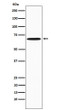
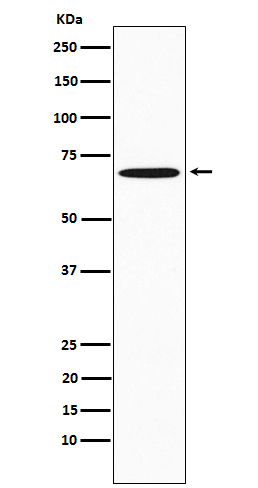

Anti-SAM68 antibody [R03-7U9] (STJA0037045)
SPECIFICATIONS
ClonalityMonoclonal
HostRabbit
ConjugationUnconjugated
IsotypeIgG
ImmunogenA synthesized peptide derived from human SAM68
General Information
| Short Description | Rabbit monoclonal anti-SAM68 for use in WB, IHC-P, ICC and IF in Human, Mouse and Rat samples. Datasheet included with dilution recommendations, and related reagents. |
| Applications | WB/IHC-P/ICC/IF |
| Host | Rabbit |
| Reactivity | Human/Mouse/Rat |
| Note | STRICTLY FOR FURTHER SCIENTIFIC RESEARCH USE ONLY (RUO). MUST NOT TO BE USED IN DIAGNOSTIC OR THERAPEUTIC APPLICATIONS. |
Product Properties
| Clonality | Monoclonal |
| Clone ID | R03-7U9 |
| Isotype | IgG |
| Conjugation | Unconjugated |
| Purification | Affinity Chromatography |
| Dilution Range | WB 1:500-1:1000IHC 1:50-1:100IF 1:50-1:200 |
| Formulation | Rabbit IgG in phosphate buffered saline, pH 7.4, 150mM NaCl, 0.02% sodium azide and 50% glycerol. |
| Storage Instruction | Store at 4°C short term. Aliquot and store at-20°C long term. Avoid freeze/thaw cycles. |
Target Information
| Gene Symbol | KHDRBS1 |
| Gene ID | 10657 |
| Uniprot ID | KHDR1_HUMAN |
| Immunogen | A synthesized peptide derived from human SAM68 |
Additional Info
| Tissue Specificity | Ubiquitously expressed in all tissue examined. Isoform 1 is expressed at lower levels in brain, skeletal muscle, and liver whereas isoform 3 is intensified in skeletal muscle and in liver. |
| Post Translational Modifications | Tyrosine phosphorylated by several non-receptor tyrosine kinases including LCK, FYN and JAK3. Also tyrosine phosphorylated by the non-receptor tyrosine kinase SRMS in an EGF-dependent manner. Negatively correlates with ability to bind RNA but required for many interactions with proteins. Phosphorylation by PTK6 negatively regulates its RNA binding ability. Phosphorylation by PTK6 at Tyr-440 dictates the nuclear localization of KHDRBS1. Phosphorylation at Tyr-387 disrupts interaction with APC. Phosphorylation at tyrosine residues by FYN inverts activity on modulation of BCL2L1 alternative splicing. Acetylated. Positively correlates with ability to bind RNA. Deacetylated by HDAC6.this regulates alternative splicing by inhibiting the inclusion of CD44 alternate exons. Arginine methylation is required for nuclear localization. Also can affect interaction with other proteins. Inhibits interaction with Src-like SH3 domains, but not interaction with WW domains of WBP4/FBP21 and FNBP4/FBP30. |
| Function | Recruited and tyrosine phosphorylated by several receptor systems, for example the T-cell, leptin and insulin receptors. Once phosphorylated, functions as an adapter protein in signal transduction cascades by binding to SH2 and SH3 domain-containing proteins. Role in G2-M progression in the cell cycle. Represses CBP-dependent transcriptional activation apparently by competing with other nuclear factors for binding to CBP. Also acts as a putative regulator of mRNA stability and/or translation rates and mediates mRNA nuclear export. Positively regulates the association of constitutive transport element (CTE)-containing mRNA with large polyribosomes and translation initiation. According to some authors, is not involved in the nucleocytoplasmic export of unspliced (CTE)-containing RNA species according to. RNA-binding protein that plays a role in the regulation of alternative splicing and influences mRNA splice site selection and exon inclusion. Binds to RNA containing 5'-AUUAA-3' as a bipartite motif spaced by more than 15 nucleotides. Binds poly(A). Can regulate CD44 alternative splicing in a Ras pathway-dependent manner. In cooperation with HNRNPA1 modulates alternative splicing of BCL2L1 by promoting splicing toward isoform Bcl-X(S), and of SMN1. Can regulate alternative splicing of NRXN1 and NRXN3 in the laminin G-like domain 6 containing the evolutionary conserved neurexin alternative spliced segment 4 (AS4) involved in neurexin selective targeting to postsynaptic partners. In a neuronal activity-dependent manner cooperates synergistically with KHDRBS2/SLIM-1 in regulation of NRXN1 exon skipping at AS4. The cooperation with KHDRBS2/SLIM-1 is antagonistic for regulation of NXRN3 alternative splicing at AS4. Isoform 3, which is expressed in growth-arrested cells only, inhibits S phase. |
| Protein Name | Kh Domain-Containing - Rna-Binding - Signal Transduction-Associated Protein 1Gap-Associated Tyrosine Phosphoprotein P62Src-Associated In Mitosis 68 Kda ProteinSam68P21 Ras Gtpase-Activating Protein-Associated P62P68 |
| Database Links | Reactome: R-HSA-8849468 |
| Cellular Localisation | NucleusCytoplasmMembranePredominantly Located In The Nucleus But Also Located Partially In The Cytoplasm |
| Alternative Antibody Names | Anti-Kh Domain-Containing - Rna-Binding - Signal Transduction-Associated Protein 1 antibodyAnti-Gap-Associated Tyrosine Phosphoprotein P62 antibodyAnti-Src-Associated In Mitosis 68 Kda Protein antibodyAnti-Sam68 antibodyAnti-P21 Ras Gtpase-Activating Protein-Associated P62 antibodyAnti-P68 antibodyAnti-KHDRBS1 antibodyAnti-SAM68 antibody |
Information sourced from Uniprot.org