

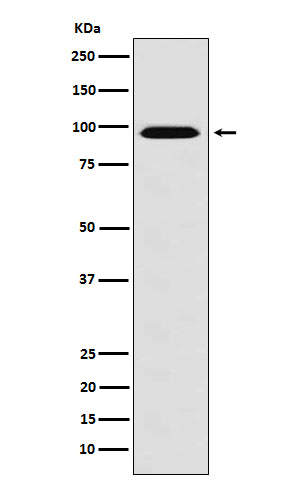

Anti-RanBP9 antibody [R04-4P4] (STJA0037400)
SPECIFICATIONS
ClonalityMonoclonal
HostRabbit
ConjugationUnconjugated
IsotypeIgG
ImmunogenA synthesized peptide derived from human RanBP9
General Information
| Short Description | Rabbit monoclonal anti-RanBP9 for use in WB, ICC and IF in Human, Mouse and Rat samples. Datasheet included with dilution recommendations, and related reagents. |
| Applications | WB/ICC/IF |
| Host | Rabbit |
| Reactivity | Human/Mouse/Rat |
| Note | STRICTLY FOR FURTHER SCIENTIFIC RESEARCH USE ONLY (RUO). MUST NOT TO BE USED IN DIAGNOSTIC OR THERAPEUTIC APPLICATIONS. |
Product Properties
| Clonality | Monoclonal |
| Clone ID | R04-4P4 |
| Isotype | IgG |
| Conjugation | Unconjugated |
| Purification | Affinity Purified |
| Dilution Range | WB 1:500-1:1000IF 1:50-1:200 |
| Formulation | Rabbit IgG in phosphate buffered saline, pH 7.4, 150mM NaCl, 0.02% sodium azide and 50% glycerol. |
| Storage Instruction | Store at 4°C short term. Aliquot and store at-20°C long term. Avoid freeze/thaw cycles. |
Target Information
| Gene Symbol | RANBP9 |
| Gene ID | 10048 |
| Uniprot ID | RANB9_HUMAN |
| Immunogen | A synthesized peptide derived from human RanBP9 |
Additional Info
| Tissue Specificity | Ubiquitously expressed, with highest levels in testes, placenta, heart, and muscle, and lowest levels in lung. Within the brain, expressed predominantly by neurons in the gray matter of cortex, the granular layer of cerebellum and the Purkinje cells. |
| Post Translational Modifications | Phosphorylated in response to stress. Can be phosphorylated by the cleaved p110 form of CDC2L1 (p110C). Ubiquitinated. Polyubiquitination targets the protein for rapid degradation via the ubiquitin system. Can be deubiquitinated by USP11. |
| Function | May act as scaffolding protein, and as adapter protein to couple membrane receptors to intracellular signaling pathways (Probable). Acts as a mediator of cell spreading and actin cytoskeleton rearrangement. Core component of the CTLH E3 ubiquitin-protein ligase complex that selectively accepts ubiquitin from UBE2H and mediates ubiquitination and subsequent proteasomal degradation of the transcription factor HBP1. May be involved in signaling of ITGB2/LFA-1 and other integrins. Enhances HGF-MET signaling by recruiting Sos and activating the Ras pathway. Enhances dihydrotestosterone-induced transactivation activity of AR, as well as dexamethasone-induced transactivation activity of NR3C1, but not affect estrogen-induced transactivation. Stabilizes TP73 isoform Alpha, probably by inhibiting its ubiquitination, and increases its proapoptotic activity. Inhibits the kinase activity of DYRK1A and DYRK1B. Inhibits FMR1 binding to RNA. |
| Protein Name | Ran-Binding Protein 9Ranbp9Bpm-LBpm90Ran-Binding Protein MRanbpmRanbp7 |
| Database Links | Reactome: R-HSA-373760Reactome: R-HSA-5673001Reactome: R-HSA-8851805Reactome: R-HSA-9861718 |
| Cellular Localisation | CytoplasmNucleusCell MembranePeripheral Membrane ProteinThe Unphosphorylated Form Is Predominantly CytoplasmicA Phosphorylated Form Is Associated With The Plasma Membrane |
| Alternative Antibody Names | Anti-Ran-Binding Protein 9 antibodyAnti-Ranbp9 antibodyAnti-Bpm-L antibodyAnti-Bpm90 antibodyAnti-Ran-Binding Protein M antibodyAnti-Ranbpm antibodyAnti-Ranbp7 antibodyAnti-RANBP9 antibodyAnti-RANBPM antibody |
Information sourced from Uniprot.org